Narihira's Journey to the East
Original title: Narihira's Journey to the East
kurzbeschreibung
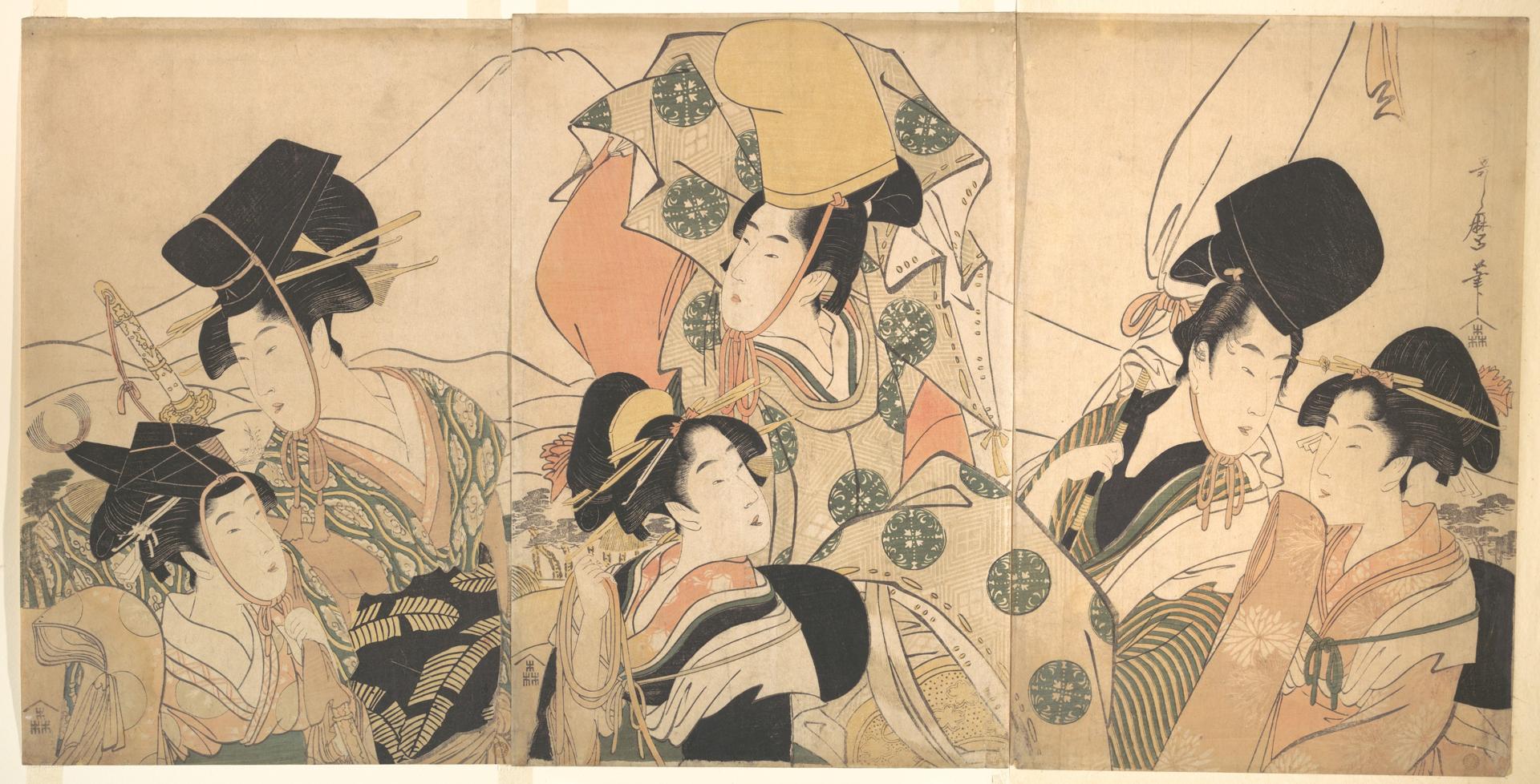
Unlike many contemporary prints that isolate a single figure, Utamaro's triptych Narihira's Journey to the East from 1797 presents a group of figures across three sheets. The color woodblock print on paper draws on an episode from the life of the poet Ariwara no Narihira and shows people in traditional Japanese attire.
Description
A woman in an elaborate hat stands on the middle sheet, flanked by other figures in traditional robes. The layout feels balanced: the central figure is the reference point, and the side sheets are subordinate to her. Earth tones dominate the color scheme, with accents of blue and green. Even light spreads across the surfaces, with no shadows—a hallmark of woodblock printing. The linework uses carefully placed, detailed contours.
Context
This print was made in the late Edo period, when ukiyo-e woodblock printing reached its peak. Its source is the legend of Ariwara no Narihira, a ninth-century poet whose travels entered classical literature. Triptychs of this kind circulated as collector's items and were often produced for the commercial market.
Impact
The even lighting and calm symmetry place the action in a detached, almost ceremonial sphere. Detailed lines and restrained colors create an elegant, quiet presence that draws the viewer into the historical scene.
Technique
This triptych was produced as woodblock prints with color on paper. Each color required a separate block, printed in succession onto the paper. Precise lines and flat areas of color define the ukiyo-e print.
AI-generated description text
Source: Metropolitan Museum of Art · Public Domain (CC0 1.0)