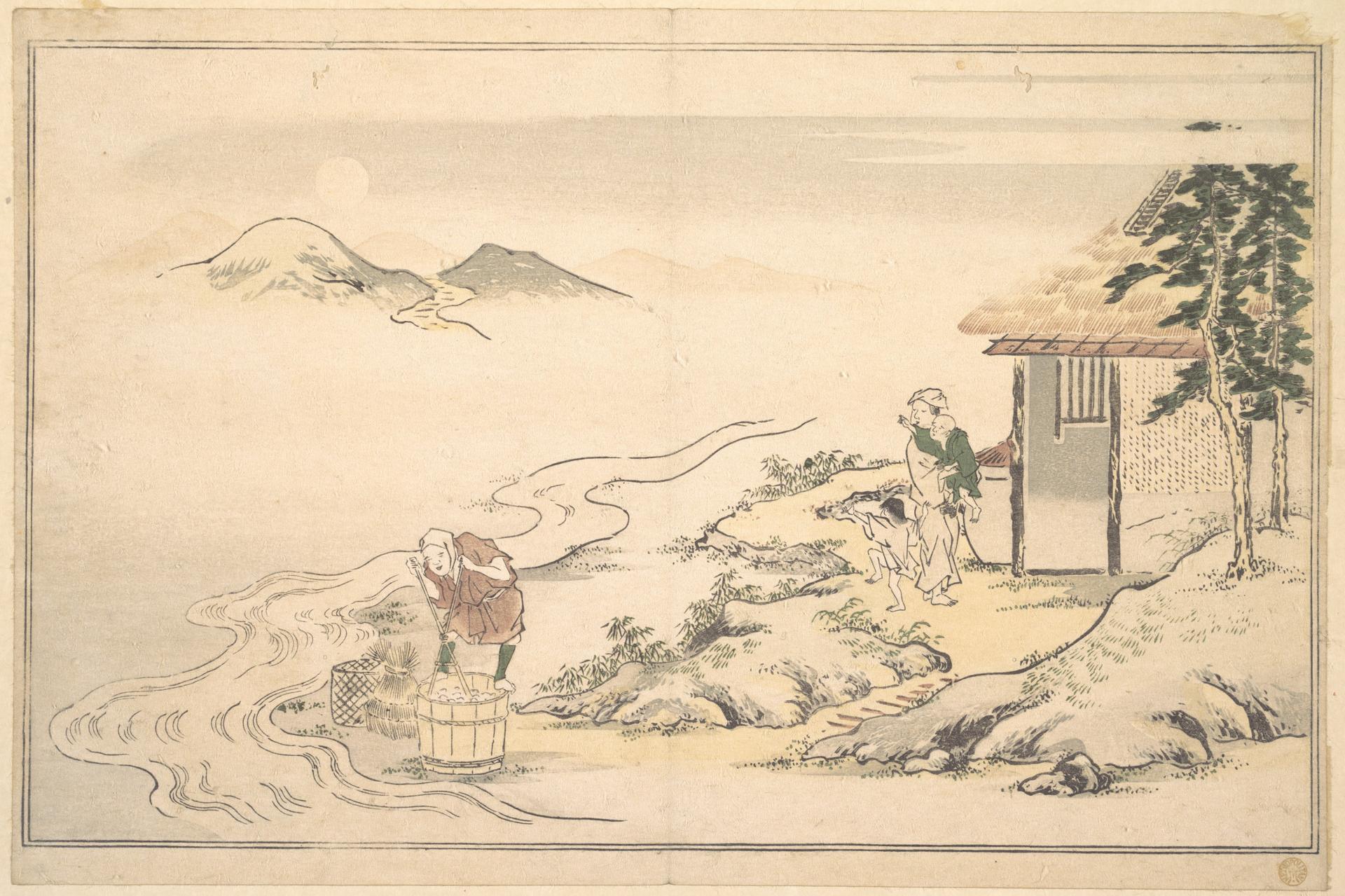
The Full Moon at the Time of the Imo Harvest
Original title: The Full Moon at the Time of the Imo Harvest
kurzbeschreibung
Kitagawa Utamaro made this colour woodblock print in the eighth month of 1789. It pictures a rural episode in Japan: one figure works at the edge of a river while two others come nearer along a path behind. Printed in ink and colour on paper, the sheet belongs to the ukiyo-e genre and shows Utamaro turning his attention to ordinary daily life.
Description
At the riverbank in the foreground a lone figure handles a stick or tool, and beside them stands a bucket filled with grain. Two people approach on a path further back, one of them carrying a child on their back. On the right a thatched building rises, framed by two trees. Mountains and a full moon close off the pictorial space. Greys dominate the palette, loosened here and there by small accents that come from the woodblock process.
Context
The print dates from 1789, a flourishing period of ukiyo-e in Japan, when rural subjects were popular alongside beauties and actors. Imo harvest means the sweet potato harvest, which fell in the eighth month of the lunar calendar and mattered greatly to country people. Utamaro was known for precise lines and for scenes of everyday life that offer glimpses of rural existence at the time.
Impact
A quiet, rural mood emanates from this sheet, carried by even light and restrained colours. The full moon and the mountains lend the view something contemplative and place the viewer in the evening stillness of harvest time.
Technique
Ink and colour were printed on paper for this ukiyo-e woodblock print. The method required a separate wooden block to be cut for each colour and then brought to the paper in turn. The precise lines and the subdued colouring attest to Utamaro's skill with this technique.
AI-generated description text
Source: Metropolitan Museum of Art · Public Domain (CC0 1.0)