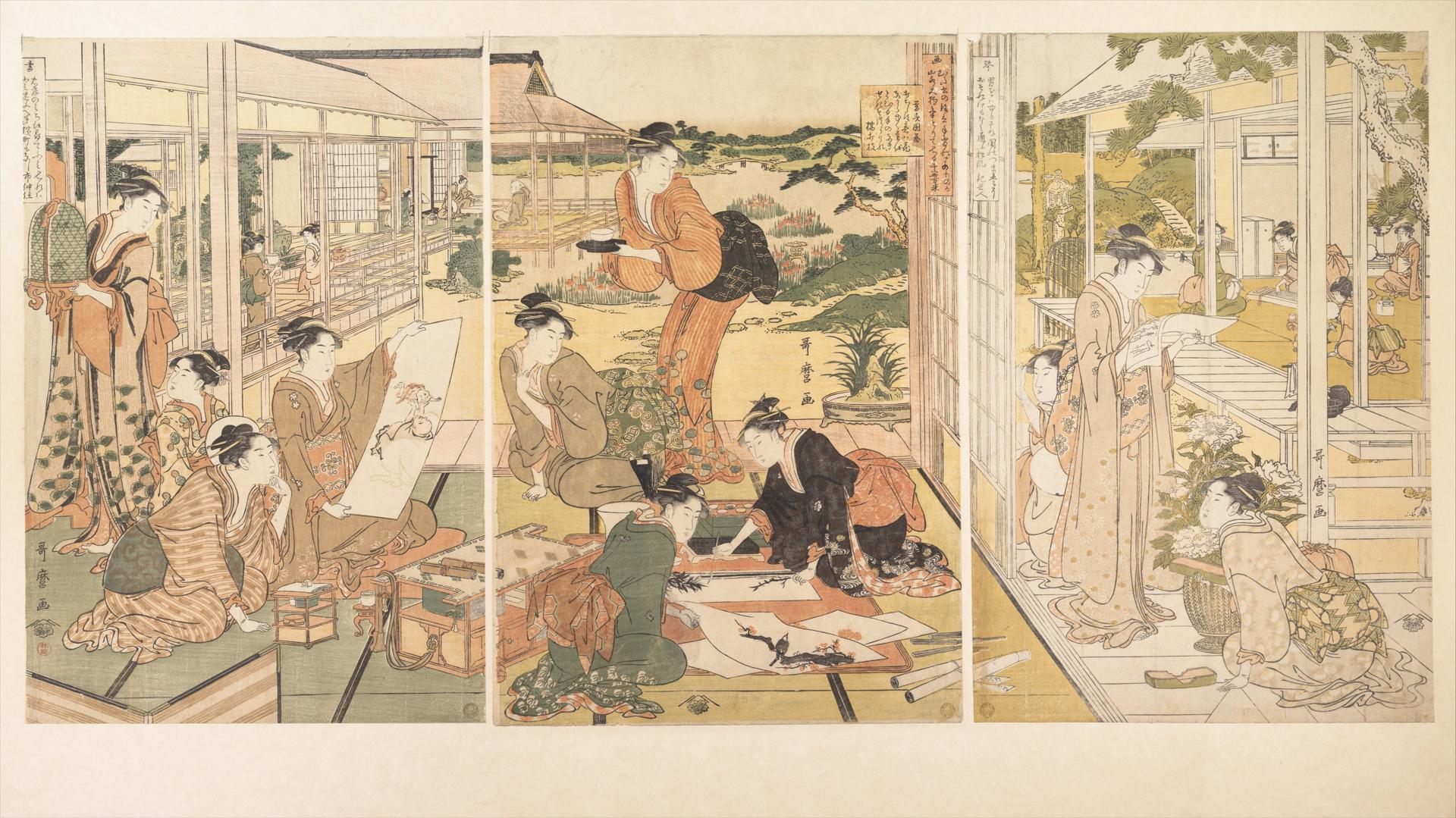
The Four Accomplishments (Kinkishoga)
Original title: The Four Accomplishments (Kinkishoga)
kurzbeschreibung
Made around 1788–90, Kitagawa Utamaro's triptych "The Four Arts" (Kinkishoga) spreads across three woodblock sheets printed in ink and color on paper. Painting, music, dance and writing appear here as the four traditional skills expected of a Japanese woman, and together the panels form a portrait of the educated female ideal of the Edo period.
Description
On the left sheet, women sit at tables and paint while another watches from behind. The middle panel gives us a woman with musical instruments, a seated companion listening to her play. To the right, women bend over writing utensils. All of them wear traditional Japanese dress, and earth tones with pastel hues set the palette. A landscape with traditional buildings fills the distance, lit evenly, without hard shadows.
Context
The print belongs to the later Edo period, when the townspeople supported cultural pursuits and a woman's training in the arts carried real prestige. The Four Arts (Kinkishoga) come from the ideal of Chinese scholar culture and were adapted in Japan to female accomplishments. Utamaro, celebrated for his images of women — above all those of the Yoshiwara pleasure quarter — did much to make Bijin-ga popular. Multi-sheet woodblock triptychs were a common format at the time for large-scale compositions.
Impact
Quiet scholarship and cultural elegance shape this calm, concentrated scene. The clear, symmetrical layout and the harmonious pastel tones produce a balance that carries the viewer into the world of educated women of the Edo period.
Technique
Woodblock prints in ink and color on paper were used for this triptych. The method allowed precise lines and flat areas of color, as was typical of the Ukiyo-e style. Even color distribution and crisp contours show how securely Utamaro and his workshop handled the printing.
AI-generated description text
Source: Metropolitan Museum of Art · Public Domain (CC0 1.0)