The Lion Dance
Original title: The Lion Dance
kurzbeschreibung
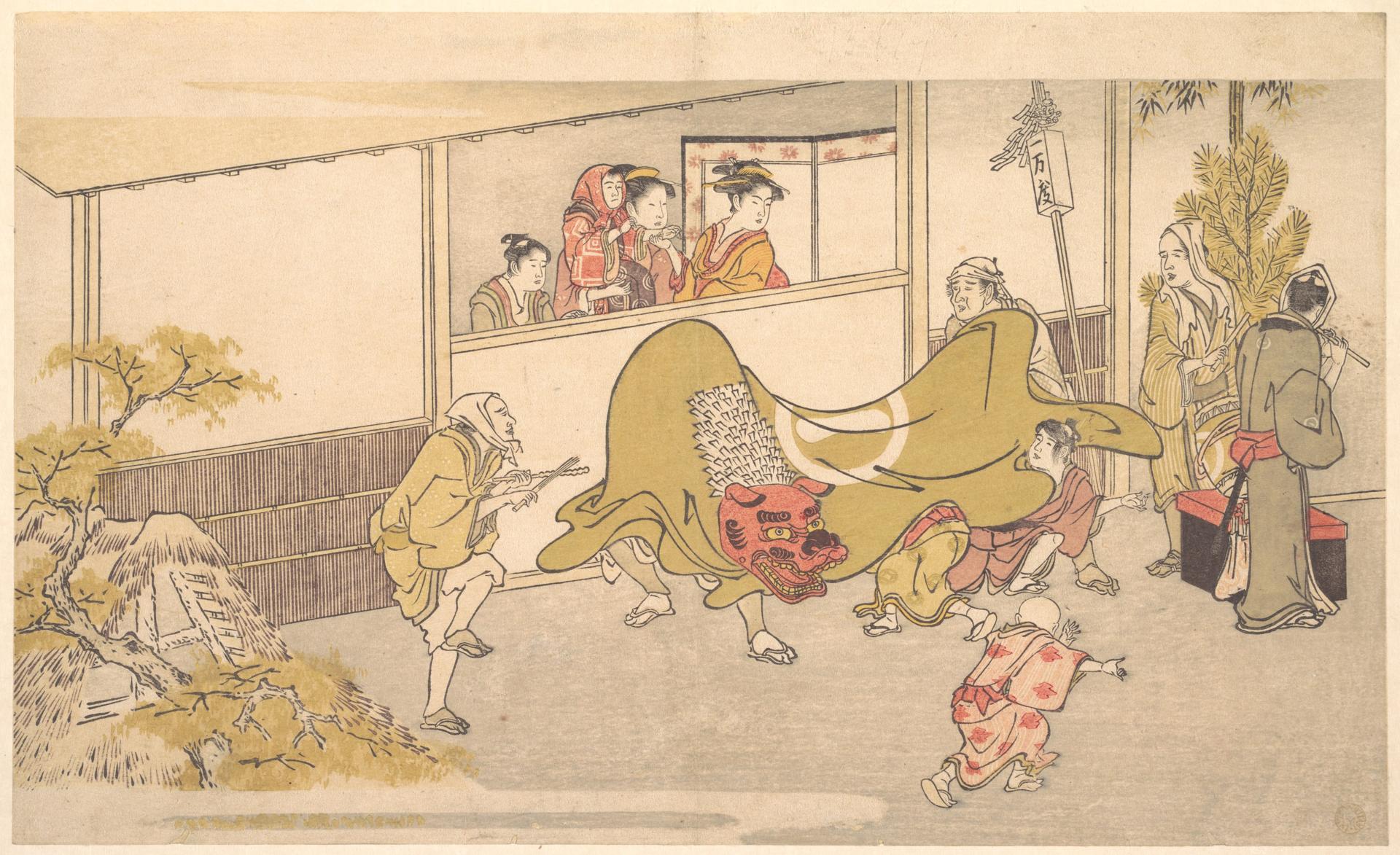
Unlike the many portraits of women for which Kitagawa Utamaro is otherwise known, this 1789 print presents a Chinese lion dance festival. Executed as a colour woodblock print on paper, it belongs to the ukiyo-e genre.
Description
A large, brightly coloured lion head dominates the foreground, carried by several people in traditional clothing, some holding masks with the lion's face before them. Some figures are walking, others pause and watch. Behind them rises a building whose balcony railing accommodates several spectators. Earth tones define the palette, with red and green adding accents.
Context
The print was made in the late Edo period, when Japan's urban bourgeoisie flourished culturally. The lion dance came from China and was performed in Japan as a festive ritual. Utamaro, famous mainly for his depictions of women, here takes up a popular event. Whether intended as part of a series or as a single sheet, it was printed for a broad audience.
Impact
A festive liveliness emanates from the print, carried by the movement of the figures and the clear lines of the print. The earthy tones with their red and green accents combine into a calm, harmonious mood that draws the viewer into the scene.
Technique
For printing, the motif was cut into wooden blocks and then transferred to paper with colour. Clear contours and flat areas of colour, characteristic of ukiyo-e printing, are made possible by this process.
AI-generated description text
Source: Metropolitan Museum of Art · Public Domain (CC0 1.0)