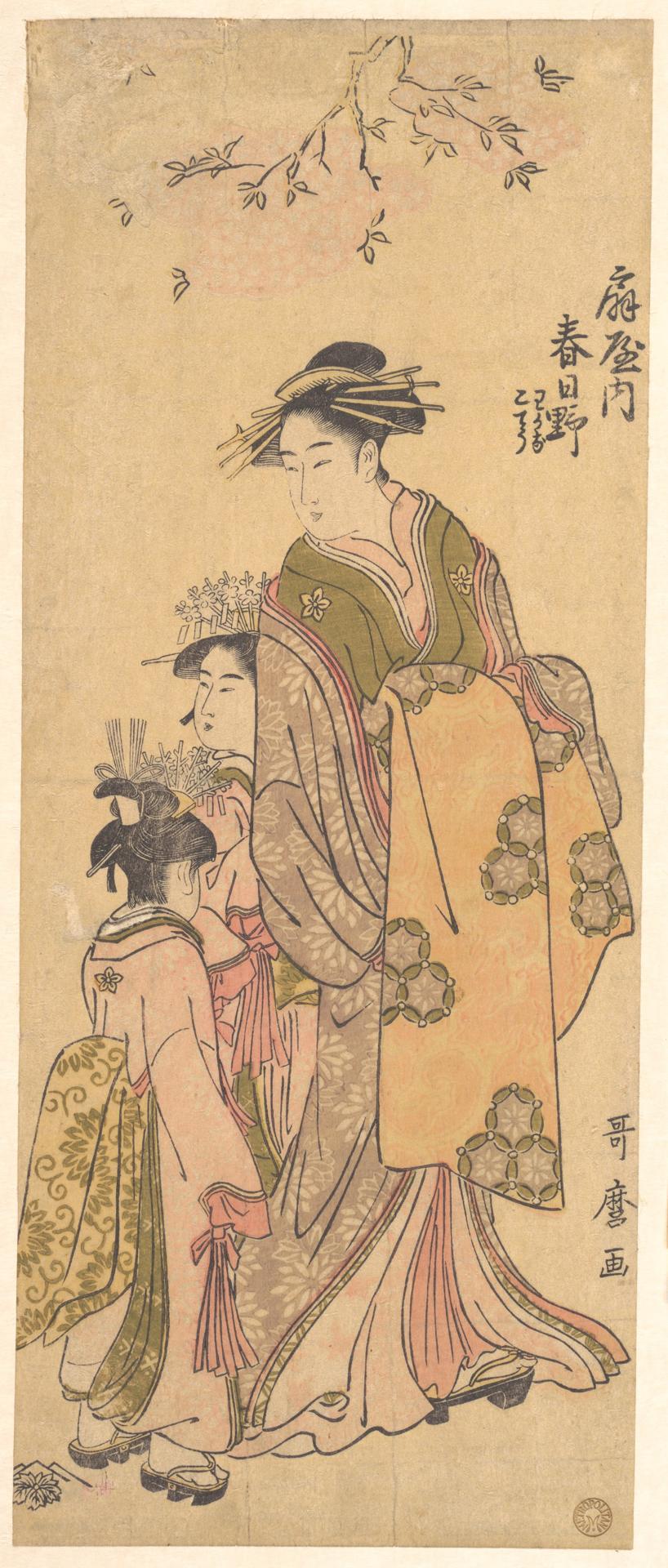
The Oiran Kasugano of Ōgiya on Parade
Original title: The Oiran Kasugano of Ōgiya on Parade
kurzbeschreibung
Kitagawa Utamaro made this woodblock print around 1788, presenting three women in traditional dress. Ink and colour on paper form its basis, and the sheet belongs to the Japanese colour woodblock tradition.
Description
Three female figures line up in a row; the middle one occupies more space, while the other two fall into place to her left and right. Elaborate hairstyles and robes decorated with flowers and patterns shape their appearance. Earth tones — brown, green, orange — govern the palette. Branches with foliage behind them suggest a natural setting. The arrangement feels symmetrical and evokes the impression of a parade or procession.
Context
Colour woodblock printing (ukiyo-e) flourished during the Edo period (1603–1868), when this sheet was also made. Utamaro became known for pictures of women, above all courtesans from the Yoshiwara pleasure district. The Ōgiya teahouse was located in that district, and Kasugano was regarded as a well-known courtesan of her day. Processions of this kind were a popular subject, serving to display the elegance and rank of the courtesans.
Impact
The symmetrical row and muted earth tones create a solemn, dignified mood. Elaborate details on the robes and hairstyles draw the eye to the figures and emphasise their distinction. Despite the small format, the sheet feels monumental and statuesque.
Technique
For this woodblock print the design was cut into a woodblock and then transferred to paper with ink and colour. Several colours required separate blocks, which demanded precise registration. By the Edo period colour woodblock printing was technically highly developed, allowing fine lines and rich tones.
AI-generated description text
Source: Metropolitan Museum of Art · Public Domain (CC0 1.0)