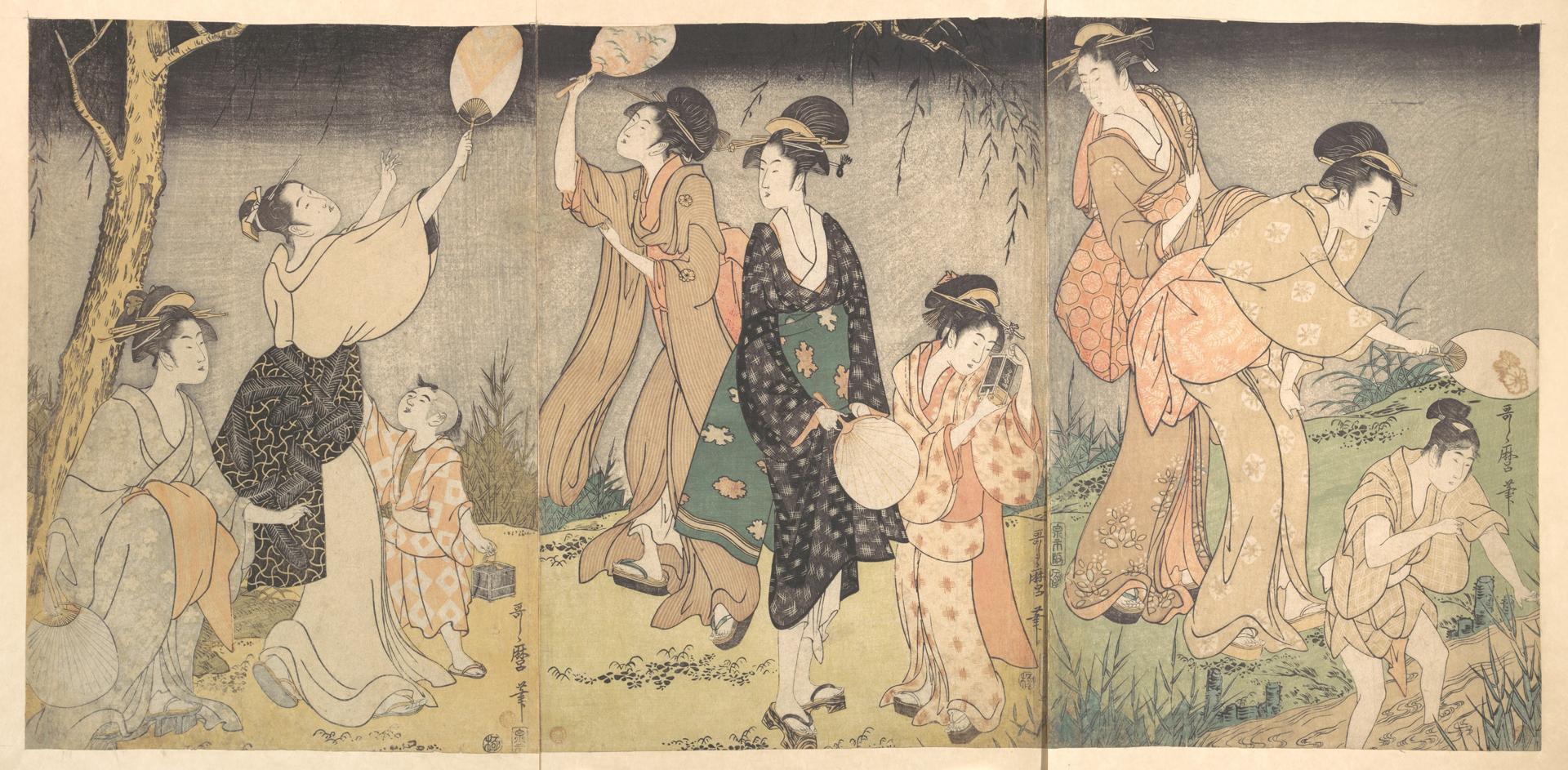
Catching Fireflies (Hotaru Gari)
Original title: Catching fireflies (Hotaru gari)
kurzbeschreibung
Around 1796–97 Kitagawa Utamaro made the triptych Glühwürmchenfang (Hotaru gari), showing women and children catching fireflies outdoors at night. The colour woodblock print with ink and colour on paper takes up a favourite ukiyo-e subject.
Description
Women in traditional kimono and obi, carrying lanterns, move through a landscape of trees and grassy ground. A child crouches on the ground, looking up at the lanterns, while other figures talk or gaze about attentively. Earth tones dominate the palette, set off by accents of blue and orange. Light falls from above, emphasising the contours of figures and objects; sharp lines and flat areas of colour are characteristic of the Japanese woodblock print.
Context
Utamaro made this work in the late Edo period, when ukiyo-e prints were gaining great popularity. The artist was known for his images of women, often from the pleasure quarters, and also for scenes of everyday life. Catching fireflies was a popular summer pastime in Japan and was often taken up in art during the eighteenth century. The triptych format allowed a wide, narrative scene, as was common at the time.
Impact
The night setting gives off a quiet, almost intimate mood, heightened by the warm light of the lanterns and the muted colours. An idyllic atmosphere emerges that lets the viewer share in the still pleasure of the moment. Clear draughtsmanship and a harmonious arrangement lend the work a timeless elegance.
Technique
Each of the three sheets of the triptych was printed as a woodblock print with watercolours on paper. This technique allowed precise lines and flat applications of colour, as are typical of the ukiyo-e style. Ink and colours on paper were the usual method in Japanese printmaking of this period.
AI-generated description text
Source: Metropolitan Museum of Art · Public Domain (CC0 1.0)