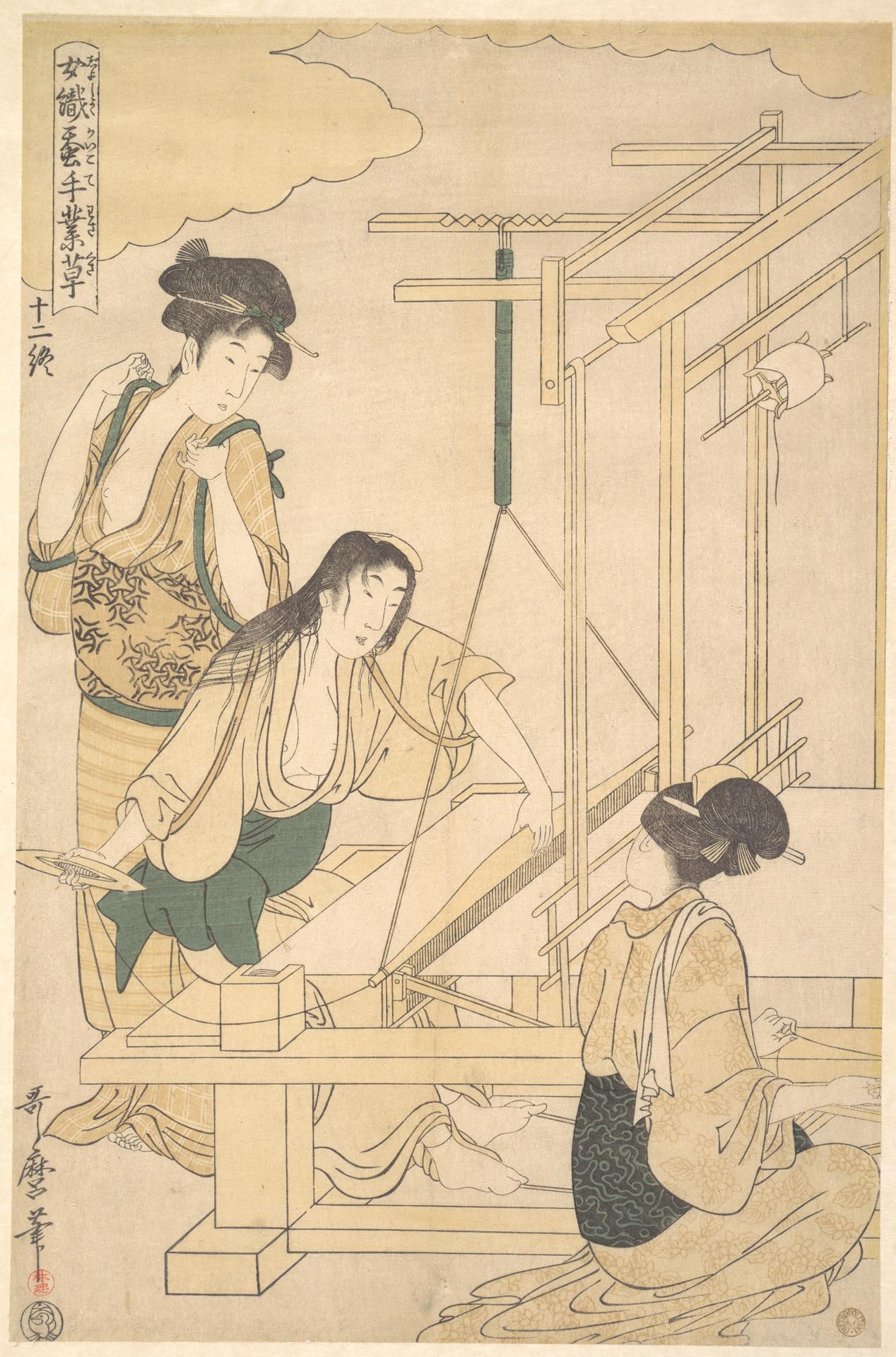
Women Weaving Silk Cloth
Original title: Women Weaving Silk Cloth
kurzbeschreibung
Kitagawa Utamaro's colour woodblock print "Women Weaving Silk" from around 1800 presents three women at a loom. Printed in ink and colour on paper, the sheet measures 37.8 × 24.8 cm and belongs to the ukiyo-e genre. It offers a scene from the everyday life of craftswomen.
Description
In the foreground a woman sits at the loom, working a length of silk, while two companions in the middle and background look on. All wear traditional Japanese dress with kimono and obi; their hair is swept up or tied in knots, some with floral ornaments. Earth tones set the palette, and faint floral patterns appear on the garments. Another loom with an operator is suggested further back. The layout is clearly ordered and calm, with no pronounced lighting effects.
Context
Kitagawa Utamaro (1753–1806) ranks among the foremost artists of the Japanese woodblock and is known for his portrayals of women (bijin-ga). This sheet dates from the late Edo period, when silk production carried real weight in the Japanese economy. Utamaro produced numerous prints on the lives of craftswomen and courtesans. The woodblock belongs to a series devoted to women's domestic and tradesmanlike occupations.
Impact
What holds the eye first is the quiet concentration carried by the balanced arrangement of the figures. Careful rendering of the fabrics and patterns draws attention to the precision of the handwork. The sheet feels elegant and at the same time close to ordinary life — characteristic of Utamaro's sympathetic portraits of women at work.
Technique
As a colour woodblock (nishiki-e), the image was produced by printing from several blocks, each carrying a different colour. Distinctive of the ukiyo-e method are the delicate linework and the flat areas of colour. Printing with ink and watercolour on paper brings out the soft tones of the clothing.
AI-generated description text
Source: Metropolitan Museum of Art · Public Domain (CC0 1.0)