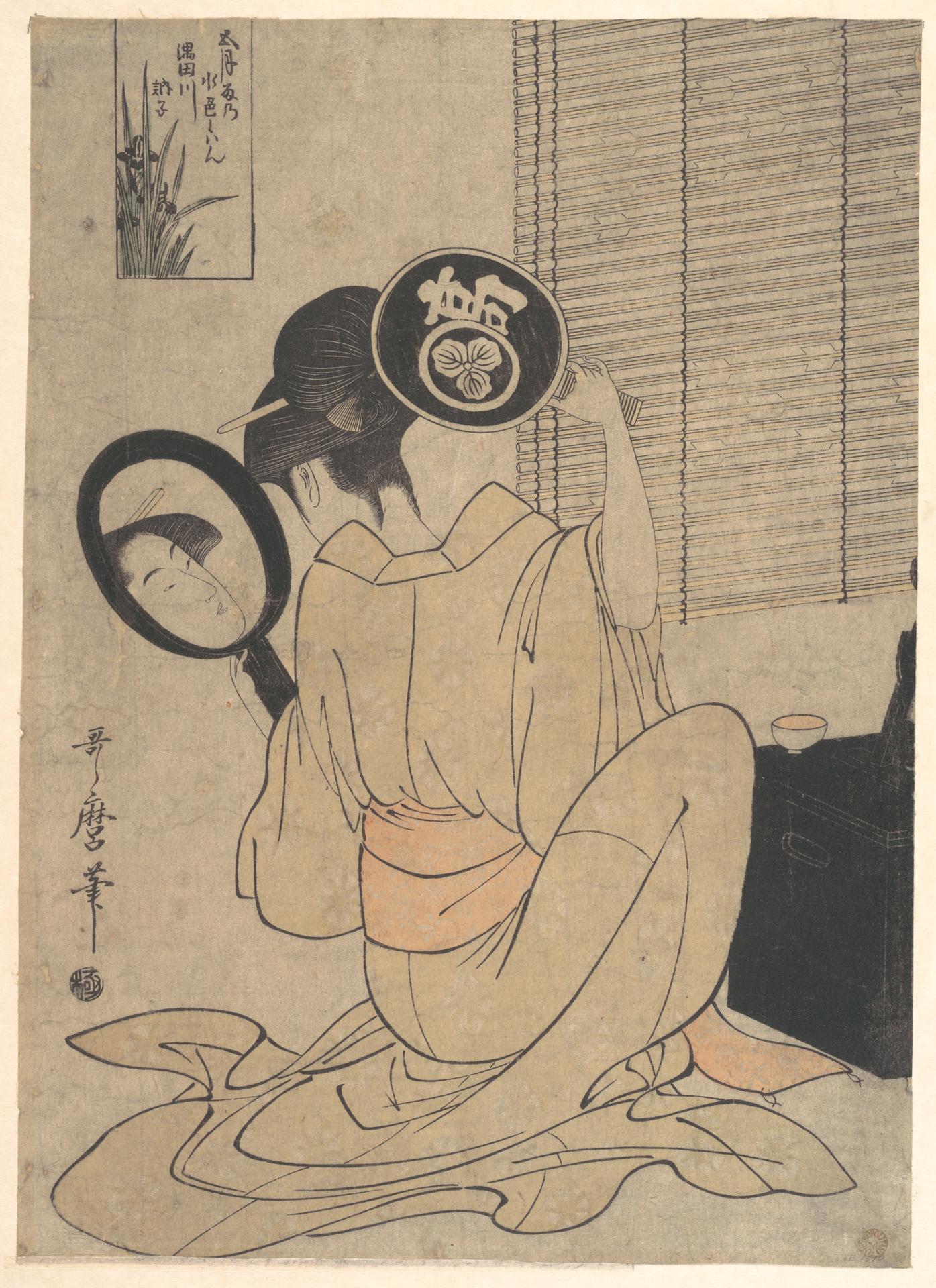
Takashima Ohisa Using Two Mirrors to Observe Her Coiffure
Original title: Takashima Ohisa Using Two Mirrors to Observe Her Coiffure
kurzbeschreibung
Where many beauty portraits of the day settle into a formal pose, this colour woodblock print by Kitagawa Utamaro, made around 1795, catches a private instant instead: a kneeling woman studies her hairdo in two hand mirrors. Ink and colour on paper, in the manner of the traditional Japanese woodcut.
Description
She sits on the floor, a large round mirror in her right hand and a smaller one in her left. Her hair is swept up and held with an ornament, and a long kimono with a tightly tied obi wraps around her. Behind her a sliding door stands half open; to its left hangs a small picture of a plant with Chinese characters. Black, white and beige carry the palette, while light falling from the front picks out the contours.
Context
The sheet belongs to the Edo period (1603–1868), an age when woodblock prints of beauties, bijin-ga, spread widely across Japan. Utamaro was known for his portraits of women from the Yoshiwara pleasure quarter and of the urban middle class. Takashima Ohisa, a celebrated beauty of her time, appears in several of his works. This print is one of a series of studies of women in everyday situations.
Impact
Restrained colour and clean lines draw the eye to the woman's quiet concentration. Through the mirrors an intimate, almost meditative mood arises, bringing out the elegance of the moment.
Technique
The design was cut into woodblocks and printed onto paper with ink and colours. Delicate linework and flat areas of colour are typical of the Japanese colour woodblock print of the late eighteenth century.
AI-generated description text
Source: Metropolitan Museum of Art · Public Domain (CC0 1.0)