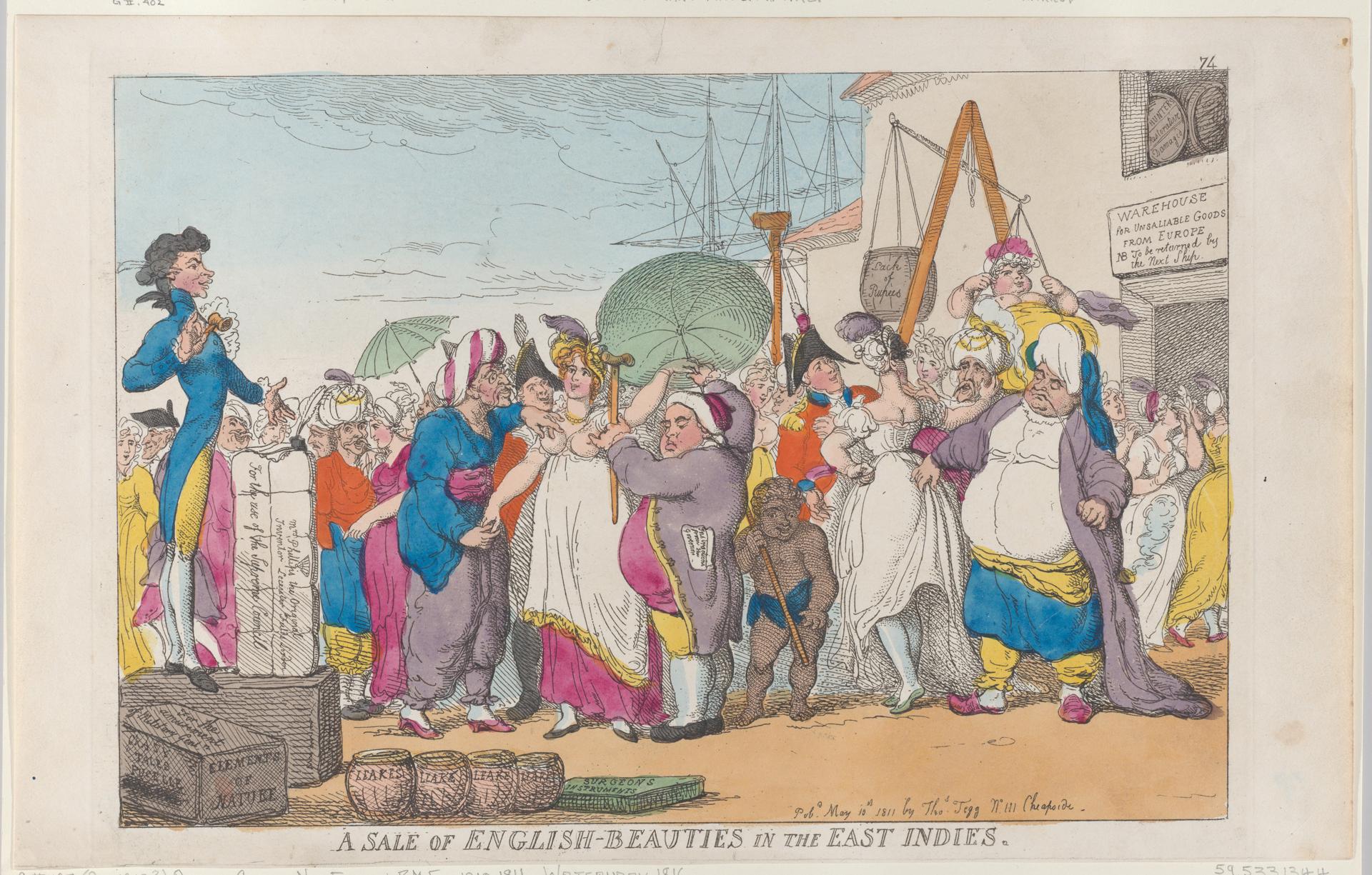
A Sale of English-Beauties in the East Indies ([May 10, 1811], reprint, Met-Objekt 4411)
Original title: A Sale of English-Beauties in the East Indies
kurzbeschreibung
An auctioneer with a hammer and pipe on a podium – that is how Thomas Rowlandson stages his etching 'A Sale of English-Beauties in the East Indies' from 10 May 1811. The hand-colored print satirically shows women being auctioned in an East Indian port while a mixed crowd of buyers gathers around the crier.
Description
On a podium stands a gentleman in a blue suit, pipe in mouth, hammer raised; his stand bears the sign 'Elements of Nature'. Around him press bidders in East Indian and Western dress, some with head coverings. Sailing ships anchor in the distance, and on the right a sign points to a 'Warehouse for Unvaluable Goods from Europe'. The caricatured figures are rich in detail, the colors strong, and the light falls evenly across the action.
Context
Rowlandson used the etching to lampoon British colonial trade and the marriage markets of the early nineteenth century. The reprint dates from 10 May 1811, a phase when Britain was economically and socially highly present in the East Indies. The artist was known for socially critical caricatures that often skewered the double standards of Victorian society.
Impact
Exaggerated expressions and costumes create a comedy that is also uncomfortable, highlighting the absurdity of the event. Many figures interact, and the layout draws the eye to the auction in the middle, inviting a longer look.
Technique
In this hand-colored etching, the lines were first etched into the plate and then painted by hand with watercolors. The sheet measures 24.8 × 34.4 cm; the fine linework and detailed figure rendering are characteristic of Rowlandson.
AI-generated description text
Source: Metropolitan Museum of Art · Public Domain (CC0 1.0)