A Pair of Polished Gentlemen
Original title: A Pair of Polished Gentlemen
kurzbeschreibung
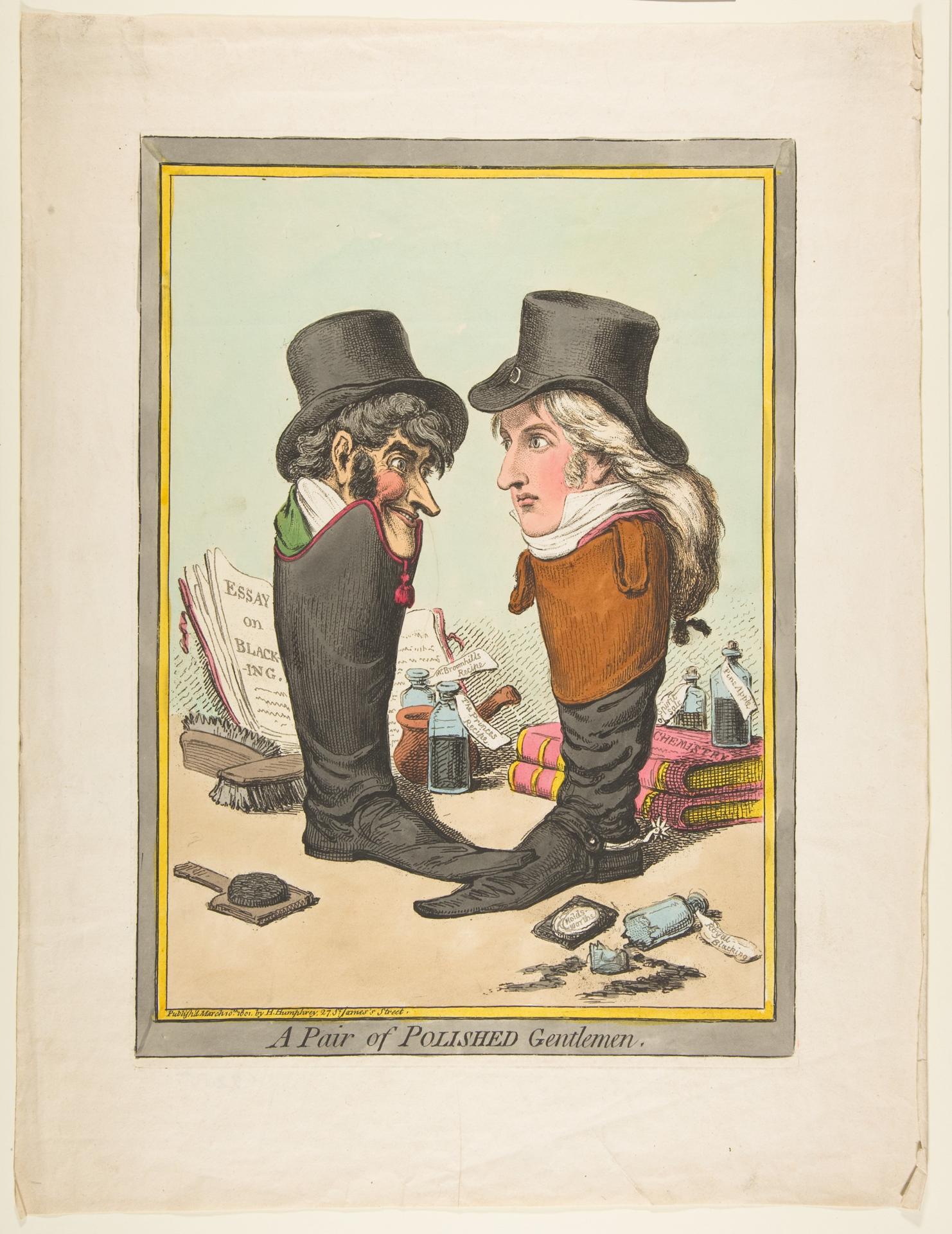
Two men in formal attire and tall black hats face each other in a room littered with books, bottles and debris. James Gillray made this hand-colored etching on March 10, 1801. The satirical drawing pokes fun at the social manners of the period.
Description
Tall black hats and formal dress dominate the image: the gentleman on the left wears a green jacket over a dark suit and has a red nose, while the one on the right has blond hair and a brown jacket over an orange shirt. Both stand upright, looking at each other. Books, bottles, a writing block and a paper inscribed “Essay on BLACK ING” surround them. The floor is covered with dirt and a broken piece of glass. Dark tones prevail, with accents of red, green and brown; the light falls evenly, without visible shadows.
Context
The etching was created on March 10, 1801, while George III ruled England. Gillray was known for his political and social satires, which often alluded to current events or people. The title plays on the word “polished” and thus suggests a critique of superficial elegance. The sheet belongs to Gillray’s series of humorous character studies sold in London art shops.
Impact
Exaggerated facial features and the messy surroundings, contrasting with the formal clothing, create a comic effect. The viewer is prompted to smile, while the satirical note establishes a critical distance from the social class depicted. The detailed scene invites repeated viewing.
Technique
An etching subsequently colored by hand gives the figures and objects individual touches of color. The linework is precise and characteristic of Gillray’s style, which combines fine etching with bold contours. The dimensions of about 35.4 x 25.1 cm (plate) are typical for prints of this period.
AI-generated description text
Source: Metropolitan Museum of Art · Public Domain (CC0 1.0)