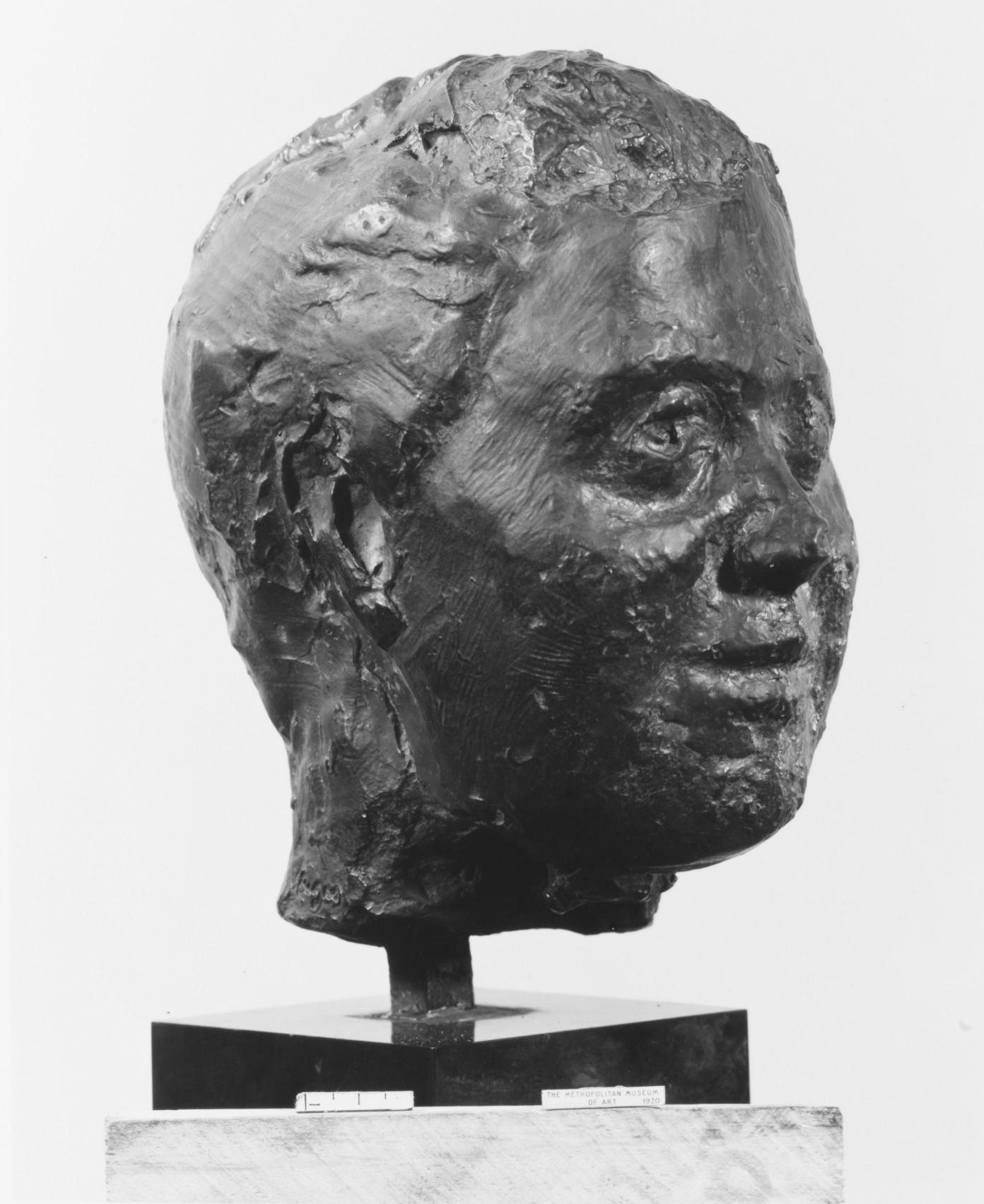
Study for a Portrait of Mathilde Salle (modeled ca. 1892, cast 1920, Met-Objekt 439)
Original title: Study for a Portrait of Mathilde Salle
kurzbeschreibung
Unlike Degas's many drawn or painted portraits of dancers, this bronze study isolates the head alone. He modeled it around 1892 as one of several attempts at a likeness of Mathilde Salle, a soloist at the Paris Opera. The cast was made in 1920, three years after his death, and shows a woman's head in half profile.
Description
A woman's head, turned partly toward the viewer, reveals carefully worked facial features, her hair, and the base of her neck. The bronze surface appears rough and uneven. Against a plain white ground, the sculpture stands on a black base fitted with a small plaque.
Context
During the 1890s Degas devoted increasing attention to dancers. Mathilde Salle, a soloist at the Paris Opera, sat for him on several occasions. Because Degas died in 1917, the 1920 cast was made posthumously—many of his wax works were only transferred into bronze after his death.
Impact
The slight turn of the head and the direct gaze give the figure a strong presence. The textured surface makes the portrait feel alive, almost impressionistic—a hallmark of Degas's late work.
Technique
Cast in bronze on a base of black marble. The uneven surface results from the wax modeling and the subsequent casting. Height with base: 28.3 cm; width: 10.2 cm; depth: 12.4 cm.
AI-generated description text
Source: Metropolitan Museum of Art · Public Domain (CC0 1.0)