Lordly Elevation
Original title: Lordly Elevation
kurzbeschreibung
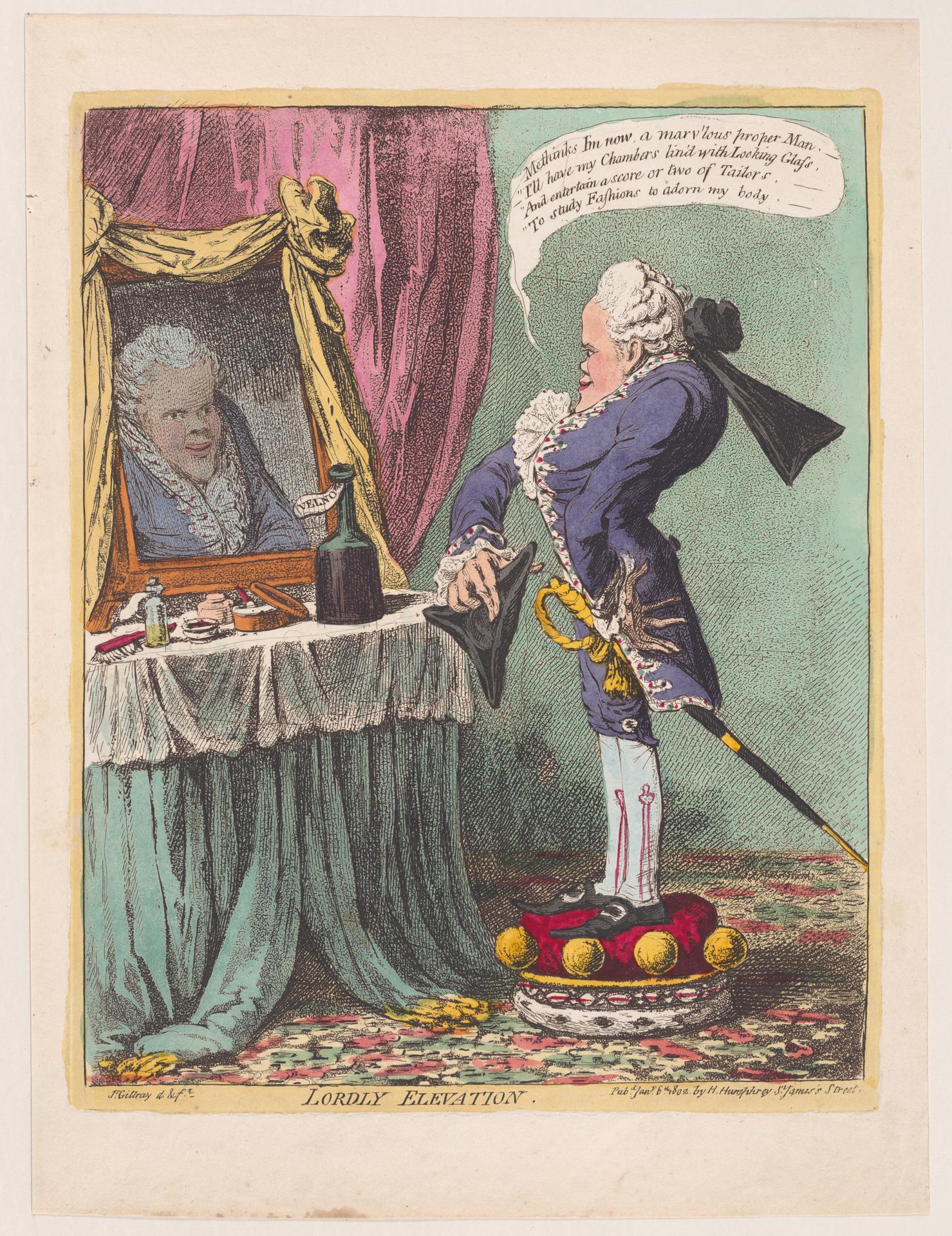
A figure in lavish finery studies himself in a mirror — James Gillray's hand-colored etching 'Lordly Elevation' from 1802 thus skewers vanity and aristocratic arrogance in Regency England.
Description
There he stands in a blue-and-white ostentatious outfit, hair curled, a gold-tipped cane in hand and a black cloth over one shoulder. His gaze falls into a mirror framed by red curtains. Beside it on the table: a bottle, a brush, a writing pad, and beneath that a cloth with yellow balls. The background glows bright green, and above the mirror hangs a banner with quoted text. Strong colors and a clear layout push the figure to center stage.
Context
Around 1800, James Gillray was one of England's most prominent caricaturists. His etching appeared in January 1802, a time of political and social upheaval after the Napoleonic Wars. Gillray often targeted the aristocracy and its self-staging. The banner parodies the fashionable follies of the day and the tendency toward self-admiration.
Impact
The exaggerated pose and opulent trappings make the print both comic and critical. Bright colors and detailed execution draw attention to the absurdity of self-reflection. Thus the viewer is invited to an ironic commentary on vanity and class consciousness.
Technique
For this hand-colored etching, the lines were etched into copper and then painted with watercolors. The delicate linework allows precise details such as fabric patterns and facial features. Because the coloring was done by hand, each impression has an individual touch.
AI-generated description text
Source: Metropolitan Museum of Art · Public Domain (CC0 1.0)