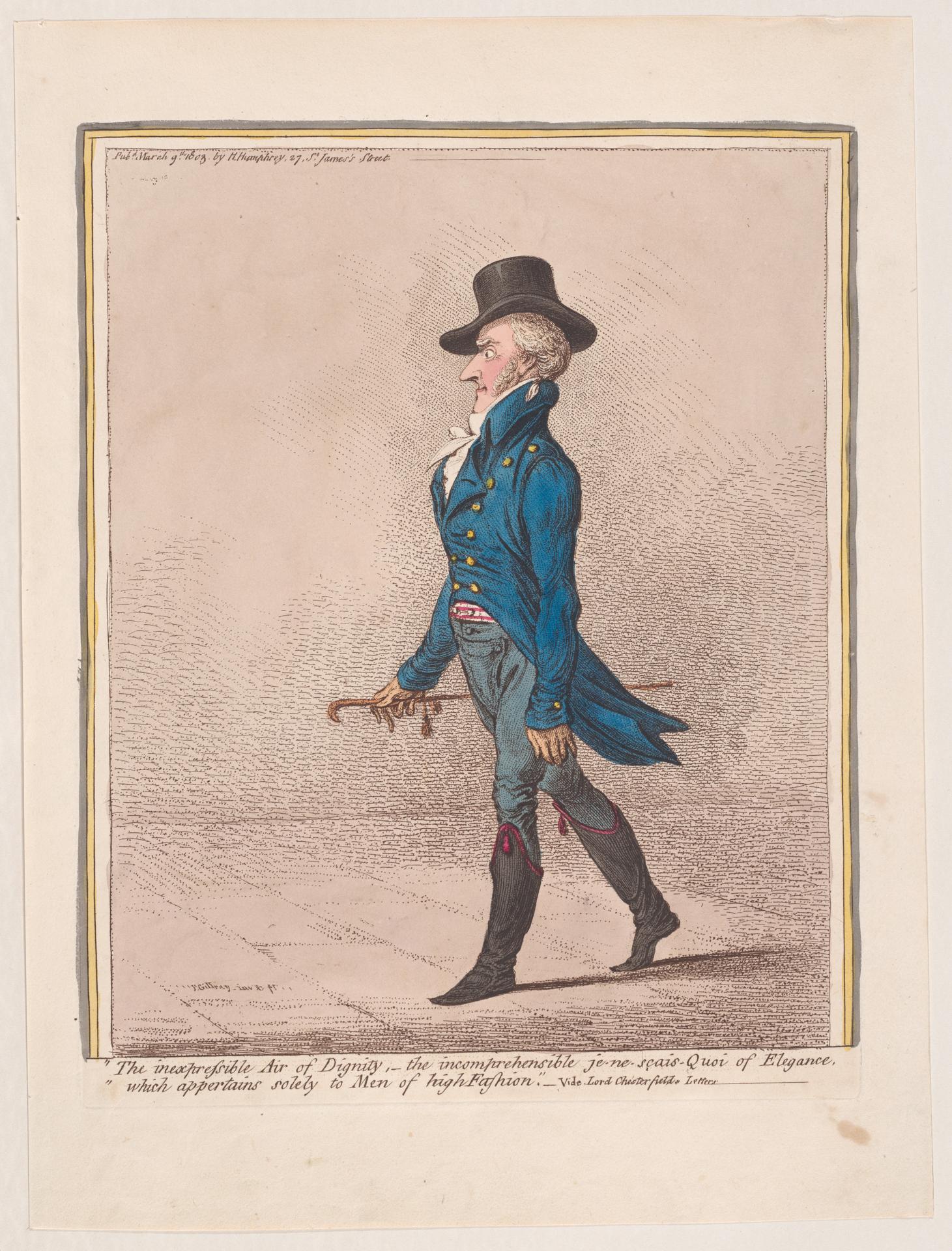
The Inexpressible Air of Dignity,–the Incomprehensible je-ne-sais Quoi of Elegance, which Appertains Solely to Men of High Fashion."–Vide, Lord Chesterfield's Letters
Original title: "The Inexpressible Air of Dignity,–the Incomprehensible je-ne-sais Quoi of Elegance, which Appertains Solely to Men of High Fashion."–Vide, Lord Chesterfield's Letters
kurzbeschreibung
James Gillray made this etching in 1803. It presents a gentleman dressed to the height of fashion, shown full-length against a plain backdrop. The sheet belongs to a run of satirical prints on the fashions of the day and nods to Lord Chesterfield's letters on good manners.
Description
Here is a gentleman in a dark blue coat with gold buttons, a waistcoat to match, a white cravat and a tall black hat. His breeches are dark blue too, trimmed at the hem with red ribbons; black boots and a cane in his right hand complete the outfit. The setting stays bare, little more than a flat grey floor. Blue, black and grey carry the colouring, lightened here and there by red and gold. Light falls evenly, with no strong shadows or highlights.
Context
Dated 9 March 1803 and made in London, the hand-coloured etching takes its place in a series of caricatures mocking the fashionable excesses of the Regency period. The title alludes to Lord Chesterfield's letters, an eighteenth-century conduct and education book widely read at the time, which makes the satirical target plain. Gillray was among the best-known caricaturists of his day, in politics as much as in society.
Impact
Precise drawing and restrained colour give the sheet an air of elegance rather than distortion. The man's somewhat exaggerated posture lends him a comic stiffness that picks up the mockery of the title. The result is an ironic tribute to the fashion of the age.
Technique
The print was made as an etching and then coloured by hand, a method common for satirical sheets around 1800. Acid bit the fine lines into a copper plate, from which the image was printed. Colourists then applied watercolours by hand, so that every impression carries its own individual note.
AI-generated description text
Source: Metropolitan Museum of Art · Public Domain (CC0 1.0)