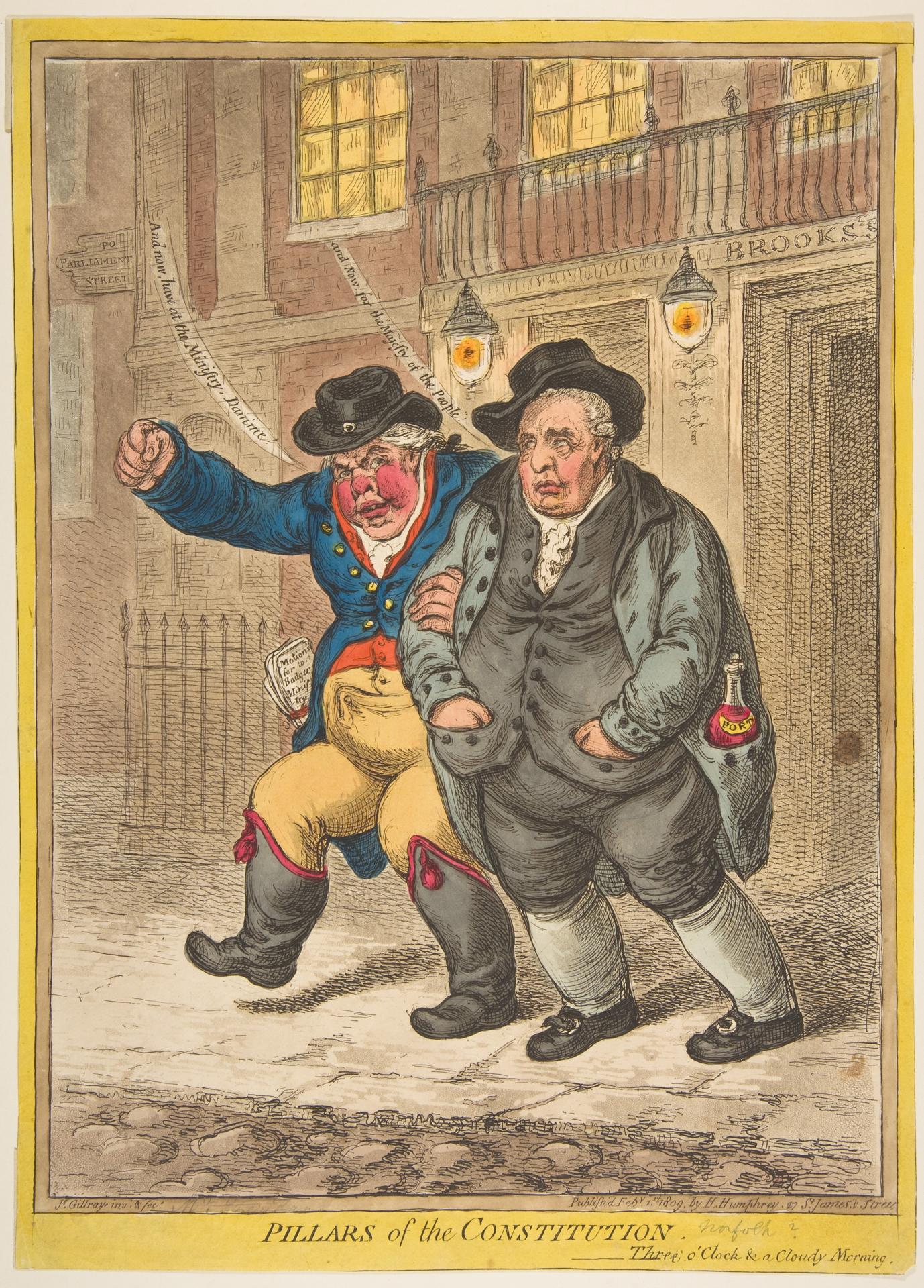
Pillars of the Constitution. Three O'Clock & a Cloudy Morning
Original title: Pillars of the Constitution. Three O'Clock & a Cloudy Morning
kurzbeschreibung
James Gillray, the great master of British caricature, produced this hand-coloured etching in 1809, a satirical scene with two figures set in a city street. Under the title 'Pillars of the Constitution. Three O'Clock & a Cloudy Morning', the print pairs political allusion with vivid figure drawing.
Description
At the left, a figure strides forward in a blue coat, yellow trousers and a red neckcloth, his nose noticeably reddened; his right hand grips a scroll. Beside him on the right stands a grey-clad man with a black bow, a grave face and a bottle in his left hand. Both wear hats and boots. Behind them a street opens out, with houses and a sign reading 'Brooks's'. Light falls in from the upper left and casts shadows to the right; the palette stays muted apart from the red accents.
Context
The etching appeared in February 1809, at a moment of political tension in Britain. Its title points to the constitution, and the subject probably alludes to contemporary events of the kind satirical prints often took up. Brooks's was a well-known London club tied to political circles. Gillray was regarded as a sharp political satirist whose work addressed an educated audience.
Impact
A tense, almost exaggerated mood emanates from the sheet and prompts reflection on the political state of things. Because the setting stays realistic while the figures are pushed toward caricature, the effect wavers between seriousness and comedy.
Technique
The etching was worked into the plate with precise, detailed lines and then coloured by hand. The red accents were applied deliberately to create contrast. The paper measures roughly 34.8 x 24.9 cm, a format usual for caricatures of the period.
AI-generated description text
Source: Metropolitan Museum of Art · Public Domain (CC0 1.0)