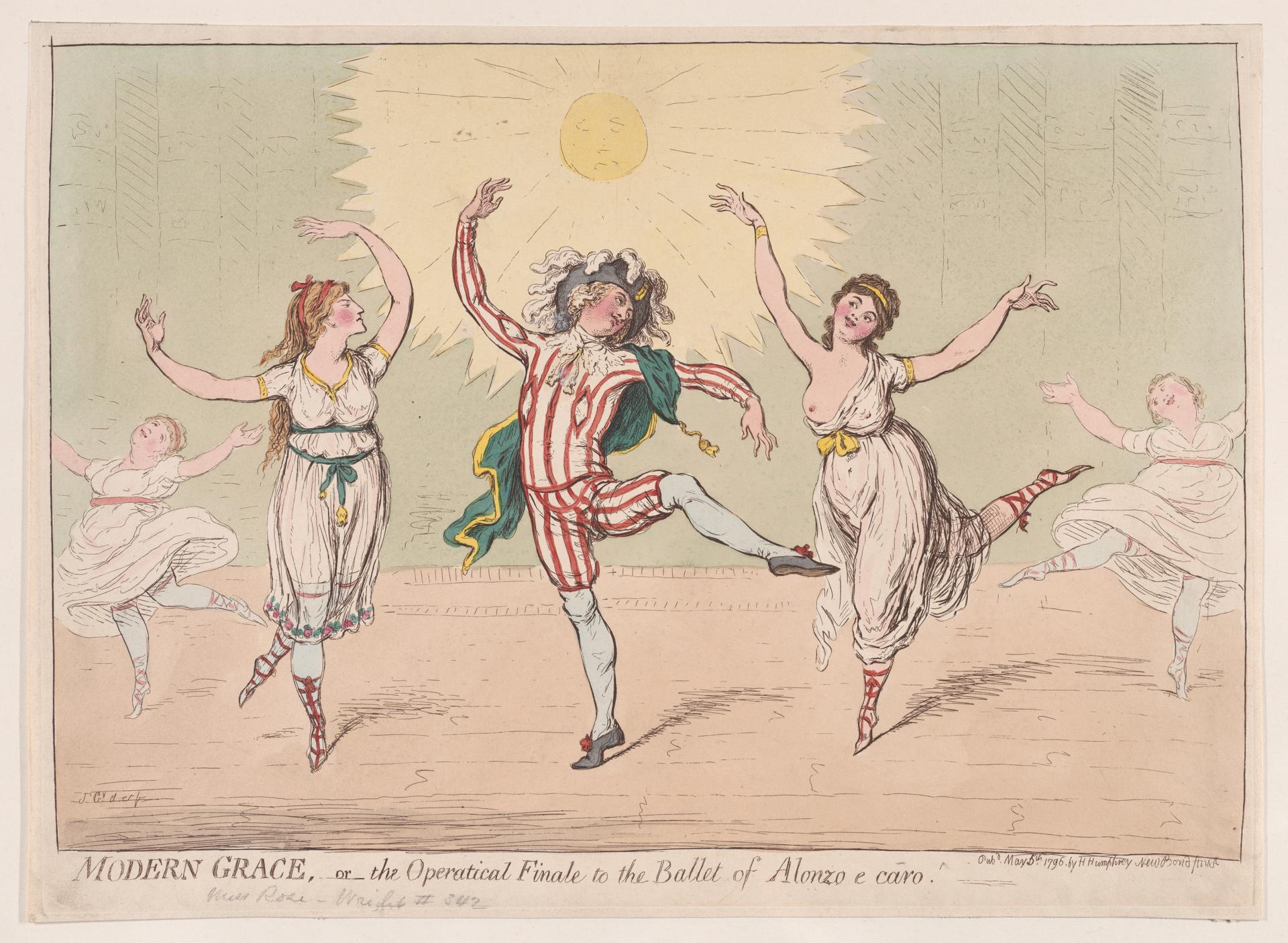
Modern Grace; - or the Operatical Finale to the Ballet of Alonzo e Caro
Original title: Modern Grace; - or the Operatical Finale to the Ballet of Alonzo e Caro
kurzbeschreibung
Unlike Gillray's other stage caricatures, which usually mock individual vanities, this 1796 print takes aim at an entire operatic finale. A ballet interlude unfolds: a male dancer in a red-and-white striped top and green jacket is surrounded by four female dancers in traditional costumes. The hand-colored etching parodies the ballet performances of its day and belongs to the artist's satirical oeuvre.
Description
At the heart of the layout stands the male dancer in a sweeping pose, his red-and-white striped top and green jacket providing the main splash of color. Around him are four ballerinas in ornate costumes with ribbons and bows, their arms and legs extended in various dance figures. A large, brightly glowing parasol lights up the background. The arrangement feels mirror-like: the dancer forms the core, with the women evenly spaced around him.
Context
Gillray published the sheet on May 5, 1796, at a time when ballet was drawing big audiences in London. It refers to "Alonzo e Caro," a ballet staged at the King's Theatre in 1796. The artist was known for his satirical commentary on British social and artistic life. In this caricature he mocks the ballet craze of those years and the operatic finales that many found overblown and theatrical.
Impact
The mirror-like arrangement and pastel tones give the print a certain harmony and elegance. At the same time, the slightly exaggerated dance poses add a comic undertone, typical of Gillray's satires. The interplay of grace and parody leaves the viewer with an ambivalent impression.
Technique
The image was drawn and colored as an etching: the design is etched into a copper plate, and the resulting print is then painted with watercolors. Fine lines and pastel hues characterize Gillray's approach. It was printed on paper trimmed to the plate mark.
AI-generated description text
Source: Metropolitan Museum of Art · Public Domain (CC0 1.0)