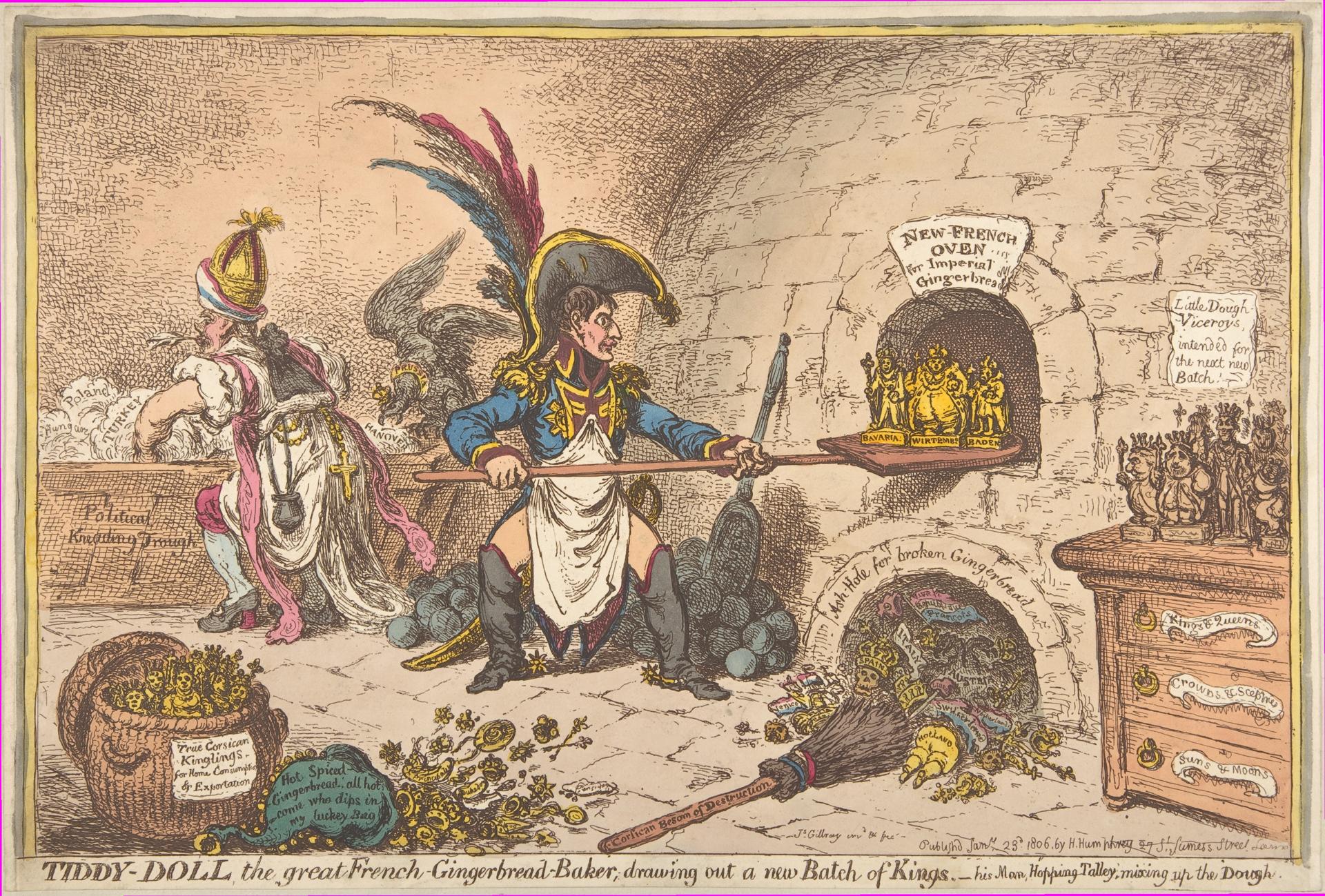
Tiddy-Doll, the Great French-Gingerbread-Baker; Drawing Out a New Batch of Kings, His Man Hopping Talley, Mixing Up the Dough
Original title: Tiddy-Doll, the Great French-Gingerbread-Baker; Drawing Out a New Batch of Kings, His Man Hopping Talley, Mixing Up the Dough
kurzbeschreibung
Unlike related Napoleon caricatures of those years, this 1806 print by James Gillray places the British satirist in a political allegory about Napoleon Bonaparte. In the hand-colored etching, Napoleon, depicted as a gingerbread baker, pulls a fresh batch of kings from the oven for Europe. The sheet is a biting commentary on Napoleonic rule and expansion policy.
Description
A figure in a military uniform helmet stands at the center, labeled Tiddy-Doll, the great French gingerbread baker. He holds a long wooden peel on which several small figures are placed as kings, drawn from an oven inscribed 'New French Oven for Imperial Gingerbread.' On the left appears a figure named 'Polish Knitting Pruss' with a head covering and a bowl. An eagle and other symbols appear in the background. Below lies a basket of small figures labeled 'True Corsican Kinglings for Home Consumption & Exportation.'
Context
The caricature was created on January 23, 1806, shortly after the Battle of Austerlitz (December 1805) and the founding of the Confederation of the Rhine. Gillray was responding to Napoleon's attempts to place his relatives and allies on European thrones. The print was published by Hannah Humphrey, Gillray's main publisher. It is typical of Gillray's satirical portrayals of Napoleon as a threat to Europe.
Impact
The exaggerated scene produces a grotesque comedy that exposes the arbitrariness of monarchical appointments. The detailed symbolism invites close scrutiny and underlines the political sharpness of the satire. By mixing the everyday (baking) with the political (king-making), the absurdity of Napoleonic politics becomes immediately tangible.
Technique
The work is a hand-colored etching on paper. The etching technique allowed for fine lines and precise details, which were then colored with watercolor. The palette is mainly in earth tones, with accents of blue and red on uniforms and headwear.
AI-generated description text
Source: Metropolitan Museum of Art · Public Domain (CC0 1.0)