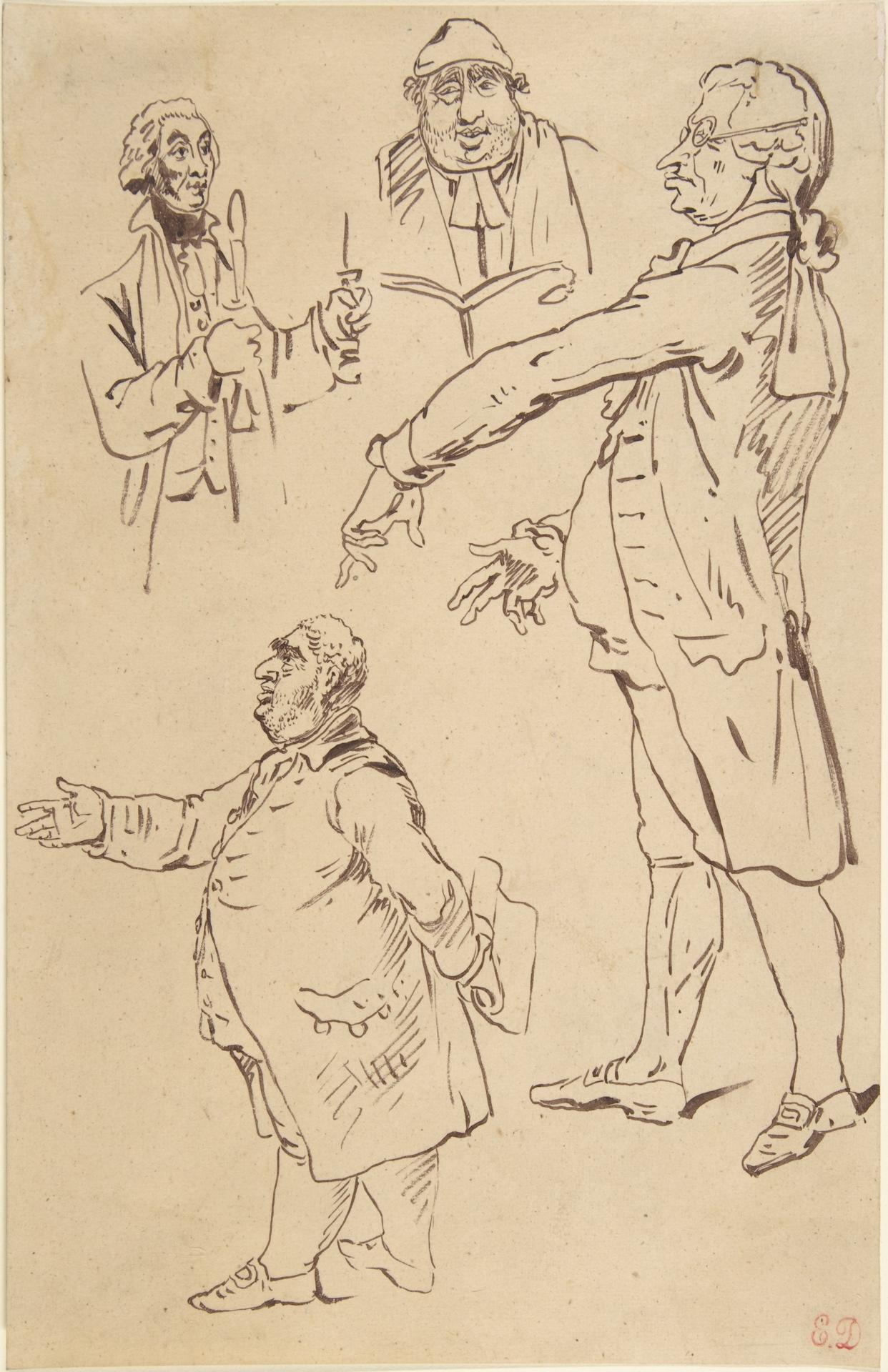
Studies of Four Englishmen, after James Gillray
Original title: Studies of Four Englishmen, after James Gillray
kurzbeschreibung
Brush and brown ink on tracing paper, later laid down on a support — with these materials Eugène Delacroix captured four gentlemen in the formal attire of the early 19th century around 1817–25. The study after James Gillray shows the men in the midst of a lively conversation.
Description
Four figures, each in a distinct pose, are caught up in conversation or a exchange of words. One holds a book and has his mouth open to speak, while the others respond with gestures of listening or reply. The drawing uses clear contours that precisely outline the folds of clothing and facial features. The background remains empty, so the figures stand out distinctly; the brown monochrome creates an even brightness without graded shadows.
Context
During these years Delacroix was deeply engaged with English caricature, especially the prints of James Gillray, who became known in the late 18th and early 19th centuries for his socially critical and political images. By copying such models, Delacroix trained his understanding of the figure and his expression. The fact that the work exists on tracing paper suggests a direct transfer.
Impact
The confident linework and animated gestures give the sheet an immediacy. Because color is limited to a single tone and the arrangement is clear, the viewer's attention is drawn entirely to the interaction among the men; this creates a tense, almost theatrical atmosphere.
Technique
Executed with brush and brown ink on tracing paper, which was subsequently mounted onto a support. This method allowed fine, flowing lines and a rapid capture of movement, as is characteristic of study sheets of the period.
AI-generated description text
Source: Metropolitan Museum of Art · Public Domain (CC0 1.0)