Taste (April 2, 1801, Met-Objekt 4310)
Original title: Taste
kurzbeschreibung
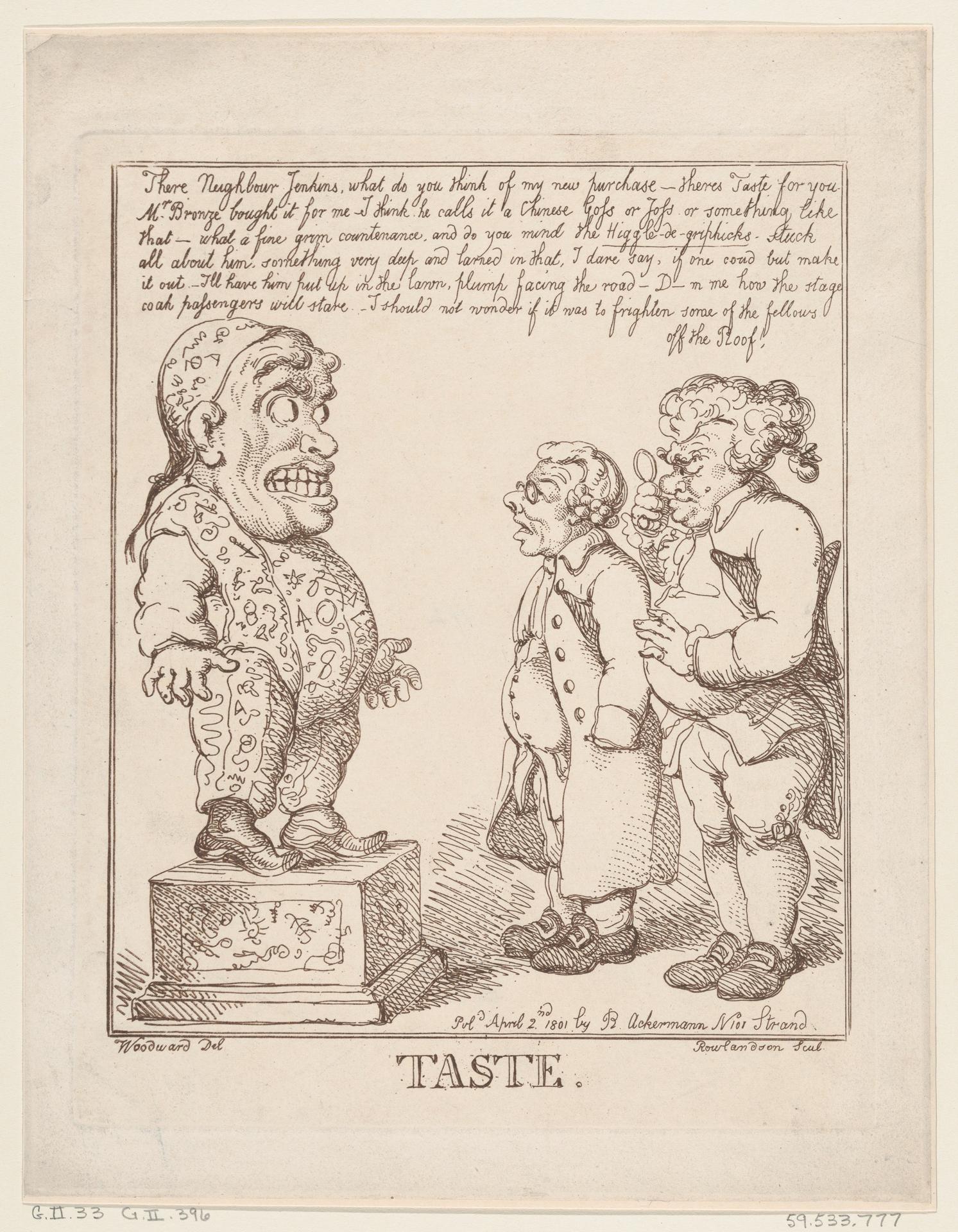
Two men stand before an odd statue whose face and shirt are composed entirely of letters and numbers. Thomas Rowlandson's 1801 etching, measuring 23.6 × 19.5 cm, appears to mock the artistic taste of its day.
Description
An exaggerated statue rises on a pedestal, its features and garment covered in letters and figures. To the right, two men examine the figure, the outer one holding spectacles in his hand. A text panel behind them contains a description and discussion of the statue. Black-and-white lines and hatching, typical of intaglio printing, structure the image.
Context
Rowlandson, an English caricaturist and graphic artist of the late 18th and early 19th centuries, was known for his satirical portrayals of social life. The etching was made in England in 1801, when caricatures were a widespread means of political and social commentary. The letters and numbers on the statue likely allude to contemporary debates about art criticism and judgments of taste; Rowlandson often ridiculed academies and art theories.
Impact
The statue's exaggerated form and the viewers set against it provoke immediate amusement and irony. The crowded mass of letters and numbers overwhelms the eye and emphasizes the absurdity of the art object. Fine lines and the monochrome execution achieve a precise graphic effect.
Technique
In etching, the drawing is scratched into a wax layer on a copper plate, and the metal is then etched. The intaglio technique transfers the inked recesses of the plate onto the paper, producing fine lines and shading. Black-and-white and clear linework correspond to the printmaking of the early 19th century.
AI-generated description text
Source: Metropolitan Museum of Art · Public Domain (CC0 1.0)