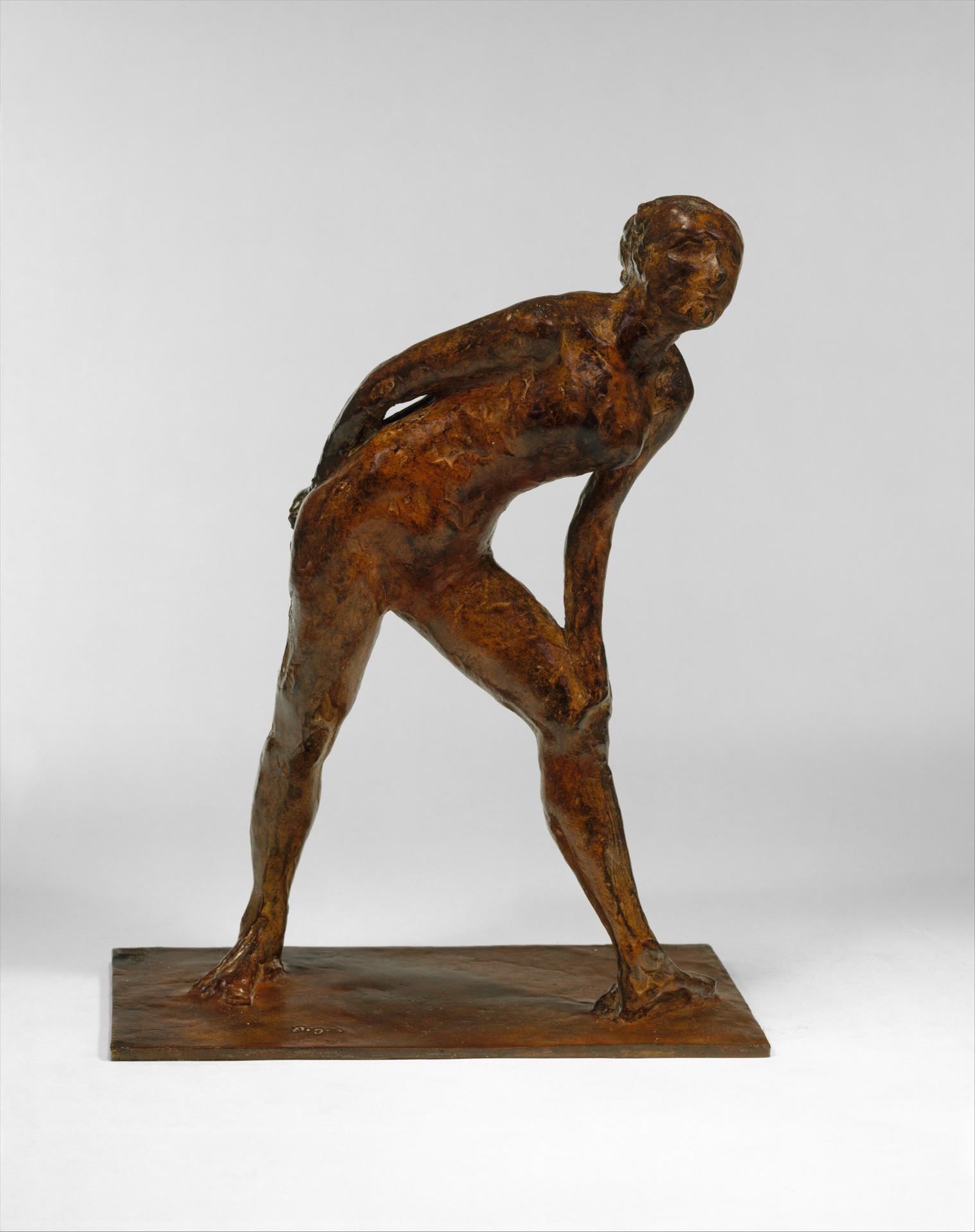
Dancer in the Role of Harlequin
Original title: Dancer in the Role of Harlequin
kurzbeschreibung
Edgar Degas modelled this bronze sculpture, Dancer in the Role of Harlequin, probably around 1884–85 as a wax figure; it was cast in bronze in 1920. Standing 31.1 cm high, the work belongs to his group of dancer figures and shows a nude male dancer in a dynamic pose.
Description
A nude, muscular man is caught in a dance pose. His left leg is slightly bent, his right arm raised, and his head tilts to one side and downward. The figure stands on a flat, rectangular base. The bronze has a patina in various shades of brown and gold that highlights the musculature and the sense of movement. A plain, neutral background makes the sculpture stand out.
Context
During the 1880s Degas engaged deeply with ballet and the movement of dancers; this sculpture emerged from that period. Harlequin was a familiar subject in nineteenth-century art and theater. The bronze cast was made only in 1920, after the artist's death—a common fate for many of his wax models, which were transferred into bronze posthumously.
Impact
The dynamic pose and expressive surface give the viewer an immediate sense of kinetic energy. The warm tones of the patina lend the figure a sensuous yet elegant presence that holds the gaze.
Technique
The cast was made using the lost-wax method. The surface has a fine patina, created by chemical treatment, which emphasizes both muscle structure and lines of movement. The original model was formed in wax and then transferred into bronze.
AI-generated description text
Source: Metropolitan Museum of Art · Public Domain (CC0 1.0)