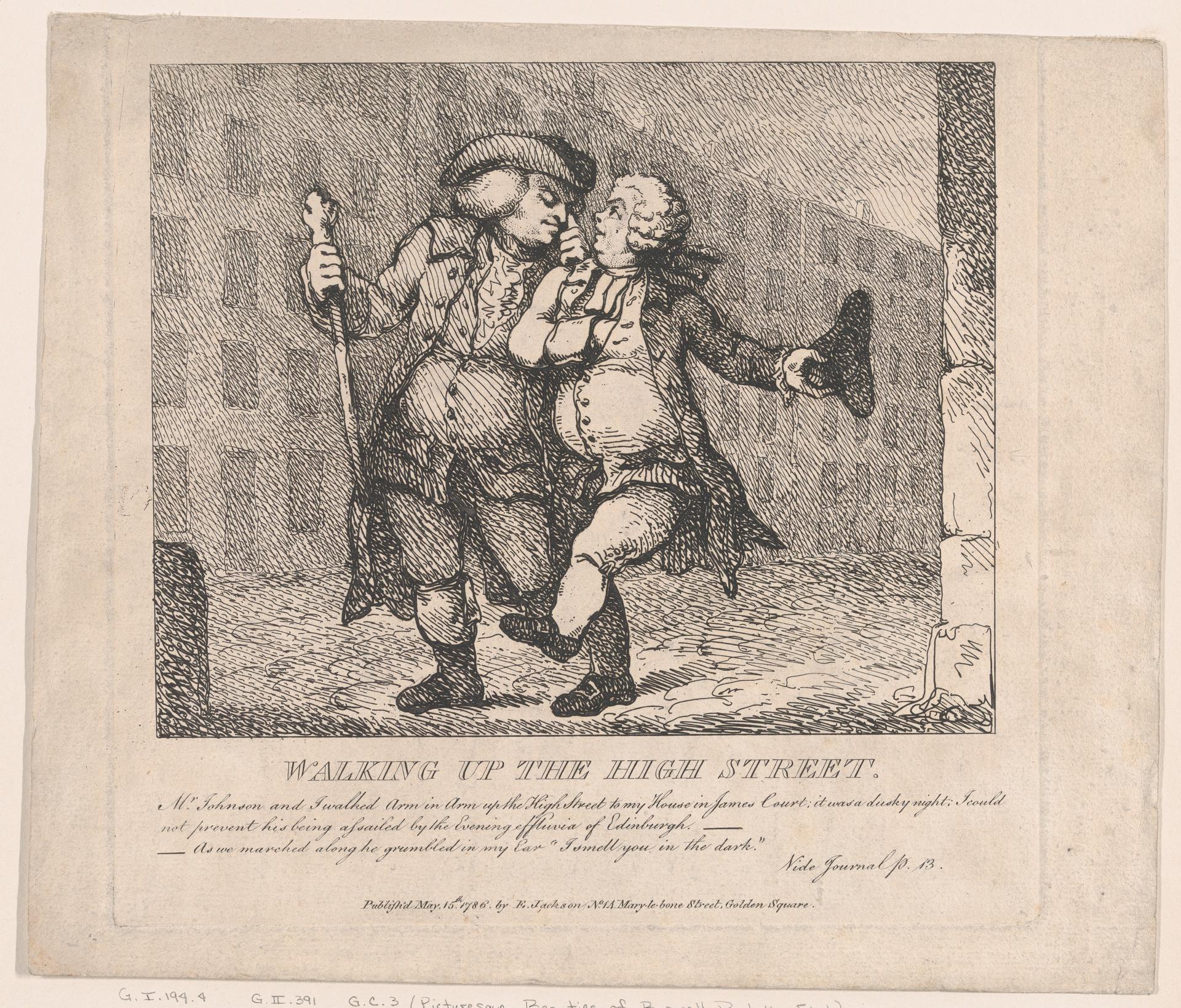
Walking Up the High Street, Edinburgh (Picturesque Beauties of Boswell, Part the First)
Original title: Walking Up the High Street, Edinburgh (Picturesque Beauties of Boswell, Part the First)
kurzbeschreibung
Two men stride along Edinburgh's High Street in this 1786 etching by Thomas Rowlandson. The print belongs to the series 'Picturesque Beauties of Boswell' and offers a humorous illustration of James Boswell's travelogue.
Description
A cobbled street stretches from left to right, with two figures walking its length. The one on the left wears a hat and coat and carries a stick; the one on the right, also hatted and coated, holds a horn. Both are deep in conversation, their postures dynamic and leaning slightly forward. Buildings and a streetlamp suggest the urban setting. Along the bottom edge, engraved text describes the walk on the High Street.
Context
Made on May 15, 1786, the etching is part of Rowlandson's series 'Picturesque Beauties of Boswell', a satire on James Boswell's travel accounts. Boswell, a Scottish writer, was known for his detailed descriptions of journeys through Scotland. Rowlandson caricatured the often exaggerated portrayal of everyday life in Boswell's texts. The series appealed to an educated, urban London audience that understood the allusions to Boswell's work.
Impact
The lively rendering of the two figures and the precise linework give the print an immediate narrative effect. The humorous exaggeration of the scene prompts the viewer to recognize the satirical intent behind the seemingly harmless slice of life. Image and text together create an ironic distance from the subject.
Technique
Etching involves incising lines into a copper plate that has been bitten with acid. This technique allows for fine, dynamic strokes that precisely capture the figures' movements and architectural details. The print was made on paper measuring 10 1/2 × 12 3/8 inches, while the plate itself measures 9 3/4 × 10 3/16 inches.
AI-generated description text
Source: Metropolitan Museum of Art · Public Domain (CC0 1.0)