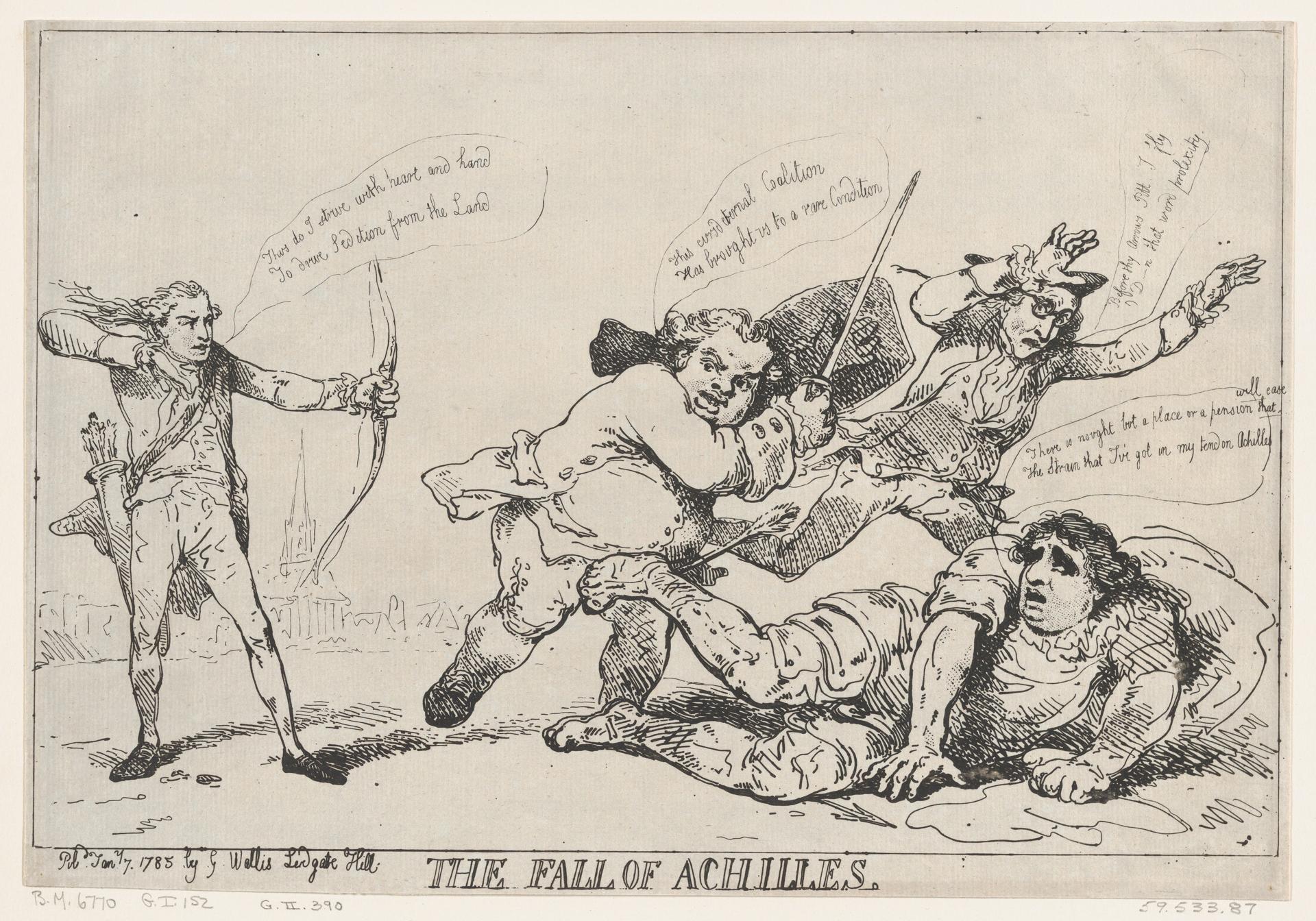
The Fall of Achilles
Original title: The Fall of Achilles
kurzbeschreibung
Dated 1785, Thomas Rowlandson's etching “Der Fall des Achilles” is a historical caricature. Four figures dressed in 18th-century clothing appear in a lively scene, accompanied by blocks of text. The print, executed as an etching, measures 23.5 × 33.8 cm.
Description
Four figures animate the layout: two are in motion, a third lies on the ground, and the fourth holds a bow and arrows. Their dress points to the 18th century. Each character is assigned text blocks that suggest statements or thoughts. The monochrome rendering relies on contrasts between light and dark areas of line that bring out the light. The caricatural style emphasizes movement and conflict.
Context
This etching by Thomas Rowlandson was made in England on 7 January 1785. It belongs to the political and satirical caricature of the late 18th century, which was widely circulated in Britain. Rowlandson was known for his humorous treatments of contemporary themes and historical references. The exact political or social background of the work has not been transmitted.
Impact
The dynamic arrangement of the figures and the expressive linework create a tense, almost theatrical mood. The caricatural style gives the scene a humorous touch and ironically breaks the historical subject. The monochrome etching directs attention to the gestures of the figures and the text blocks.
Technique
This sheet is an etching: the drawing was incised into a metal plate and bitten with acid. The linework is precise and varies in density and shading to create light and shadow. It was printed on paper, as was customary for 18th-century prints.
AI-generated description text
Source: Metropolitan Museum of Art · Public Domain (CC0 1.0)