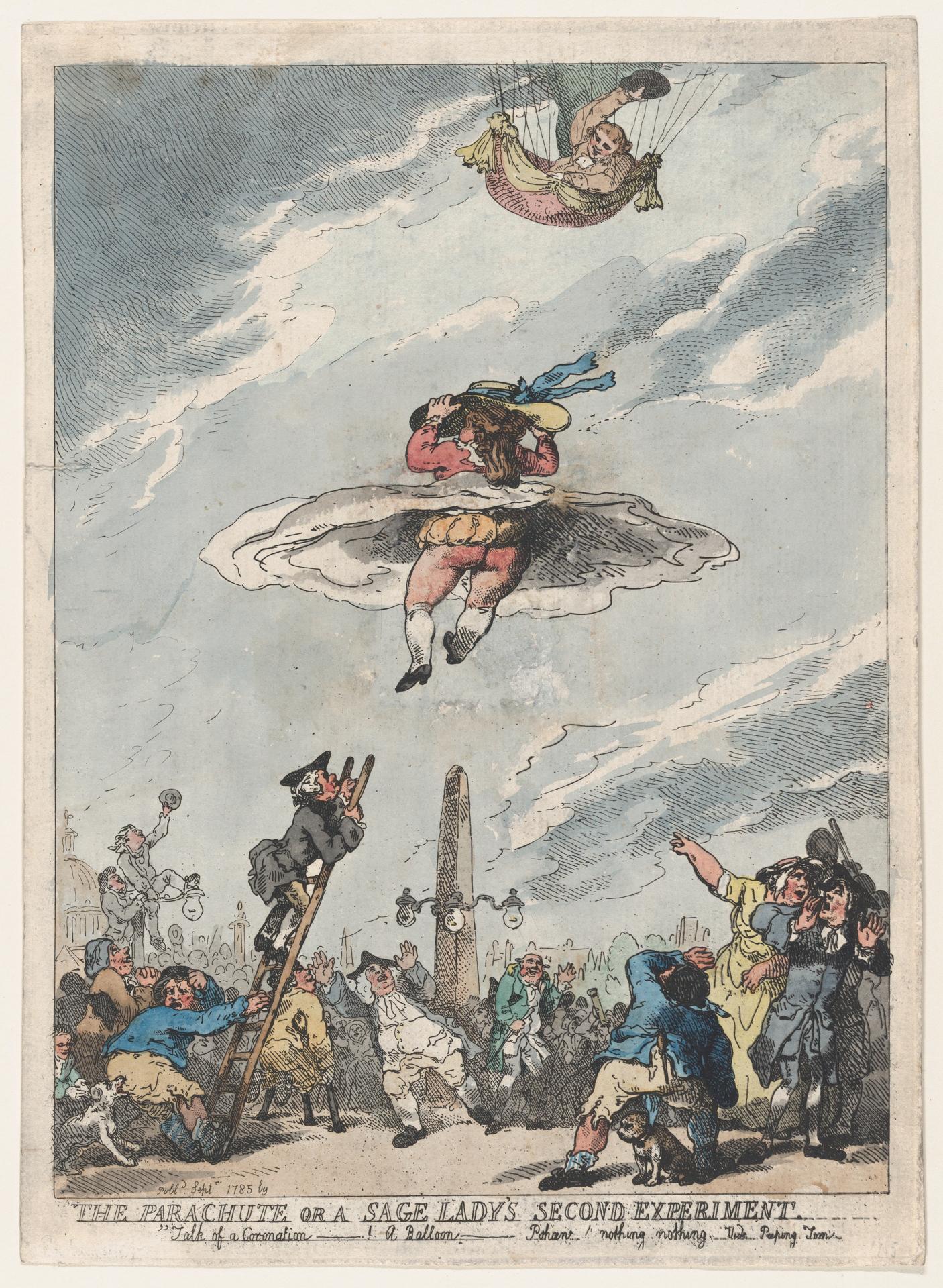
The Parachute or a Sage Lady's Second Experiment
Original title: The Parachute or a Sage Lady's Second Experiment
kurzbeschreibung
Thomas Rowlandson's hand-coloured etching of September 1785 makes fun of an early parachute attempt. Two figures drift through the air in a flying contraption above a crowd that has gathered to watch. The sheet measures 35.5 by 25.7 centimetres.
Description
High in the picture two figures float in a paraglider-like craft: one sits calmly, the other is caught in a stretched, energetic pose. Both wear historical dress cut in the fashion of the eighteenth century. Below, a crowd watches a man on a ladder who holds an object in his hand. The onlookers range from attentive to bewildered or anxious, and a few have dogs with them. The layout feels restless, with figures scattered in every direction. Colours stay mostly muted in blues, greys and browns, while the clothing supplies the accents.
Context
Rowlandson made the etching in September 1785, only a few years after the Montgolfier brothers' first manned balloon flights of 1783. He was drawing on the contemporary craze for aviation and its public demonstrations. The figure of a "wise lady" points to the fashionable experiments of the Enlightenment. The sheet belongs among Rowlandson's satirical prints commenting on the social phenomena of his day.
Impact
Technical daring and comic absurdity pull against each other, and the result is an uneasy tension. The restless arrangement of the figures and the subdued colouring give the scene a note that is at once dramatic and ironic. The viewer wavers between admiration for the reckless attempt and amusement at the oddity of the situation.
Technique
The work is a hand-coloured etching, its lines sharp and rich in detail. Colouring was applied by hand after printing, mainly in blues, greys and browns. At 35.5 by 25.7 cm the sheet matches the usual size for single prints of the period.
AI-generated description text
Source: Metropolitan Museum of Art · Public Domain (CC0 1.0)