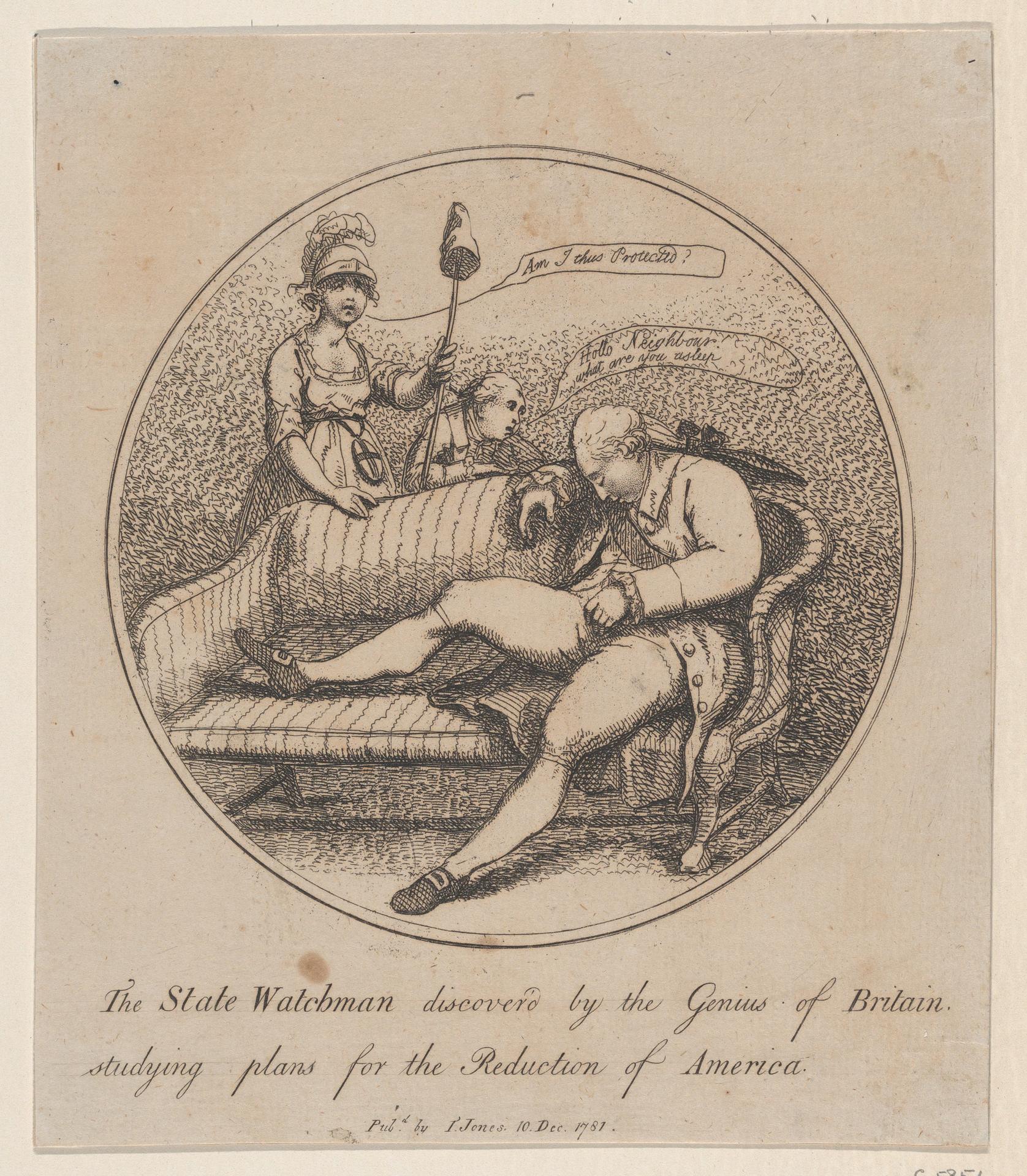
The State Watchman Discovered by the Genius of Britain Studying Plans for the Reduction of America
Original title: The State Watchman Discovered by the Genius of Britain Studying Plans for the Reduction of America
kurzbeschreibung
Unlike contemporary battle scenes or heroic engravings, Thomas Rowlandson's 1781 etching offers a satirical allegory on British politics during the American Revolutionary War. Three figures – a woman in classical dress, a skeleton, and a uniformed man – are placed within an oval frame. The print takes aim at Britain's conduct of the war and its public perception.
Description
On the left stands a woman in classical attire, armed with a helmet and a staff, her expression worried. Opposite her, on the right, a skeleton crouches with a pipe in its mouth, while a man in uniform, cap, and buttoned jacket lies stretched out on a bench, staring at the skeleton. Above the skeleton floats a scroll inscribed 'Am I thus Protected?', and above the man another reads 'Hello, Neighbour, what are you about?'. Dotted lines cover the background, and a handwritten title line runs along the bottom edge.
Context
The etching is dated 10 December 1781, just weeks after the British surrender at Yorktown in October of that year, the turning point of the American Revolutionary War. Rowlandson, known for his political caricatures, thus addressed Britain's military setbacks. His print parodies the official rhetoric of 'reducing' America and the government's role.
Impact
Ironic distance arises because the actors appear as grotesque figures. The combination of classical allegory and contemporary caricature gives the print satirical bite and prompts the viewer to reflect on the political events.
Technique
In this etching, the artist scratches the drawing into a copper plate coated with wax and then etches it. Precise printing technique is evident in the fine lines and oval contours. The dotted structures in the background likely result from a special etching technique that creates a textured surface.
AI-generated description text
Source: Metropolitan Museum of Art · Public Domain (CC0 1.0)