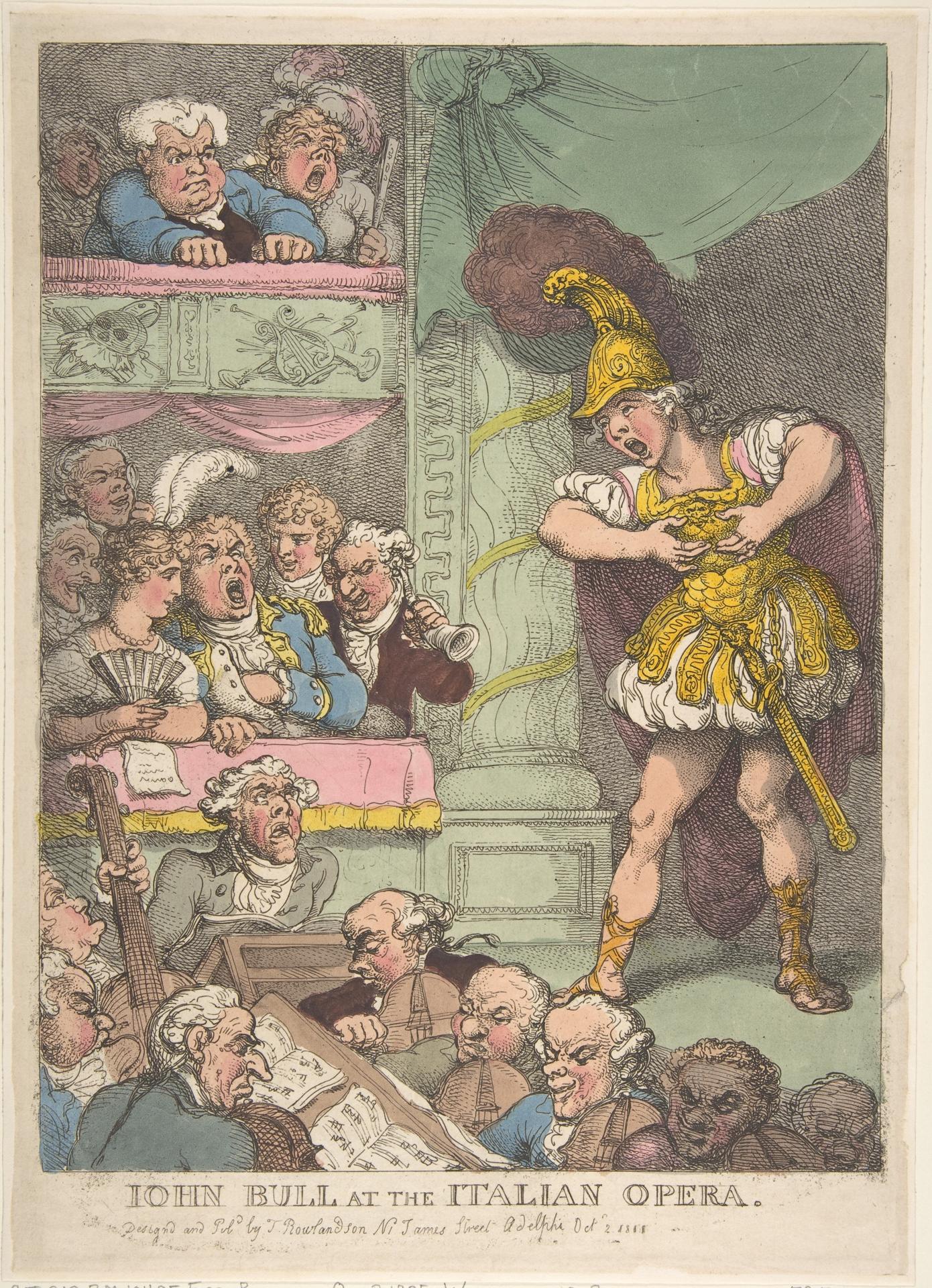
John Bull at the Italian Opera
Original title: John Bull at the Italian Opera
kurzbeschreibung
A man in Roman costume blasts a trombone — that figure opens Thomas Rowlandson's caricature John Bull at the Italian Opera from 1811. This hand-colored etching, 34.1 by 24.5 cm, presents a satirical scene in an Italian opera house, with the trombonist surrounded by spectators reacting in various ways.
Description
Up front, a fellow in Roman attire — a purple robe with gold trim and a gold helmet dome — blows a dramatic trombone, and the gesture pulls the eyes of everyone around him. The onlookers respond in kind: laughter, surprise, horror; a few clutch flutes or trombones, marking them as opera-goers. The layout runs horizontally, the main actor in the middle, reactions spreading to both sides. Grays and browns dominate, with gold here and touches of blue and red in individual costumes.
Context
Rowlandson drew this caricature on October 2, 1811, in London, when Italian opera was both popular with the British public and a target of mockery. John Bull then stood as a national allegory for the typical Englishman, often drawn with a critical or humorous edge. Rowlandson was known for social satires that skewered city life and cultural fashions. The print appeared as a single sheet and addressed a broad, art-interested audience.
Impact
The contrast between the trombonist's theatrical entrance and the spectators' varied reactions makes the sheet immediately lively and funny. Despite the satirical intent, the delicate hand-coloring gives the scene a touch of elegance and draws the eye to details. The overall impression is dynamic, ironically underscoring the absurdity of the opera world.
Technique
The print was made as an etching, an intaglio process in which the drawing is bitten into a metal plate. Rowlandson's characteristic fine lines and hatching produce a detailed rendering of the figures. Coloring was then applied by hand; colors such as gold, blue, and red were placed selectively to highlight certain areas.
AI-generated description text
Source: Metropolitan Museum of Art · Public Domain (CC0 1.0)