The Exhibition "Stare-Case"
Original title: The Exhibition "Stare-Case"
kurzbeschreibung
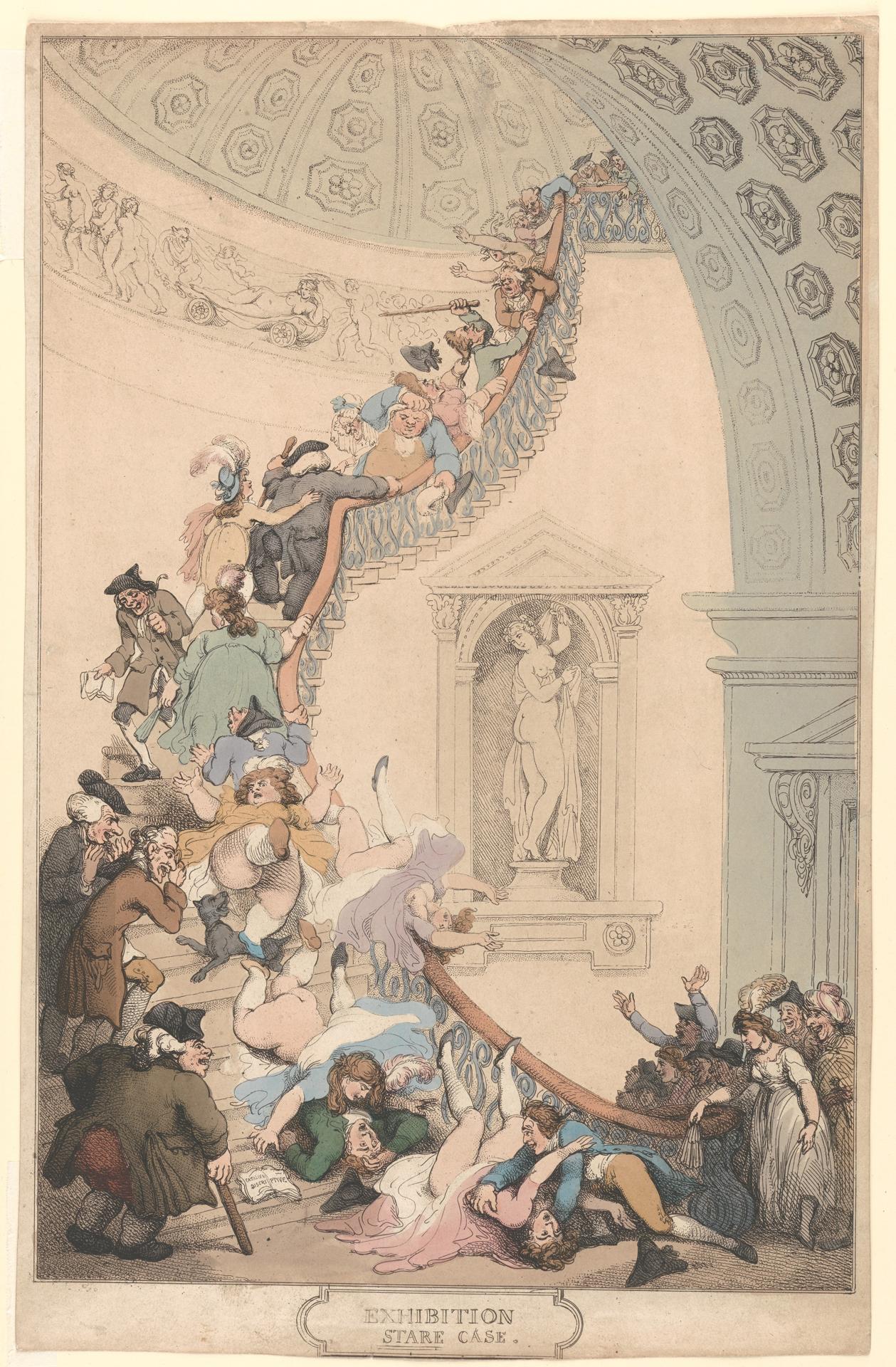
Thomas Rowlandson's etching "The Exhibition 'Stare-Case'" dates from around 1811 and captures a chaotic scene on a staircase. In the hand-coloured print, measuring 47.6 × 33.2 cm, people appear in every kind of posture: some tumble, others rush to help. The subject pairs architectural elements with a mocking account of human behaviour.
Description
A large spiral staircase, its ornament recalling classical columns, dominates the layout. Figures crowd it in restless, sometimes falling poses, while others cling on or hurry over. A statue of a woman stands on a pedestal in a niche toward the back. Hand-colouring in blue, pink, green and brown enlivens the print, and the figures' conflicting directions of movement keep the scene agitated. Even light from above picks out details of the people and the space.
Context
Thomas Rowlandson (1757–1827) was an English artist known for his satirical prints. He made this sheet at a time when public exhibitions in London, the Royal Academy among them, drew large crowds. Rowlandson often ridiculed the crush and vanity of audiences at such events. The etching belongs to a series that treats social scenes with a humorous undertone.
Impact
The bustling arrangement of figures and the strong colouring produce immediate tension. Viewers are drawn into the apparent chaos and at the same time amused by the grotesque poses. The contrast between architectural order and human muddle sharpens the satirical effect.
Technique
For the etching the artist worked with fine lines and hatching. The sheet was then coloured by hand, which accounts for its lively colour. The paper size of 47.6 × 33.2 cm matches the standard for prints of the period and allows a detailed rendering.
AI-generated description text
Source: Metropolitan Museum of Art · Public Domain (CC0 1.0)