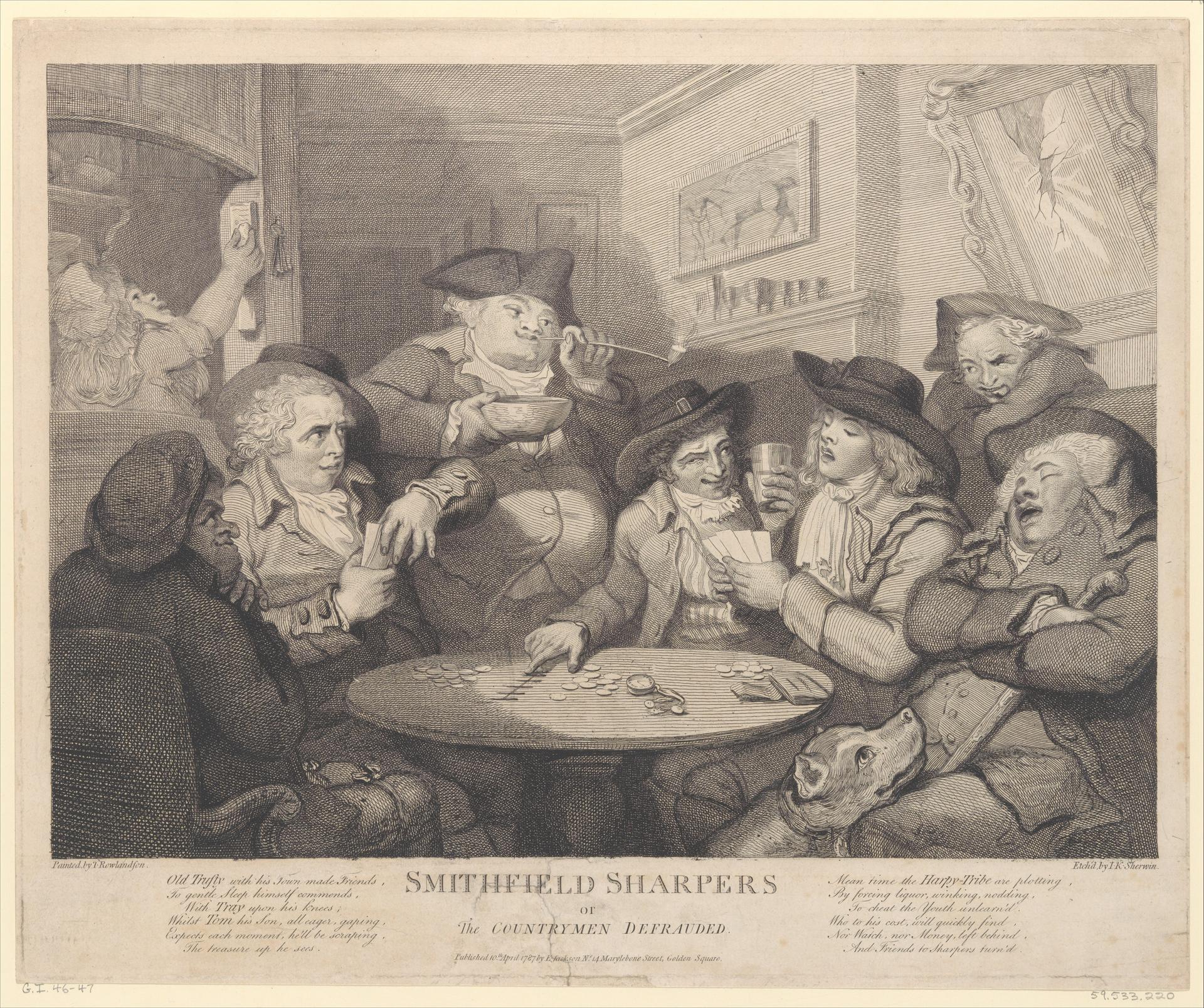
Smithfield Sharpers, or the Countryman Defrauded
Original title: Smithfield Sharpers, or the Countryman Defrauded
kurzbeschreibung
A countryman is parted from his money at an inn: John Keyse Sherwin's etching "Smithfield Sharpers, or the Countryman Defrauded," dated 10 April 1787, lays this swindle out before the viewer. Several figures crowd around a table strewn with coins and playing cards, and the outsider plainly cannot match the cunning of the city folk.
Description
Inside a tavern room, a group of figures has gathered at a table scattered with coins and cards. Some hold tankards, others cards, and a few fix their eyes on the game; a dog sits on the floor in front of the table. Those present wear late-eighteenth-century dress, with caps and jackets. A wall hung with a painting and a clock closes off the room, and lettering running across the image gives the title together with an explanatory note.
Context
The print appeared in England in 1787, a time when satirical and moralising sheets circulated widely. Sherwin, a respected English engraver and painter, was known for his meticulous reproductive work as well as his own graphics. The title alludes to London's Smithfield Market, a place notorious for cheating and sharp practice; the subject takes up the period's worry about country people coming to harm in the city.
Impact
Dense storytelling and a wealth of detail draw the viewer straight into the swindle. A clear arrangement and precise lines give the sheet an almost documentary quality that reinforces its moral message. The etching's greys set a serious, sober mood.
Technique
The sheet was produced by etching: lines are bitten into a metal plate, yielding the fine strokes and hatching characteristic of the process. The image stays in shades of grey, a result of printing with black ink on paper.
AI-generated description text
Source: Metropolitan Museum of Art · Public Domain (CC0 1.0)