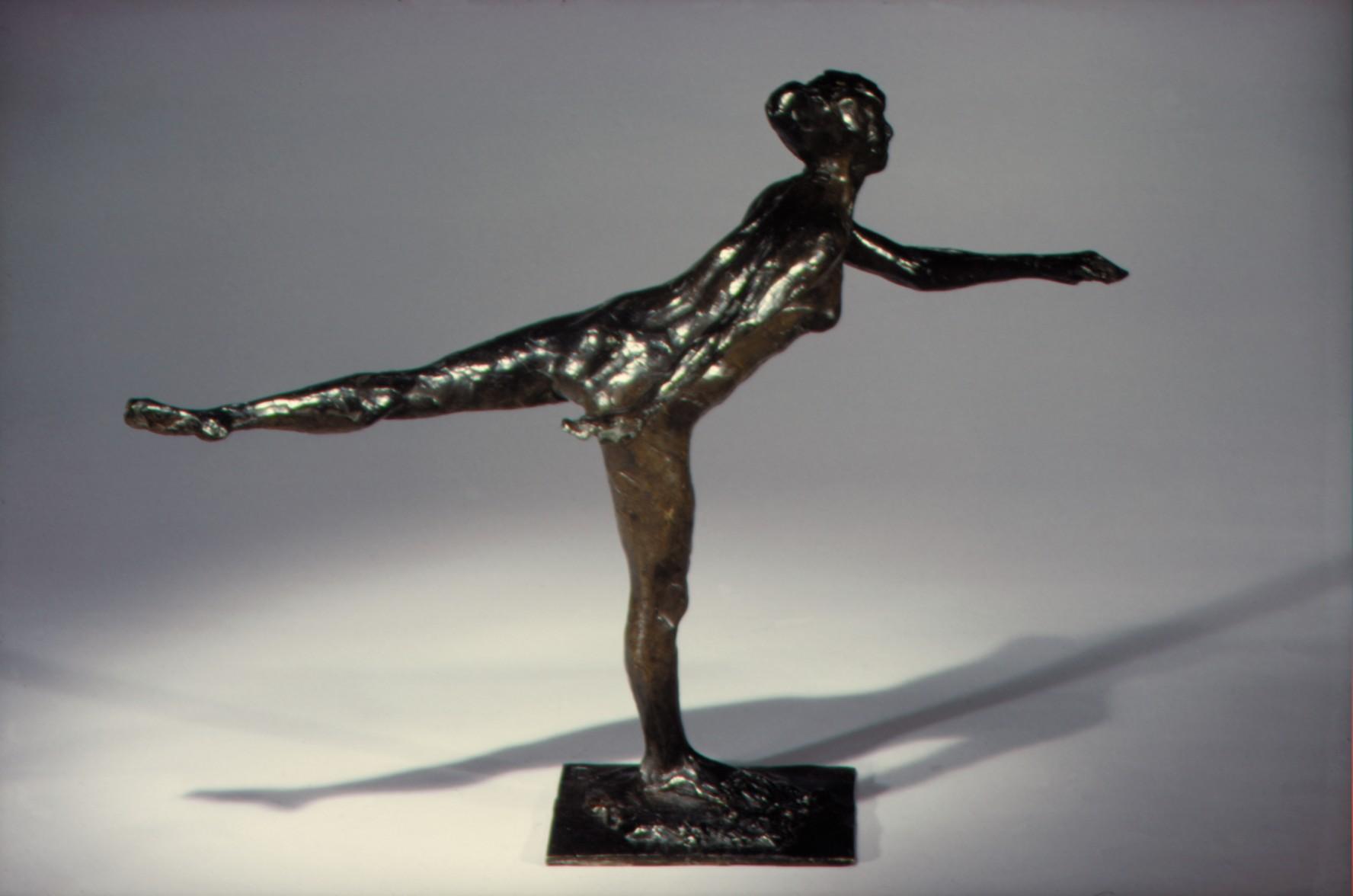
Second Arabesque (modeled before 1885, cast 1920, Met-Objekt 426)
Original title: Second Arabesque
kurzbeschreibung
Edgar Degas modeled 'Zweite Arabeske' before 1885; the bronze cast was made in 1920. The sculpture shows a dancer in an expansive pose: arms open, one leg stretched backward.
Description
Side lighting shapes the figure's contours and casts shadows on the flat, square base. The ballerina stands in a dance position: arms open, one leg extended behind, the other slightly lifted. She wears a sleeveless top and tight pants that emphasize her agility. A neutral, monochrome background makes the silhouette stand out.
Context
The modeling was done before 1885, the bronze cast only in 1920, after the artist's death. Degas repeatedly engaged with dancers and also translated them into sculptures. The arabesque is a classical ballet pose that he varied in several versions. During this time, he intensively studied movement and posture.
Impact
From the first glance, the lightness of the pose captivates, typical of Degas's dancers. The outstretched limbs draw the eye diagonally across the figure. A tension arises between movement and stability that holds the viewer's attention.
Technique
Bronze, a material valued for durability and fine detail, forms the basis. The surface preserves the artist's modeling traces, fixed by the casting process. On a flat base, the figure stands stably and is presented in this way.
AI-generated description text
Source: Metropolitan Museum of Art · Public Domain (CC0 1.0)