Wit's Last Stake, or the Cobbling Voters and Abject Canvassers
Original title: Wit's Last Stake, or the Cobbling Voters and Abject Canvassers
kurzbeschreibung
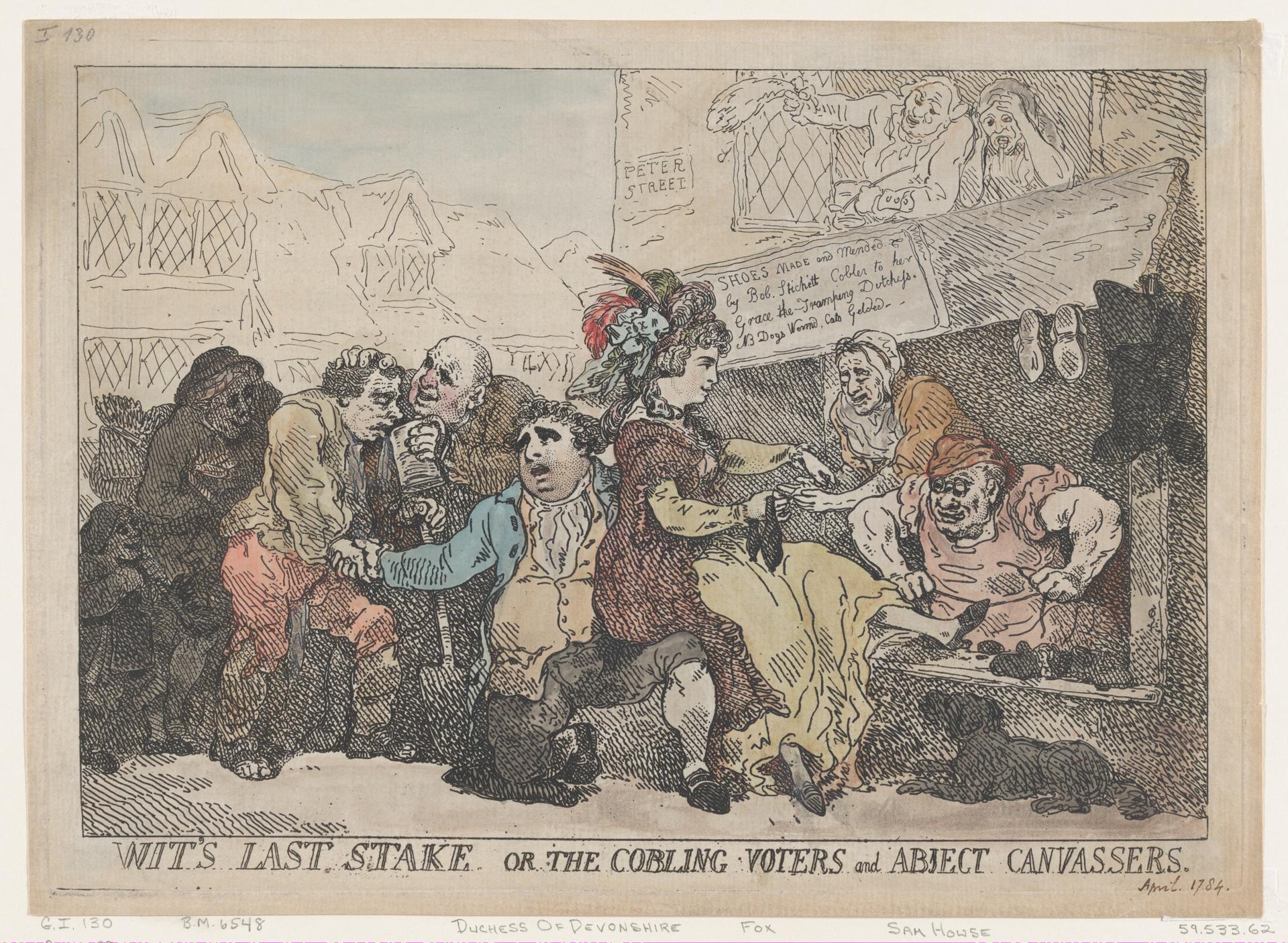
Thomas Rowlandson's print 'Wit's Last Stake, or the Cobbling Voters and Abject Canvassers', dated 22 April 1784, presents a crowded city street. A woman in an elaborate headdress stands at the centre, surrounded by people drinking and arguing. In front of a building marked 'PETER STREET', electioneering and drinking scenes unfold. The etching is hand-coloured.
Description
People gather before a house labelled 'PETER STREET'; some drink, others converse or watch. A woman in striking dress with a feathered headdress commands the centre and draws the eye. Two figures look down from a window of the building. Grey and brown tones dominate, given touches of colour by hand. The tight grouping of figures pushes the central character forward, while fine lines and hatching record details precisely.
Context
The caricature appeared in April 1784, amid the British general election following the fall of Charles James Fox's government and the appointment of William Pitt the Younger as prime minister. Rowlandson, known for his satirical views of political and social life, here takes up election practices of the time, including the influence of alcohol on voters and the role of canvassers. The phrase 'Cobbling Voters' plays on the craft metaphor for manipulating votes, a common motif in eighteenth-century political satire.
Impact
The dense, almost chaotic arrangement of figures makes the image immediately lively and conveys the frenzy of an election campaign. The central female figure with her extravagant headdress is an ironic focal point and underlines the absurdity of the proceedings. Thus a satirical distance emerges that invites a smile without blunting the critique of political conditions.
Technique
This print was made as an etching with fine lines and hatching to bring out detail and shadow. It was then hand-coloured with watercolour or wash, adding colour accents to the grey and brown tones of the plate. This combination of precise etching and restrained colouring was typical of Rowlandson's satirical prints and allowed inexpensive but detailed reproduction.
AI-generated description text
Source: Metropolitan Museum of Art · Public Domain (CC0 1.0)