Landscape (1780–1827)
Original title: Landscape
kurzbeschreibung
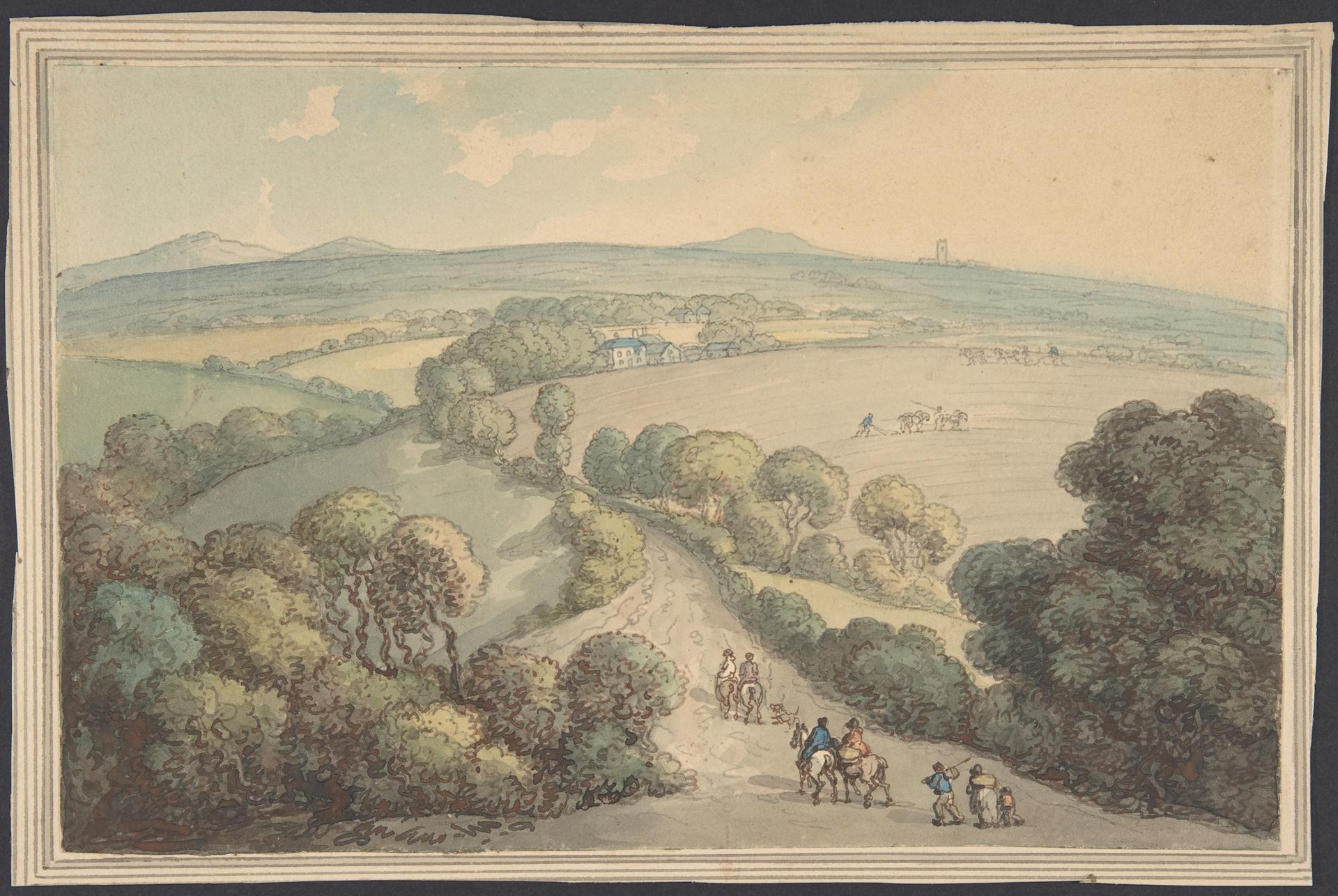
Thomas Rowlandson made the drawing 'Landschaft' between 1780 and 1827. Riders and walkers move along a path through a rural setting. The sheet is executed in watercolour, graphite, pen and ink and measures 17.2 x 26.9 cm.
Description
Several figures travel along a woodland path, some on horseback and others on foot. Beyond the path, fields and clusters of trees open out to form a graceful landscape. Further off, hills and a tower can be made out, probably a church tower. Light cloud fills the sky, and the palette stays mostly in greens and blues, which creates a peaceful mood. The layout runs horizontally and draws the eye toward the landscape with its wandering figures.
Context
Rowlandson, an English artist, is known for satirical and socially critical work, but he also devoted himself to landscape. The span 1780–1827 covers a large part of his working years, during which he travelled extensively through England making sketches. The sheet belongs to an era when landscape painting gained weight in Britain, often linked to the idea of the picturesque. Rowlandson often worked for publications and collectors who valued the English landscape as part of national identity.
Impact
Delicate watercolour tones and precise pen drawing give the scene a quiet, almost idyllic note. The figures remain embedded in the landscape and preserve its naturalness; people and nature appear in balanced proportion. The sheet reads like a silent observation of rural everyday life.
Technique
A mixed technique of watercolour, graphite, and pen and ink on paper. The watercolours produce soft, translucent areas, while pen and ink strokes clearly outline details such as figures and tree structures. This combination was characteristic of English watercolour art in the eighteenth and early nineteenth centuries.
AI-generated description text
Source: Metropolitan Museum of Art · Public Domain (CC0 1.0)