Wooded Landscape with Ruins
Original title: Wooded Landscape with Ruins
kurzbeschreibung
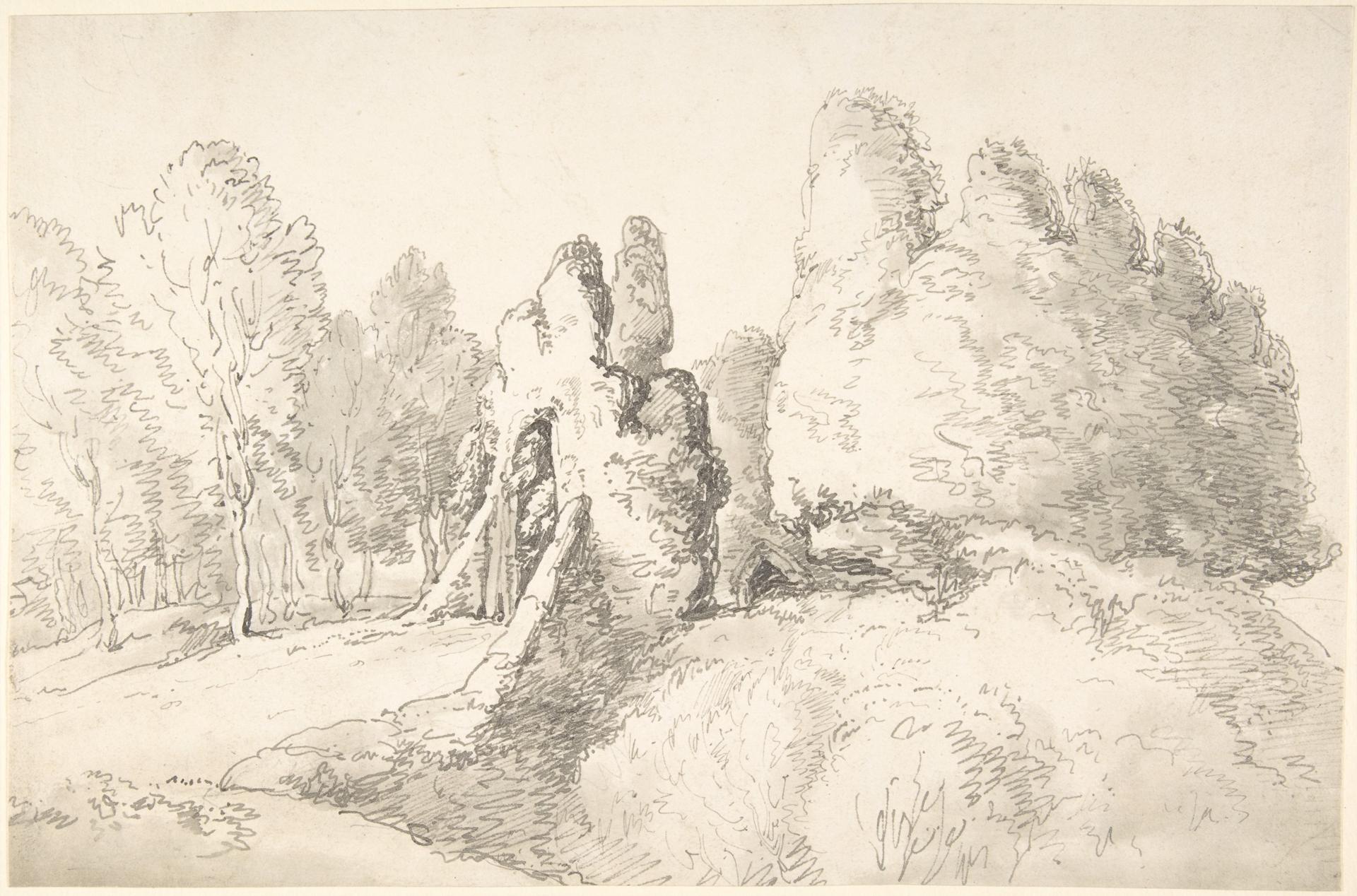
Unlike many of Rowlandson's other landscape drawings, which often seek open vistas, this sheet from 1780 to 1827 draws the eye to a tight, rock- and foliage-filled section. The work is executed in pen and gray ink, with brush and wash added; it shows a wooded area with boulders in the foreground that have already collapsed in on themselves.
Description
A splintered rock occupies the foreground, partly surrounded by trees and bushes, and partly overgrown by plants. Further back, more trees and shrubs are staggered, creating the impression of a dense forest. The layout runs across the format, with the rock as the resting center and the trees extending to either side. Color comes into play only as gradations of gray; brightness and depth arise from the density of strokes and the various shades.
Context
Thomas Rowlandson (1757–1827) is known today mainly for his satirical caricatures, yet he also drew landscapes and topographical views. This sheet falls in a period when he traveled extensively through England, making sketches on the way. Ruined structures and rock formations in nature were highly popular in British art of the late eighteenth and early nineteenth centuries, inspired by Romanticism and the concept of the sublime.
Impact
The sheet conveys a quiet, nature-oriented mood, supported by the restrained gray nuances and the soft wash. The crumbling rock and the dense forest evoke a melancholic tendency characteristic of the Romantic view of landscape.
Technique
For the clear outlines and details, Rowlandson used pen with gray ink; brush and wash were added for the broader shadow tones. The interplay of drawn lines and washes creates a graded light. The paper measures 19.4 x 29.5 cm, a format common for sketches made in nature.
AI-generated description text
Source: Metropolitan Museum of Art · Public Domain (CC0 1.0)