Study of Trees
Original title: Study of trees
kurzbeschreibung
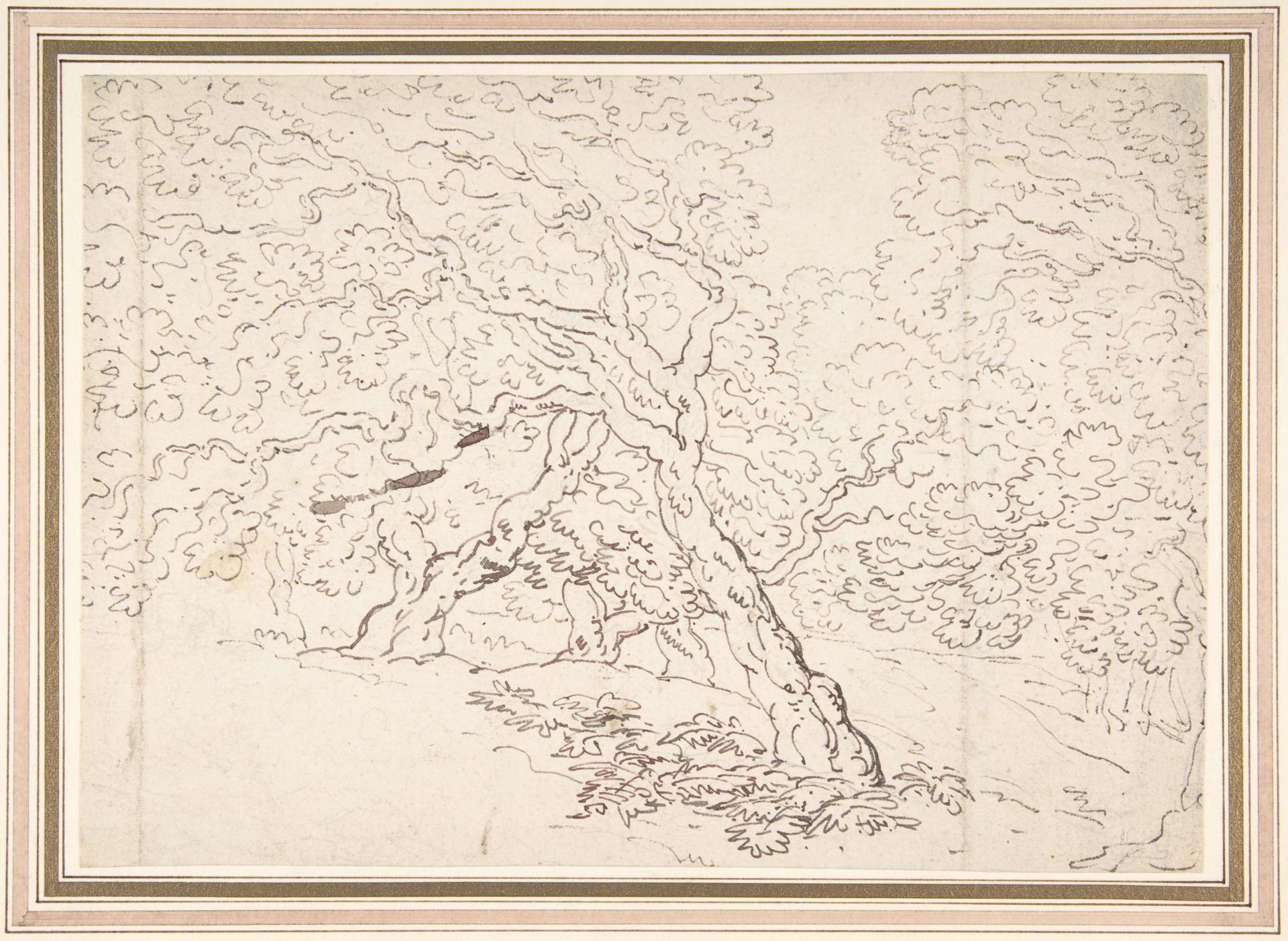
Thomas Rowlandson's Baumstudie, made between 1780 and 1827, captures trees in their natural setting with keen attention to detail. Drawn in pen and brown ink, the sheet focuses on a prominent tree in the foreground whose crown is vigorous and twisted, its trunk leaning. Behind it, further trees and shrubs appear, less finished, suggesting a dense woodland.
Description
A single tree dominates the foreground, its branches and leaves sketched in detail, the crown strong and sinuous, the trunk heavily inclined downward. Behind it, other trees and bushes are indicated with fewer strokes, hinting at a thick forest. Brown tones govern the monochrome image, and the lines for branches and foliage flow with a dynamic quality. No figures or human activity appear at all; the paper has a slight texture, and a border surrounds the sheet, giving it the look of an old document.
Context
Thomas Rowlandson (1757–1827) was an English artist best known for his satirical caricatures. Nature studies were a standard part of artistic training in his day, and this tree study likely arose from that practice. Rowlandson produced numerous landscape drawings, often serving as preparatory material for his prints. The exact purpose of this sheet is undocumented; it may have been an exercise or a store of motifs for later compositions.
Impact
Loosely placed, dynamic lines give the sheet an immediate, spontaneous feel. Because the drawing is reduced to brown tones and executed in a sketchy manner, a calm, concentrated atmosphere emerges, drawing the eye to the structure of the trees. Without staffage, pure observation of nature comes to the fore, lending the sheet a timeless quality.
Technique
Pen and brown ink on paper form the basis; the linework remains fluid and varied. Hatching and lines create a lively texture that suggests bark and foliage. The monochrome palette and the slight paper texture are typical of drawings from this period.
AI-generated description text
Source: Metropolitan Museum of Art · Public Domain (CC0 1.0)