Dancer with Tambourine
Original title: Dancer with Tambourine
kurzbeschreibung
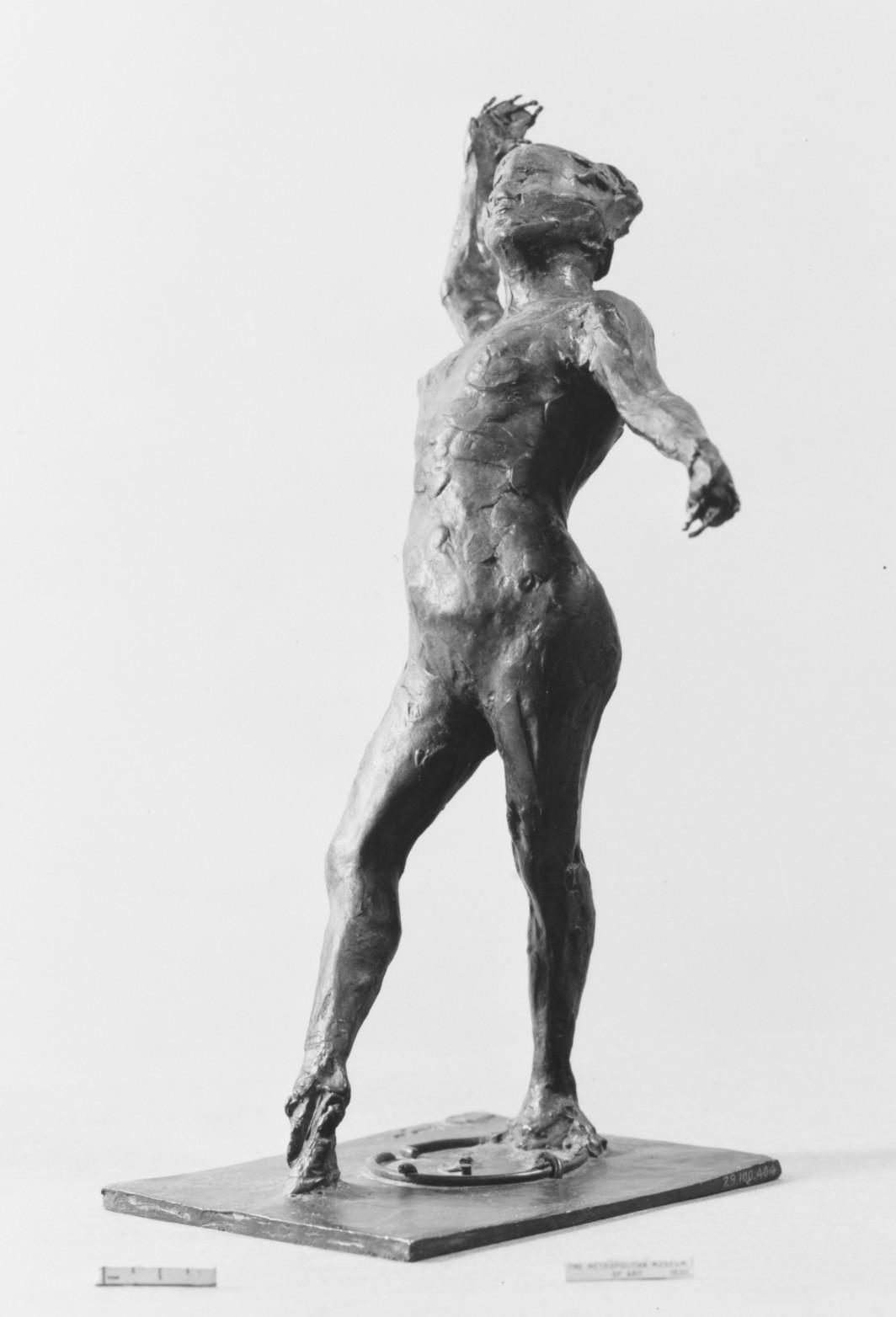
Unlike many of Edgar Degas's dance pieces, this bronze figure does not emphasize a graceful pose but instead captures a moment of energetic turning. Modeled around 1885 and cast in 1920, the work is titled "Dancer with Tambourine" and belongs to the sculptures in which Degas engaged with ballet.
Description
The dancer's body appears strong and well-trained. Her head is thrown back, arms raised high, expressing both tension and lightness. Her legs are in a jumping position, conveying vitality. A square base supports the figure, while the background remains bare. The surface is consistently bronze-colored, with light distributed evenly.
Context
This model was created during a phase when Degas was deeply involved with ballet and dancers. However, the bronze cast was made only in 1920, after the artist's death, even though the form existed as early as 1885. Degas often used wax and clay to capture movement studies, which were later transferred to bronze.
Impact
The raised arms and dynamic posture evoke a sense of grace and kinetic energy. Through the bronze surface and balanced structure, the figure appears calm yet alive.
Technique
Bronze was chosen for the execution, a material valued for its durability and detail accuracy. The sculptural modeling precisely renders the human body, with fine nuances in musculature and posture.
AI-generated description text
Source: Metropolitan Museum of Art · Public Domain (CC0 1.0)