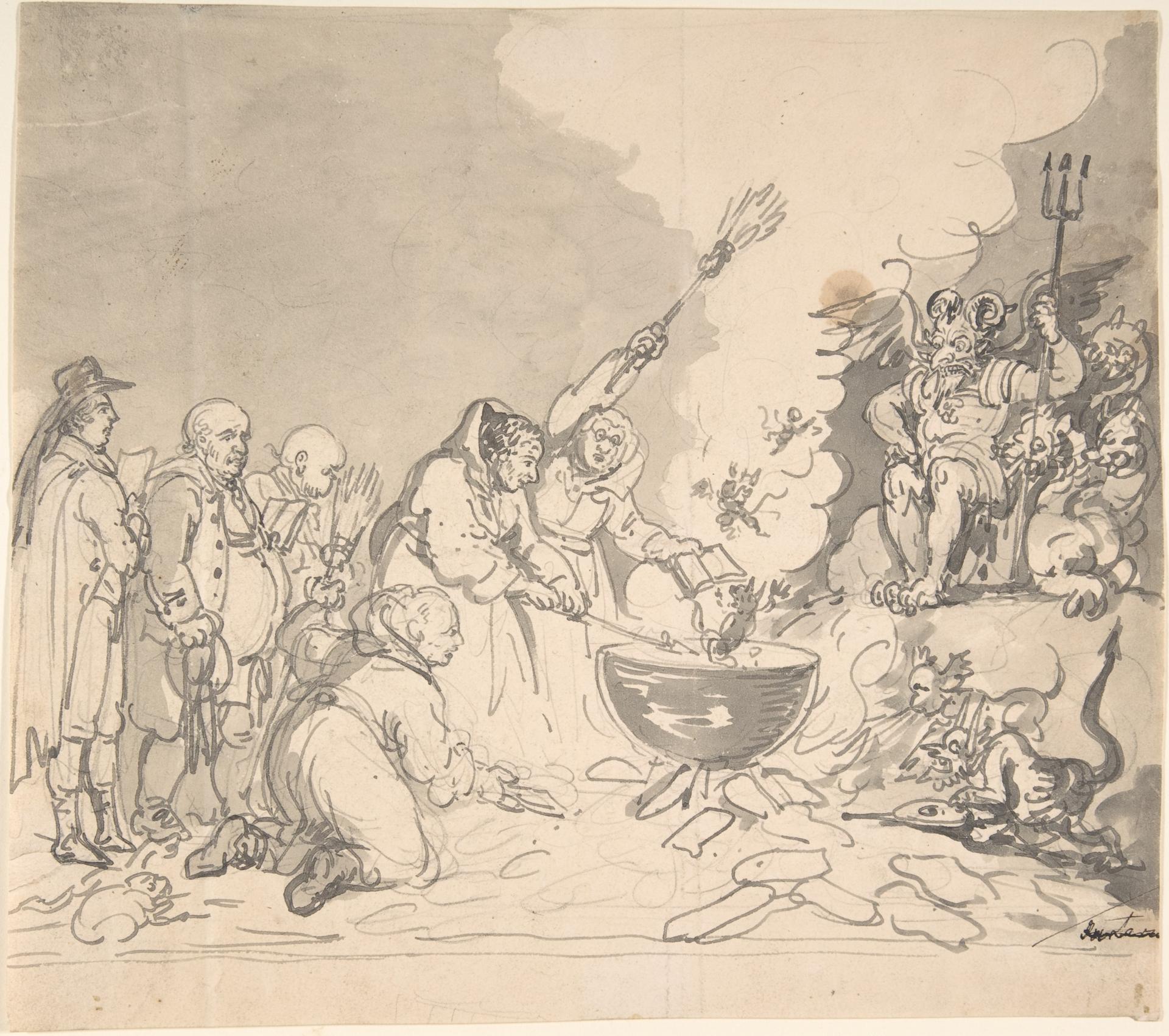
Study for "A charm for democracy, reviewed, analyzed, and destroyed January 1, 1799" (recto and verso)
Original title: Study for "A charm for democracy, reviewed, analyzed, and destroyed January 1, 1799" (recto and verso)
kurzbeschreibung
Drawn in 1799, Rowlandson's sheet gathers a restless group around a smoking cauldron, with demonic beings lurking nearby. Executed in pen and gray ink, brush and gray wash over graphite, it serves as a study for a satirical composition.
Description
A crowd presses around a large cauldron with smoke rising from it. Some figures hold rods or implements, while others watch the pot intently. At the back, a figure sits enthroned, surrounded by demonic creatures. The drawing is rich in detail, with varied clothing and facial expressions. The style is sketchy and expressive, the figures arranged dynamically with an emphasis on movement. Gray tones come from brushstrokes and shading, the light even without visible shadows.
Context
The study was made in 1799, a year after the Coalition Wars and during the political debates surrounding the French Revolution. The title hints at the destruction of a symbol of democracy, which can be read as a critical reaction to radical political ideas. Rowlandson was known for his satirical caricatures, often directed against political and social ills. The drawing probably served as preparatory work for a print, though no such print has been traced.
Impact
The dense group of figures and demonic beings create a threatening, chaotic atmosphere. The expressive sketchiness intensifies the impression of unrest and political critique. The viewer is drawn into a scene full of tension and symbolic meaning.
Technique
The recto combines pen and gray ink with brush and gray wash over graphite, uniting fine line work with soft, broad shading. The verso consists of a graphite drawing that serves as a preparatory study. The paper size of 22.5 x 25.7 cm is compact for a study and allows quick, spontaneous sketches.
AI-generated description text
Source: Metropolitan Museum of Art · Public Domain (CC0 1.0)