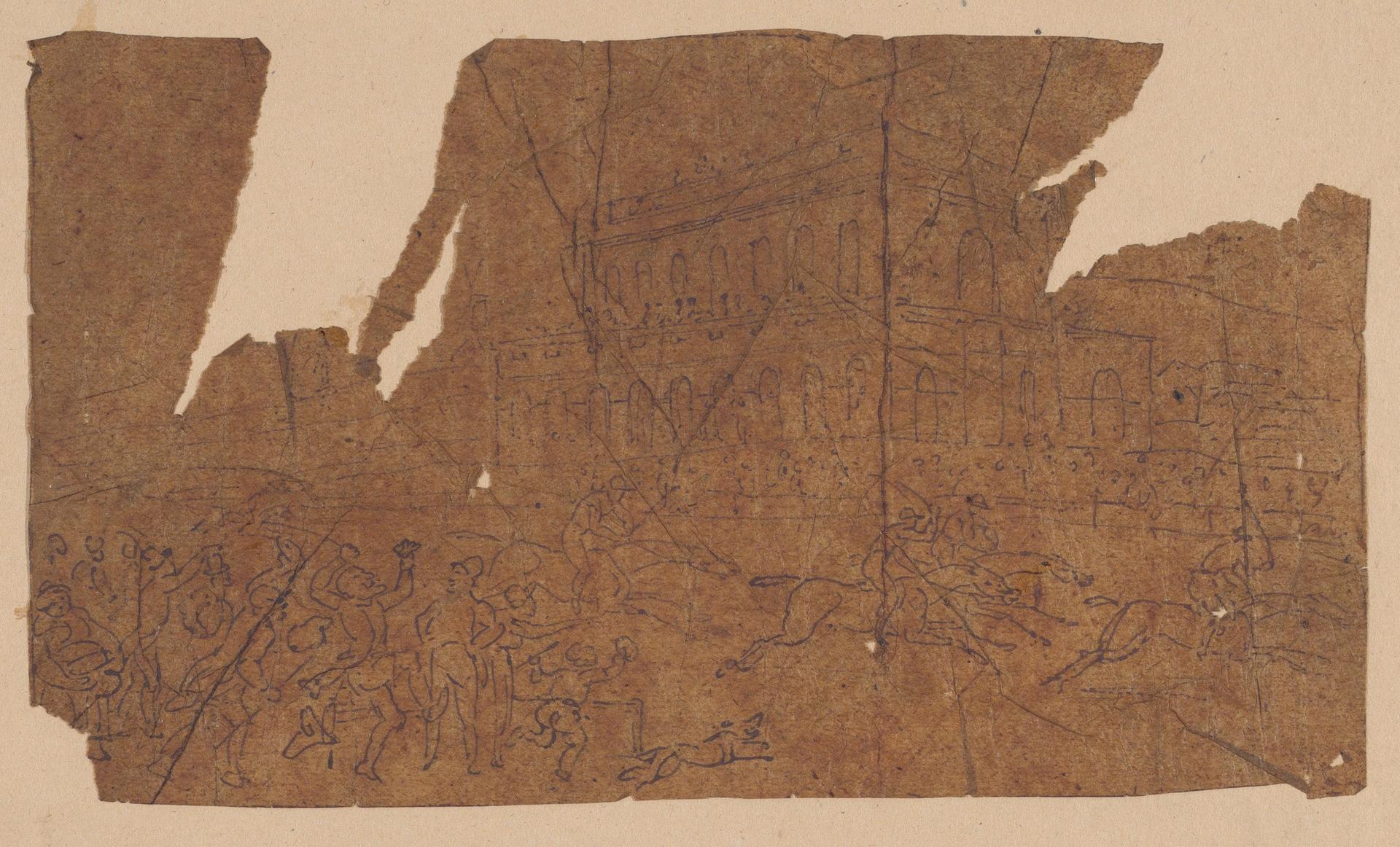
Tracing of scene from Dr. Syntax (ca. 1819)
Original title: Tracing of scene from Dr. Syntax
kurzbeschreibung
On a fragment of dark brown, semi-transparent tracing paper, Thomas Rowlandson set down a sketchy scene around 1819: several figures in the foreground and a tall, multi-storey building behind them. The drawing is in black pencil, and the sheet measures 11 × 19 cm.
Description
Up front, a cluster of people — some caught mid-movement, others plainly talking or otherwise engaged with one another. Rising behind them is a large architectural structure of several storeys that calls to mind an ancient temple or palace. Everything stays simple and loose, the way a draft usually does. The paper looks slightly worn, with creases and tears, and the palette goes no further than the dark brown of the sheet and the black of the pencil.
Context
Thomas Rowlandson was an English artist and caricaturist known for his satirical takes on social life. He made this work around 1819, while he was busy with book illustrations. Dr. Syntax is a literary figure from the popular verse tales by William Combe, which Rowlandson illustrated. The tracing may have served as a preparatory study for a print, a common step in the way he worked.
Impact
The dark, translucent paper lends the drawing an intimate, almost secretive mood. Sketchy linework gives it a spontaneous, lively quality that draws the viewer into the scene. With colour reduced to brown and black, the drawn gesture and the layout of the image come to the fore.
Technique
Black pencil works across a fragment of dark brown, faintly translucent tracing paper. Tracing was used to transfer an original or to work out a composition. Signs of wear and tears in the paper suggest it was handled or stored for some time.
AI-generated description text
Source: Metropolitan Museum of Art · Public Domain (CC0 1.0)