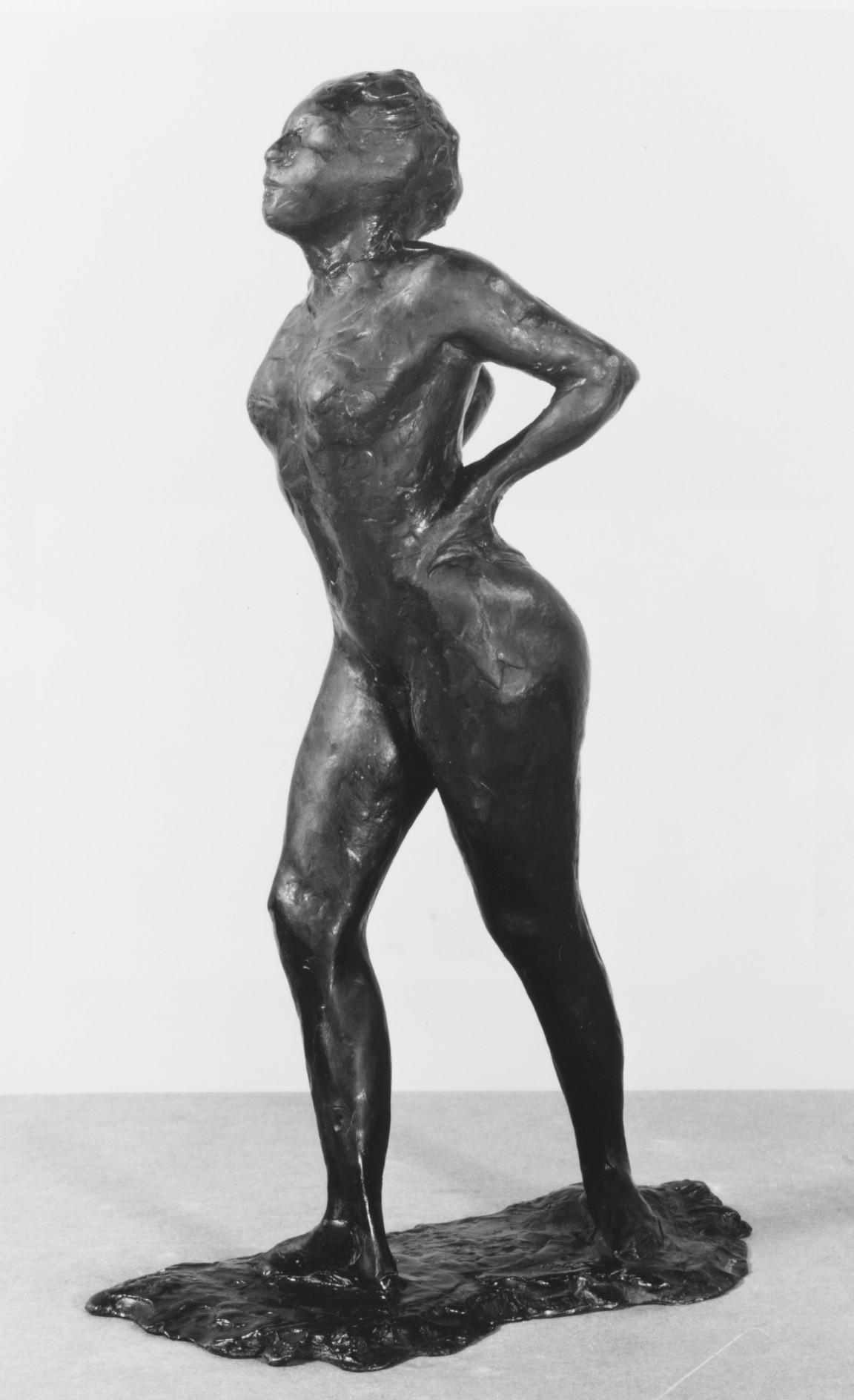
Dancer at Rest, Hands Behind Her Back, Right Leg Forward
Original title: Dancer at Rest, Hands Behind Her Back, Right Leg Forward
kurzbeschreibung
This bronze statue, 'Dancer at Rest, Hands Behind Her Back, Right Leg Forward,' is by Edgar Degas. Modeled possibly around 1895 and cast in bronze in 1920, it depicts a nude female figure standing upright with her arms crossed behind her back and her right leg slightly advanced.
Description
A nude woman stands, her arms clasped behind her back, right leg placed a little forward, left leg straight. Her head tilts back, creating a calm, pensive pose. The figure appears slender and muscular, with a clear physical presence. She rests on a flat, irregular base that suggests a natural form. The bronze looks dark, with glossy areas on the surface.
Context
Degas was deeply engaged with dancers at the time, and they appear in many of his other works. The bronze cast was made only in 1920, after his death in 1917, reflecting the late recognition of his sculptural work. Degas often worked in wax and clay before bronzes were made. This sculpture shows his interest in movement and stillness.
Impact
The tilted-back head and relaxed arm position evoke a quiet, thoughtful mood. The slender, muscular body emphasizes the figure's physical presence. The result is an elegant yet powerful aura.
Technique
Bronze, dark with a glossy surface variation, defines the appearance. The surface shows a natural texture that points to the lost-wax casting process: a wax model is lost and replaced by bronze.
AI-generated description text
Source: Metropolitan Museum of Art · Public Domain (CC0 1.0)