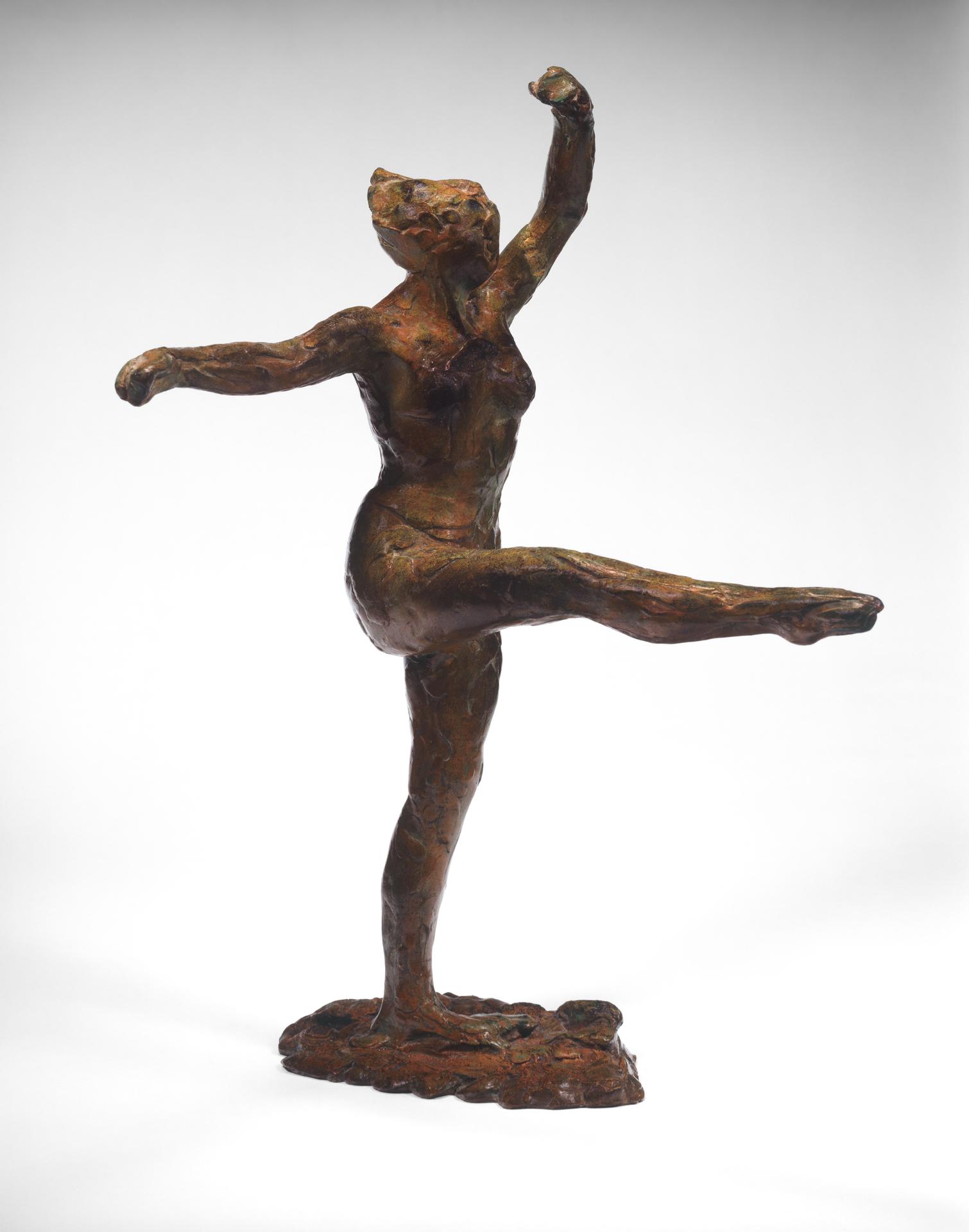
Arabesque Devant (modeled probably ca. 1883–88, cast 1920)
Original title: Arabesque Devant
kurzbeschreibung
Balanced on one leg with the other kicked high behind and arms flung wide, Edgar Degas's bronze 'Arabesque over the Right Leg' captures a dancer mid-strain. The wax model was likely made between 1883 and 1888; the bronze was cast in 1920.
Description
The right leg plants firmly on a shallow, uneven base while the left sweeps up and back. Arms stretch far apart: the left points upward, the right angles downward. A coppery sheen plays over the surface, whose lively texture makes movement and muscle tension stand out. A plain, neutral backdrop lets the figure emerge clearly.
Context
During the 1880s Degas focused intensely on the human body in motion, especially ballet dancers. The wax original of the 'Arabesque' dates from this period, but only in 1920, after the artist's death, was it cast in bronze. He was drawn to the fleeting moment, which he tried to capture through various materials and techniques.
Impact
The figure seems ready to shift pose the very next instant—so immediate is the dynamism, so light the appearance. The rough, uneven surface gives the work an expressive, almost impressionistic note that stresses the transient moment of movement.
Technique
The sculpture was cast using the lost-wax method. Degas shaped the original in wax, which was later transferred to bronze. The irregular surface bears witness to modeling with fingers and tools and brings out the musculature.
AI-generated description text
Source: Metropolitan Museum of Art · Public Domain (CC0 1.0)