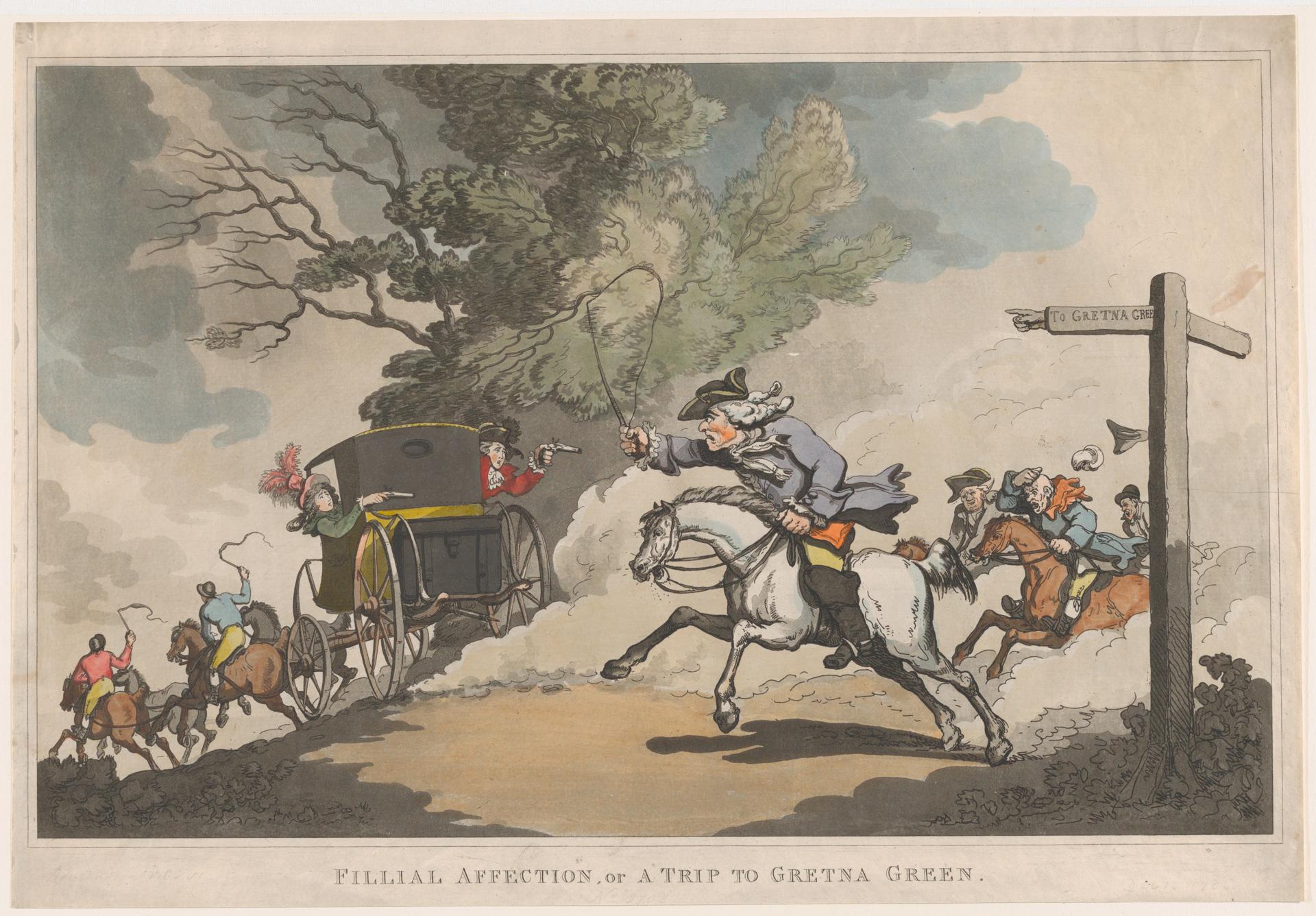
Filial Affection, or a Trip to Gretna Green
Original title: Filial Affection, or a Trip to Gretna Green
kurzbeschreibung
Instead of focusing solely on the wedding couple, as most marriage caricatures of the period did, Thomas Rowlandson's hand-colored etching with aquatint from 1785 centers on the wild pursuit that precedes the ceremony: riders, a carriage, and pursuers race toward Gretna Green, the notorious destination for clandestine weddings at the time.
Description
In the foreground a white horse rears, its rider working the whip against his own forward motion; attached to his carriage is a trailer in which a woman with a red feather in her hair and a pistol in her fist crouches. Behind this group more riders press forward, everything in motion. A signpost reading 'To Gretna Green' anchors the scene. The layout thrives on the diagonal tilt of the figures and the vanishing line to the right; muted tones dominate the sheet, with only the red feather and a few uniforms standing out.
Context
In Scotland couples could then marry without parental consent, which made Gretna Green a refuge for brides and grooms from England. Rowlandson lampoons this practice and the excitement it stirred. Satirical prints enjoyed great popularity in 1780s England, and this sheet belongs to a series of publications he issued in those years.
Impact
The speed and pent-up violence of the chase are immediately communicated to the viewer. Exaggeration and precise observation of social maneuvering blend into each other, making the print an amusing sideswipe at the morality of its time. The red feather and colorful uniforms provide accents against the restrained coloring.
Technique
The work was executed in etching with aquatint, followed by hand coloring. Aquatint provides soft tonal gradations and shading, while the hand coloring highlights individual areas. Lines and tonal areas together give the image a painterly character.
AI-generated description text
Source: Metropolitan Museum of Art · Public Domain (CC0 1.0)