Going to Ivy Bridge
Original title: Going to Ivy Bridge
kurzbeschreibung
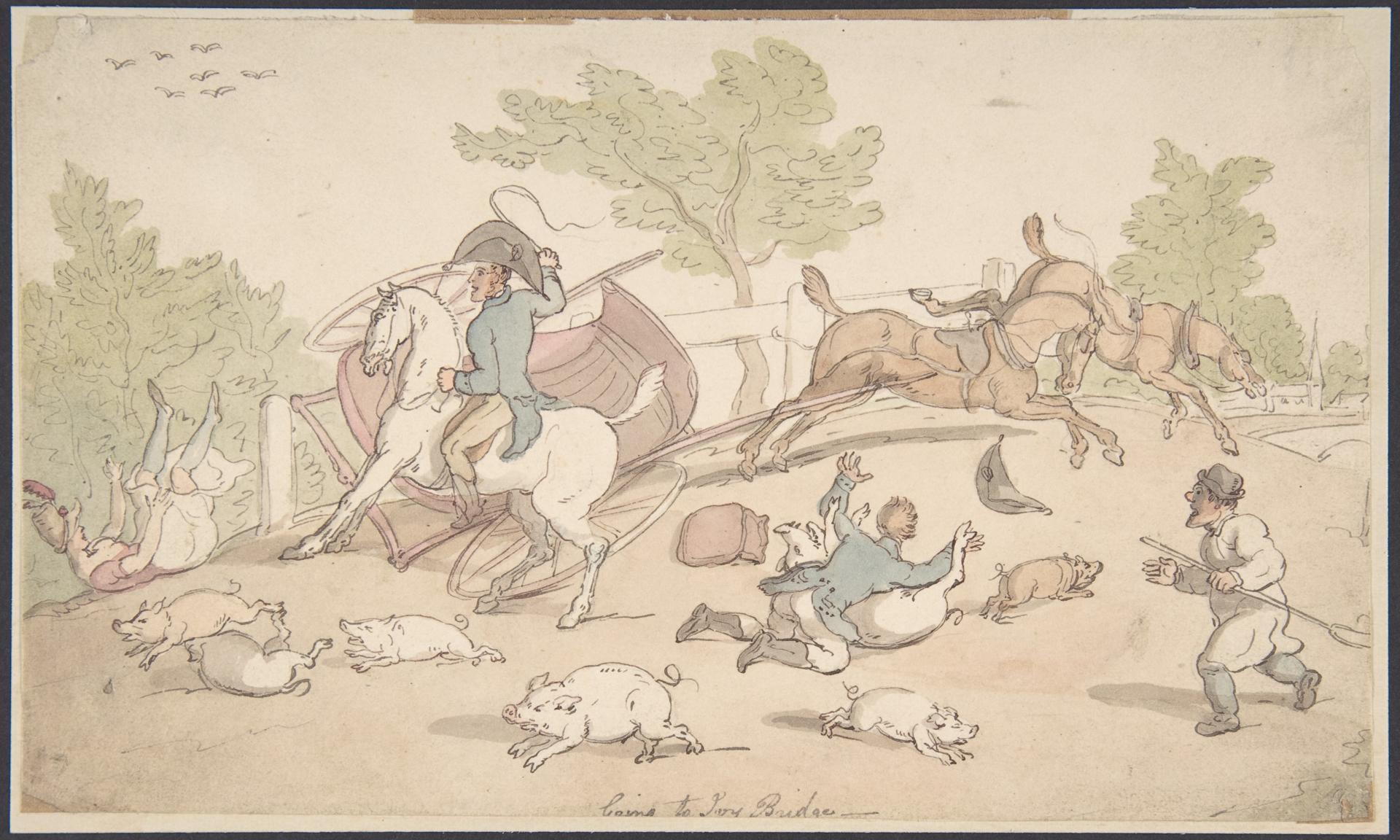
Where many pictures of the period dwell on rural calm, this watercolour by Thomas Rowlandson, made between 1780 and 1827, goes for restless motion instead. A rider on a white horse hauling a cart is part of the turmoil, and so are the people and pigs scattering beneath the vehicle. A man in pale clothing, whip in hand, hurries along behind. Rowlandson stays true here to his fondness for lively, comic scenes of English country life.
Description
At the front a white horse strains against a cart, on which a rider sits with his whip raised. Underneath the cart people and pigs bolt in every direction, which gives the picture its sense of stir and movement. Another man in light-coloured dress, also carrying a whip, runs along behind the cart. Trees and a fence suggest the rural setting. Pastel tones dominate the colouring, and the light falls evenly, with no strong shadows or highlights.
Context
Rowlandson made this sheet at a stage of his career when he was known for satirical and cheerful scenes of English everyday life. The commission probably came from a wealthy collector who took pleasure in country amusements. Watercolour was increasingly prized in England in the late eighteenth century, and Rowlandson used it often. The exact circumstances of its making are not recorded; the work belongs to a larger group of drawings that shows how versatile he was.
Impact
The fleeing figures and the movement of the horse give the impression of a moment caught on the spot, almost like the record of an unforeseen mishap. The pastel colours lend the image something cheerful, almost idyllic, which strengthens its humorous tone. The disorder and jumble of figures invite a smile.
Technique
Executed in watercolour on paper, a medium that allows quick, spontaneous sketching. With fine brushstrokes and glazed layers of colour Rowlandson worked out the details of the figures and the landscape. The even distribution of light and the pastel tones are typical of his watercolour technique, which often went together with light ink lines to emphasise the contours.
AI-generated description text
Source: Metropolitan Museum of Art · Public Domain (CC0 1.0)