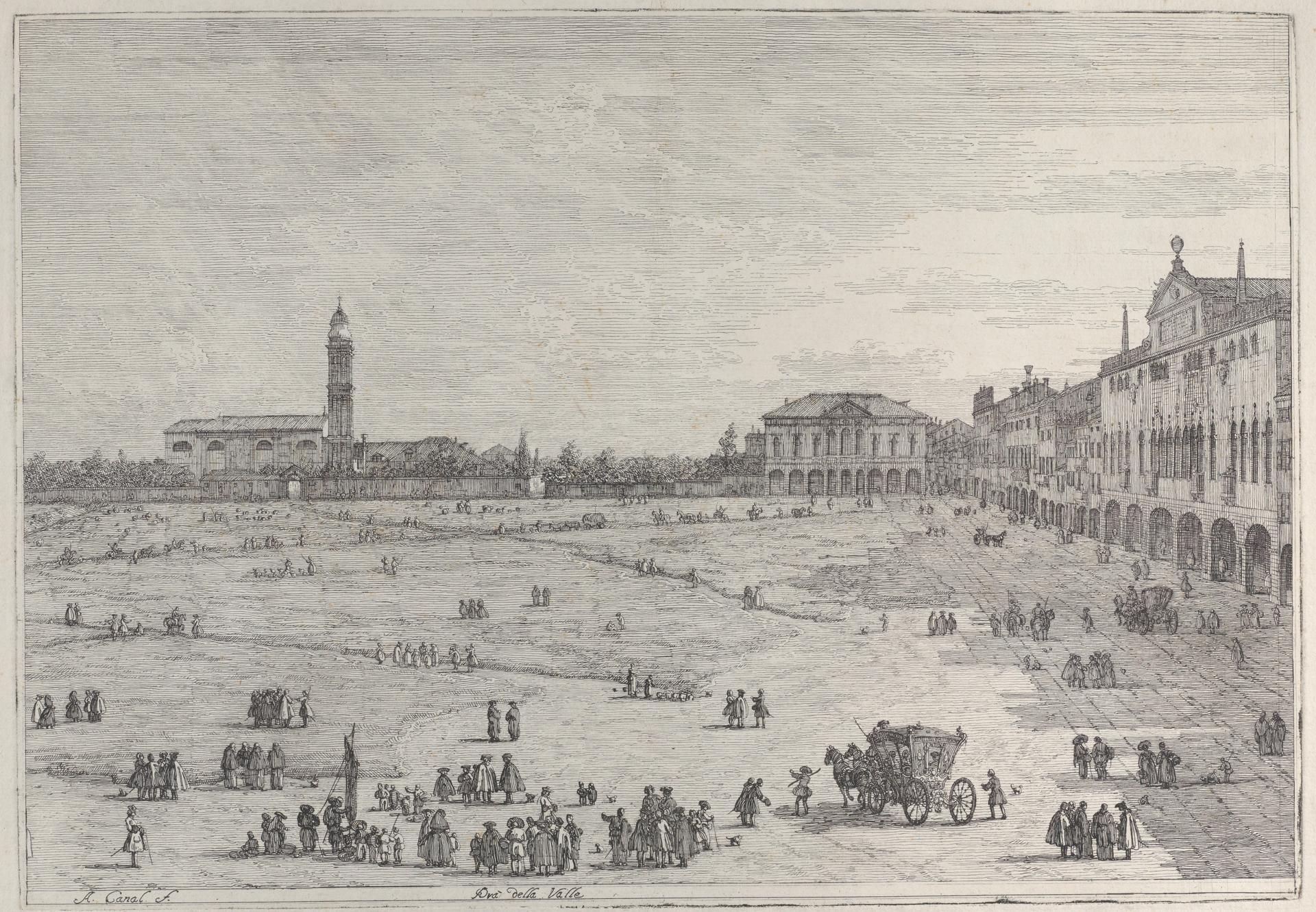
Prà della Valle: the right half of the square of Prà della Valle in Padua, with the Colleggio Universitario at right
Original title: Prà della Valle: the right half of the square of Prà della Valle in Padua, with the Colleggio Universitario at right
kurzbeschreibung
Canaletto (Giovanni Antonio Canal) made this etching between 1735 and 1746. It records the right-hand half of the Prà della Valle in Padua, with the Collegio Universitario standing at the right edge of the image. Groups of people, wagons and an arcaded square fill the view.
Description
A broad open square spreads out, crowded with figures who stand talking in clusters or gather around wagons and carts. On the right the Collegio Universitario rises, with several arcades and a distinctive roof. A church with a tall tower overtops the surrounding buildings in the distance. Fine hatching shapes the architecture and the figures with precision; the black-and-white print sits in even, diffuse light without hard shadows, suggesting a bright time of day.
Context
Canaletto, better known in Venice as a painter of city views, probably etched this plate after a drawing made during a stay in Padua. The Collegio Universitario, today the Palazzo del Bo, housed the University of Padua and points to the civic weight of the site. The print belongs to a series of Italian town views that Canaletto produced for the art market.
Impact
Clear and full of detail, the print gives back both architecture and city life. Its delicate linework lends the view a quiet, almost idyllic mood and carries the viewer into historic Padua. Even lighting and precise perspective give it the sober, topographic air of a record rather than a showpiece.
Technique
The plate was bitten with acid to create the lines of this etching. Canaletto worked with fine needle strokes and hatching to draw out light and shade. The plate measures 29.8 × 42.8 cm; impressions were pulled on paper of 39.6 × 55 cm. The present sheet is the first state of two known.
AI-generated description text
Source: Metropolitan Museum of Art · Public Domain (CC0 1.0)