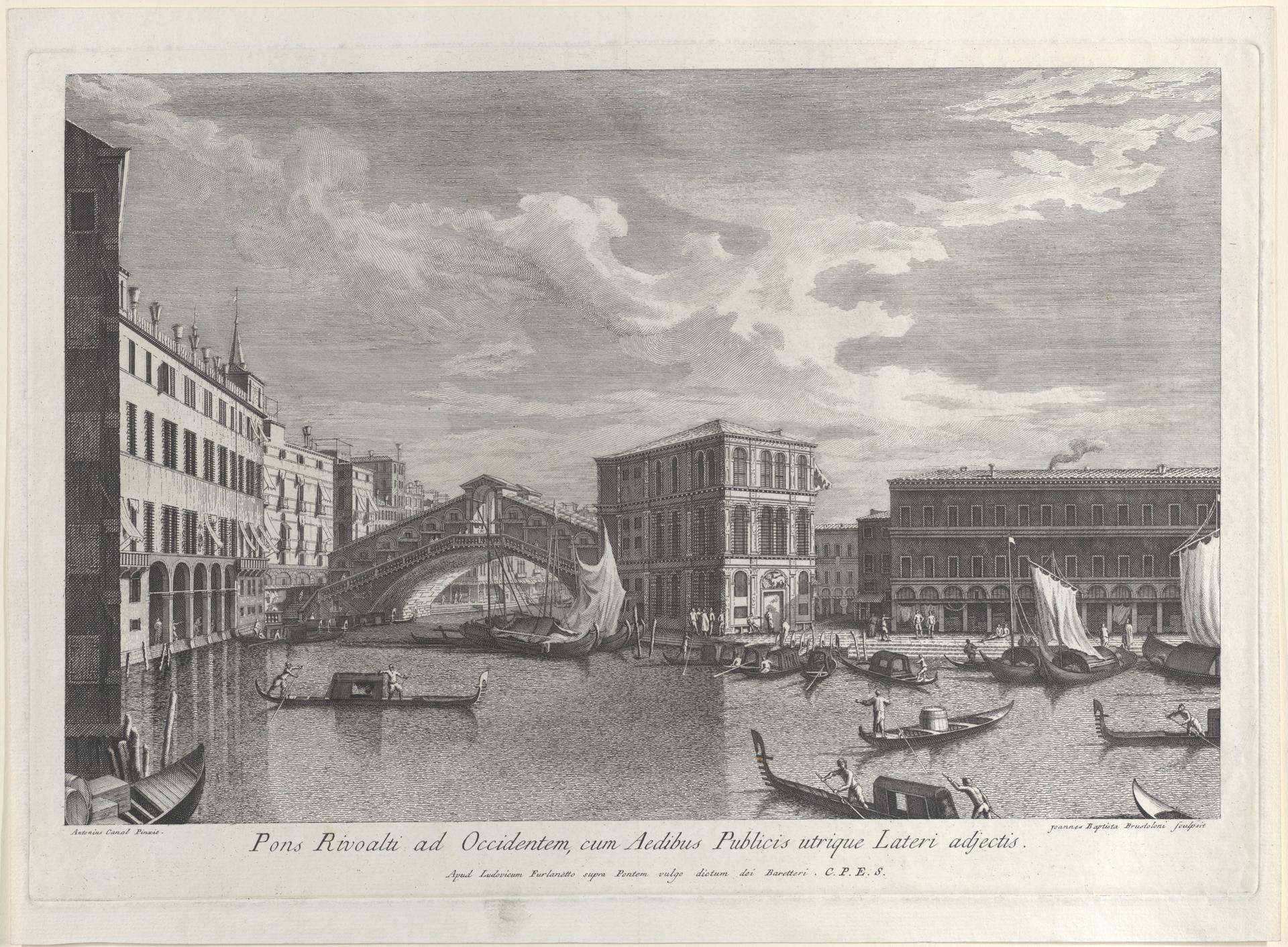
The Rialto Bridge, Venice, with boats and gondolas in the water
Original title: The Rialto Bridge, Venice, with boats and gondolas in the water
kurzbeschreibung
In this 1763 etching, Giovanni Battista Brustolon captures the Rialto Bridge in Venice, with boats and gondolas animating the water in the foreground. The subject belongs to the Venetian veduta, a popular genre in the eighteenth century.
Description
The layout feels balanced: the Rialto Bridge forms the focal point, while buildings on either side close off the view toward the horizon. Several boats and gondolas are scattered across the water in the foreground; the figures seated in them are small and detailed, though no single person stands out clearly. A cloudy sky produces subdued light and soft shadows. Gray tones run through the entire surface, in keeping with the etching technique.
Context
Brustolon, a Venetian engraver, translated views of Venice after designs by Canaletto into prints around the mid-eighteenth century. At the time, the Rialto Bridge served as an important hub for trade and traffic. This print was made in an era when Venetian vedute were in high demand among Grand Tour travelers. It belongs to a series that made famous city views available to the art market.
Impact
The viewer is first drawn in by the calm expanse of water and the balanced arrangement, which lend the view an almost static serenity. Subdued light and delicate lines create an atmospheric density that gives the sense of immersing oneself in the lagoon city. The precise rendering of the architecture and the lively boats feel at once documentary and picturesque.
Technique
For this etching, the drawing was incised into a copper plate and then bitten with acid. Fine lines and hatching produce graduated gray values that model light and shadow. The impression was pulled on paper and shows the monochrome typical of intaglio printing.
AI-generated description text
Source: Metropolitan Museum of Art · Public Domain (CC0 1.0)