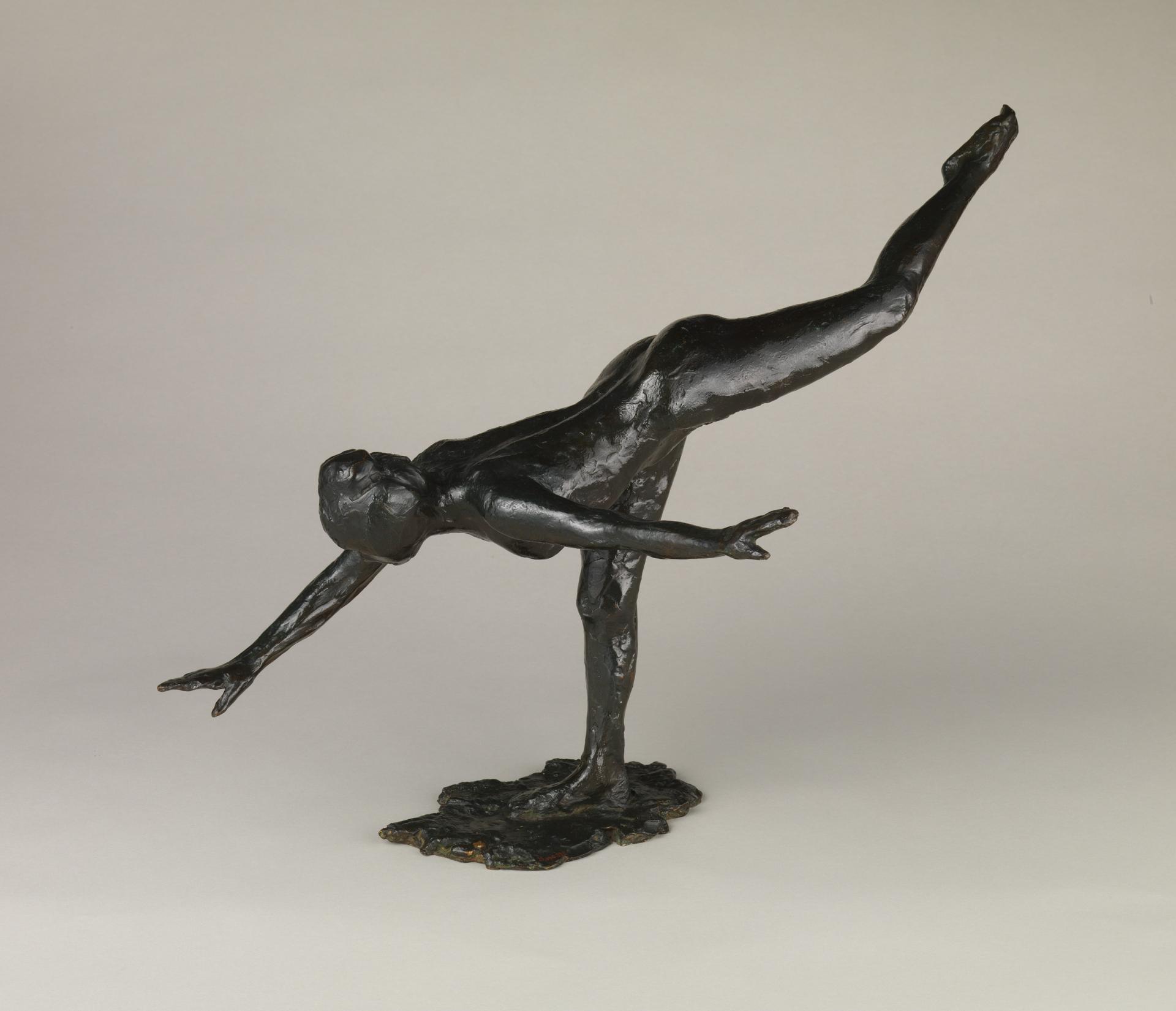
First Arabesque Penchée (modeled probably ca. 1892–96, cast 1920)
Original title: First Arabesque Penchée
kurzbeschreibung
Edgar Degas's bronze sculpture 'Erste Arabeske Penchée' was modeled in wax around 1892–96 and cast in 1920. It shows a nude dancer in an acrobatic pose and belongs to the series of dancer bronzes in which the artist captures a fleeting moment of movement and balance.
Description
A nude figure appears in a lively dance pose: one leg is lifted high and tilted slightly back, the other extended forward. The arms are open, emphasizing the body's dynamism. The figure stands on an uneven, flat base. Even light falls on the statue without casting shadows, suggesting a neutral environment. The surface is a uniform bronze-gray, with patina slightly worn and aged.
Context
Degas modeled the figure in wax, probably in the 1890s, when he was deeply engaged with dance. The bronze casts were made only after his death in 1917 by the founder Adrien-Aurélien Hébrard, beginning in 1919. The 'Arabesque Penchée' is one of numerous studies reflecting Degas's interest in human movement and the aesthetics of ballet. It belongs to a series of about 74 surviving wax models that were posthumously cast in bronze.
Impact
The sculpture feels highly alive through its balanced yet unstable pose. The combination of realistic body rendering and frozen movement creates a tension that holds the viewer's attention. The patina gives the work a timeless, historical aura.
Technique
The bronze cast was made using the lost-wax method, with the original model in wax. The surface shows clear traces of modeling that preserve the artist's touch. The irregular base is part of the cast and emphasizes the sketch-like character of the figure.
AI-generated description text
Source: Metropolitan Museum of Art · Public Domain (CC0 1.0)