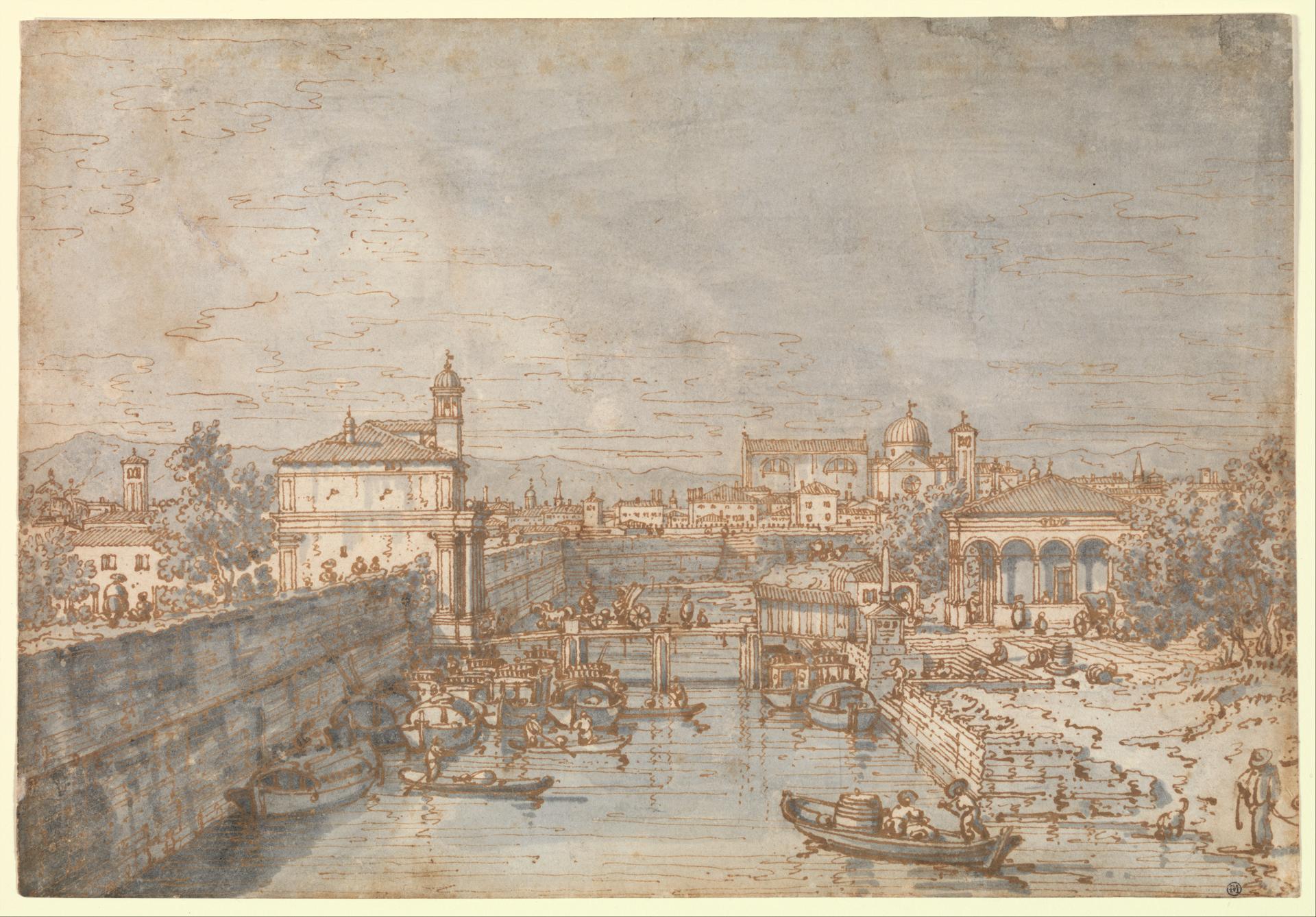
Padua: The River Bacchiglione and the Porta Portello
Original title: Padua: The River Bacchiglione and the Porta Portello
kurzbeschreibung
Unlike so many eighteenth-century vedute that keep their focus on the piazzas and canals of Venice, this sheet by Canaletto (Giovanni Antonio Canal) turns toward a less familiar prospect in Padua: the river Bacchiglione with the Porta Portello. Drawn around 1750–60 in pen and brown ink with gray wash on paper, it measures 18.5 x 26.5 cm.
Description
The Bacchiglione runs across the foreground, where several boats lie moored. A bridge carried on columns spans the water at the left bank. On the right stands an arcaded building, with figures visible in front of it. Domes and towers rise beyond, shaping the city's silhouette. Light clouds hang in the sky, and the muted grays come from ink and gray wash.
Context
Canaletto made this view of Padua in his later years, after returning from England around 1755, when he devoted himself increasingly to vedute drawings of northern Italian cities. The Porta Portello, a sixteenth-century city gate, was an important entry into the city by way of the Bacchiglione, a river that mattered for trade and traffic with Venice. The sheet belongs to a series of views made for collectors and Grand Tour travelers.
Impact
Calm and clarity govern the layout, which brings the river and bridge forward and settles the city architecture behind them. Even light and subdued grays deepen the atmosphere and draw the eye into the scene. Precise linework and delicate wash give the sheet an almost photographic presence, characteristic of Canaletto's late work.
Technique
For contours and details Canaletto used pen and brown ink, adding gray wash to model tonal values and shadow. Linear drawing and washed areas allowed a quick yet exact grasp of architecture and water. The paper size of roughly 18.5 x 26.5 cm suggests a study or draft that could later serve as a model for paintings or etchings.
AI-generated description text
Source: Metropolitan Museum of Art · Public Domain (CC0 1.0)