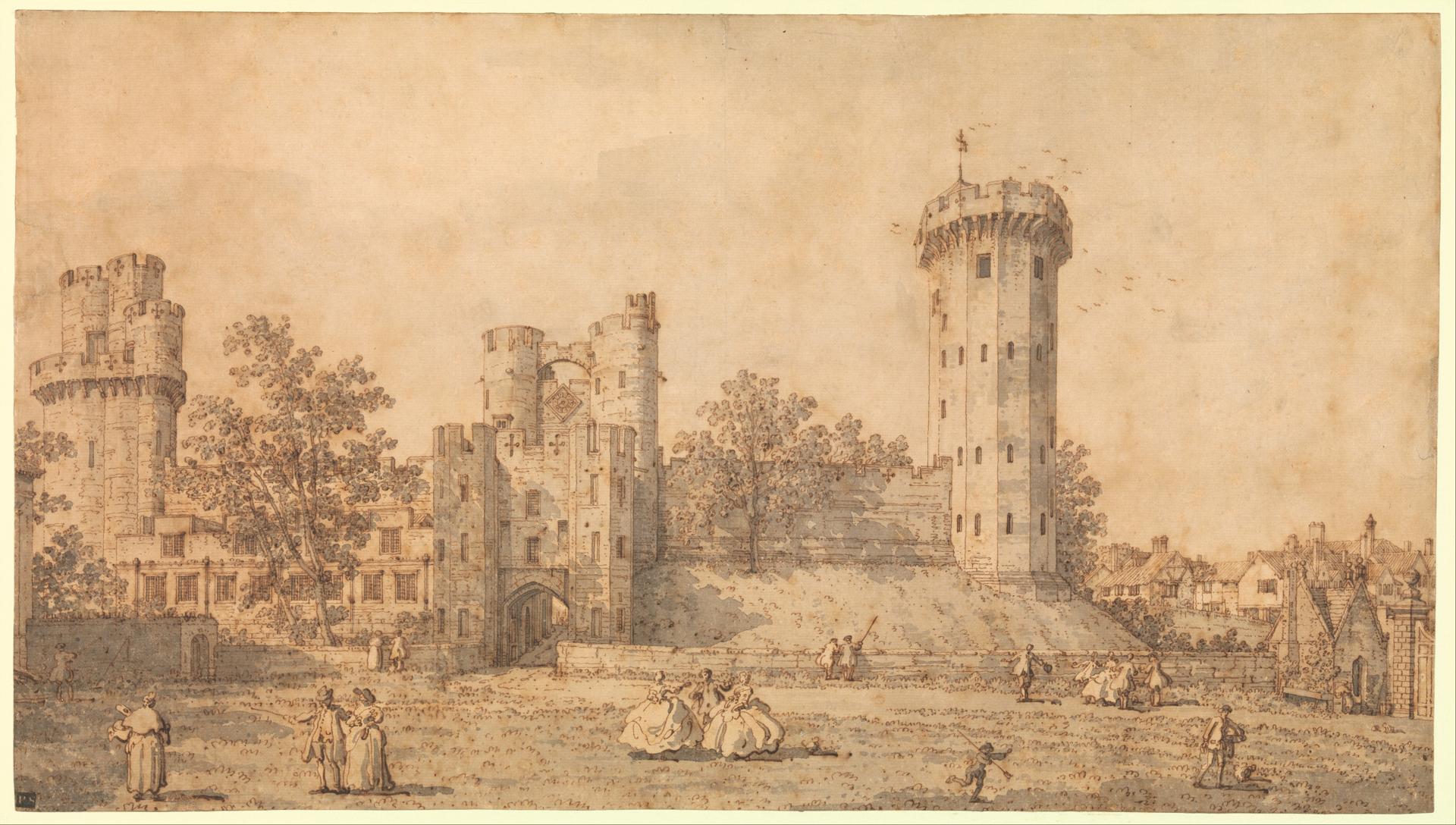
Warwick Castle: The East Front
Original title: Warwick Castle: The East Front
kurzbeschreibung
Pen and brown ink with grey wash: this is the means Canaletto (Giovanni Antonio Canal) used in 1752 to record Warwick Castle in England. A cluster of figures in period dress stands in the foreground, and behind them the carefully drawn architecture of the castle spreads out.
Description
The east front of Warwick Castle fills the sheet, its towers and walls dominating the arrangement and set out in an almost mirror-like symmetry. In front, a good number of people have gathered in eighteenth-century clothing. Trees and open ground suggest the surroundings; the light stays soft and undefined, which gives the sheet a quiet mood. Grey tones govern the view and strengthen its historical feel.
Context
The drawing was made in 1752, in the middle of Canaletto's years in England, 1746 to 1755. Warwick Castle was among the most sought-after subjects for artists, since it counted as one of the country's grandest medieval castles. The sheet probably served either as a preparatory study for a painting or as a standalone collector's piece for the English nobility.
Impact
From the precise rendering of the architecture and the soft, diffused light grows a dense atmosphere. The symmetrical layout and the carefully executed details give the sheet a dignified, almost monumental character and make the historical weight of the place palpable.
Technique
Canaletto worked with pen and brown ink, supplemented by a grey wash. The diluted ink allowed him soft transitions and gradations that bring out the spatial depth of the landscape. His precise pen strokes show a sure command of draughtsmanship.
AI-generated description text
Source: Metropolitan Museum of Art · Public Domain (CC0 1.0)