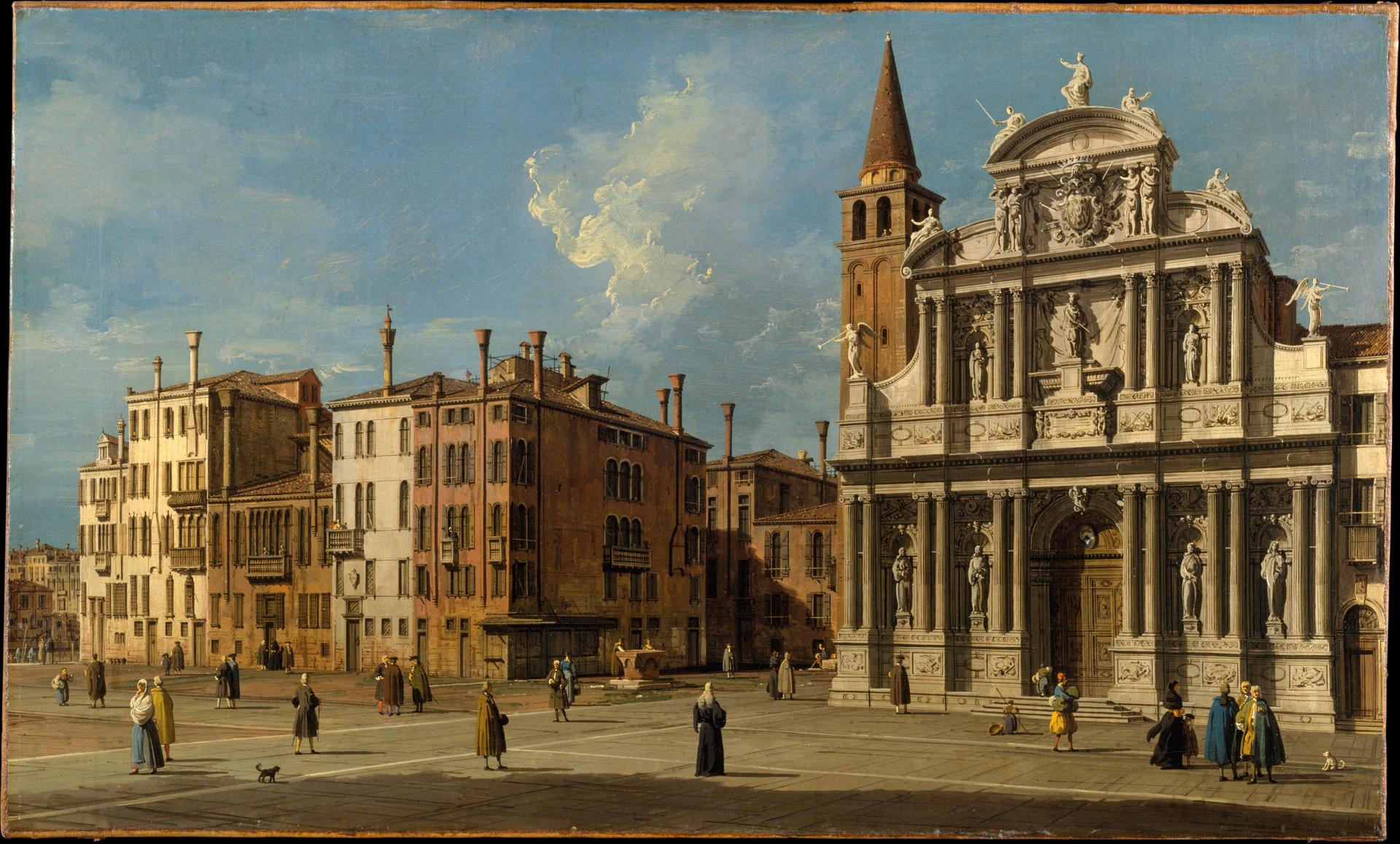
Campo Santa Maria Zobenigo, Venice
Original title: Campo Santa Maria Zobenigo, Venice
kurzbeschreibung
The Campo Santa Maria Zobenigo in Venice, dominated by the elaborately decorated facade of its church, is the subject of this view, which Canaletto painted in the 1730s in oil on canvas.
Description
The church's richly ornamented front fills most of the picture, adorned with sculptures and architectural detail. To its left stand several Venetian houses with varied facades and roofs. On the square in the foreground, groups and lone figures in contemporary dress go about their business. Light falls from the left, and the sky is blue with scattered clouds. Warm browns in the buildings and the blue of the sky set the picture's colouring.
Context
Canaletto won fame in the eighteenth century with vedute, precise views of Venice. British travellers on the Grand Tour prized such pictures in particular and took them home as souvenirs. The church of Santa Maria del Giglio, whose facade appears here, goes back to a design by Giuseppe Sardi from the seventeenth century. Canaletto made several views from this square, distinguished by their topographical accuracy.
Impact
A calm mood of Venetian daily life, flooded with sunlight, emanates from the picture. The symmetrical layout with the church at the centre gives it clear order, while the staffage figures add liveliness. The exact rendering of the architecture makes the view feel like an authentic snapshot.
Technique
Canaletto worked in oil on canvas, using fine brushstrokes for the architectural details. The careful gradation of light and shadow and the nuanced colouring are typical of his practice. At 47 × 78.1 cm the picture is comparatively small and was probably intended as a cabinet piece for a private collector.
AI-generated description text
Source: Metropolitan Museum of Art · Public Domain (CC0 1.0)