Spanish Dancer (First State)
Original title: Spanish Dancer (First State)
kurzbeschreibung
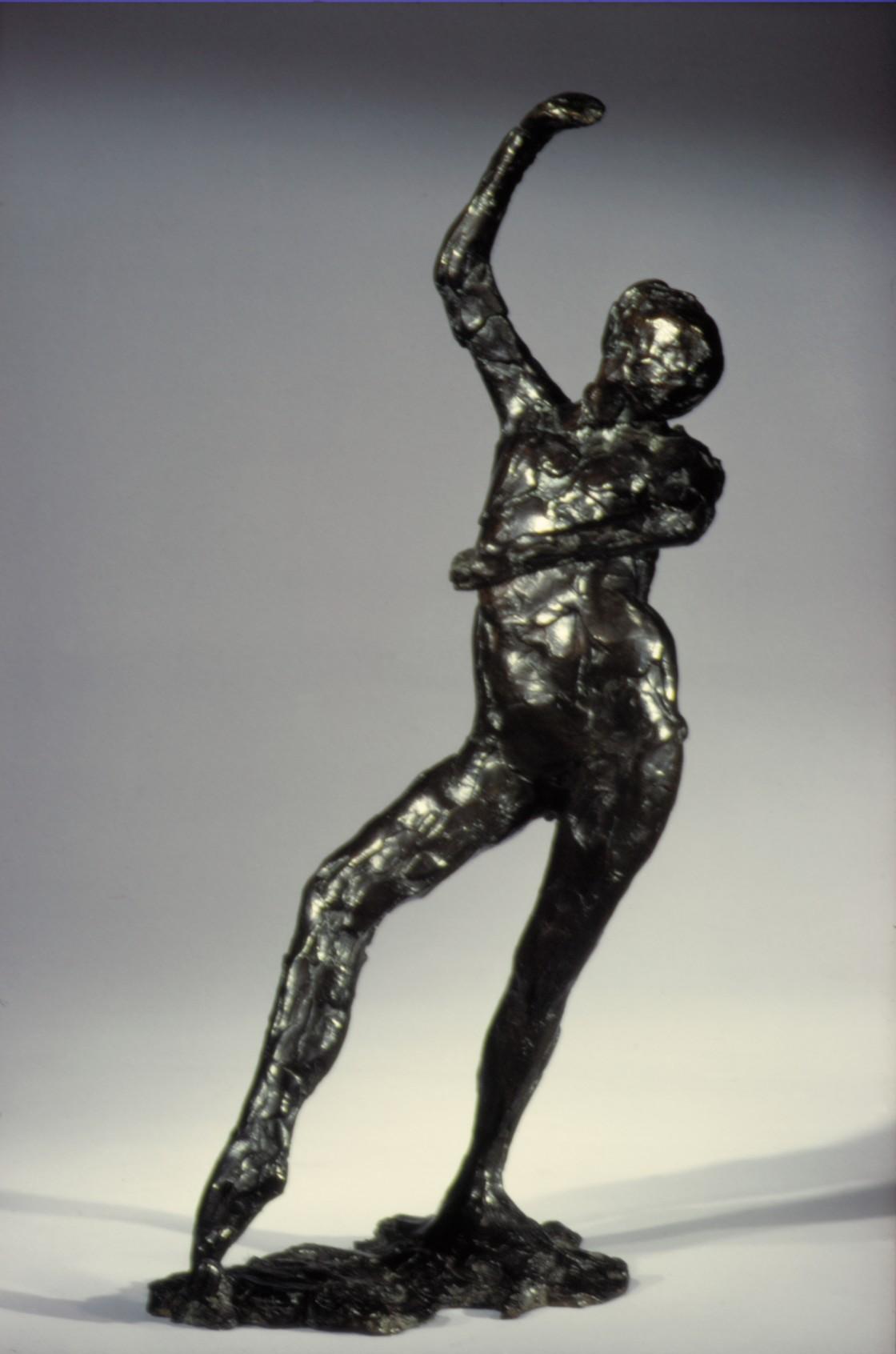
Unlike many of Degas’s dancers, who appear in groups or in the ballet studio, this bronze figure stands alone and is entirely devoted to Spanish dance. The model was probably made around 1884, but it was not cast until 1920. The raised arm and extended leg belong to a series of movement studies in which the artist tried to capture dancing in sculpture.
Description
On an irregularly shaped base, the figure stands with one leg stretched far out and one arm lifted high. The torso twists slightly, and the arms seem held mid-flow. Strongly developed legs make the strain of the dance visible. The bronze surface is glossy and shows patches of patina.
Context
Around 1884 Degas was deeply engaged with dance as a subject. During this period he produced numerous wax studies of dancers, from which this figure also emerged. In his lifetime the artist allowed only a few of his wax models to be cast in bronze; the casting of 1920 took place after his death.
Impact
The twisted pose and powerful legs give the figure an immediate tension. The shiny surface with its traces of patina feels both calm and enduring. The uneven base makes the movement appear lively and slightly restless.
Technique
The figure was cast in bronze, a material that allows durability and precise reproduction of details. Over time, a glossy patina has formed on the surface through oxidation. The lost-wax casting process preserves the fine traces of the modeling.
AI-generated description text
Source: Metropolitan Museum of Art · Public Domain (CC0 1.0)