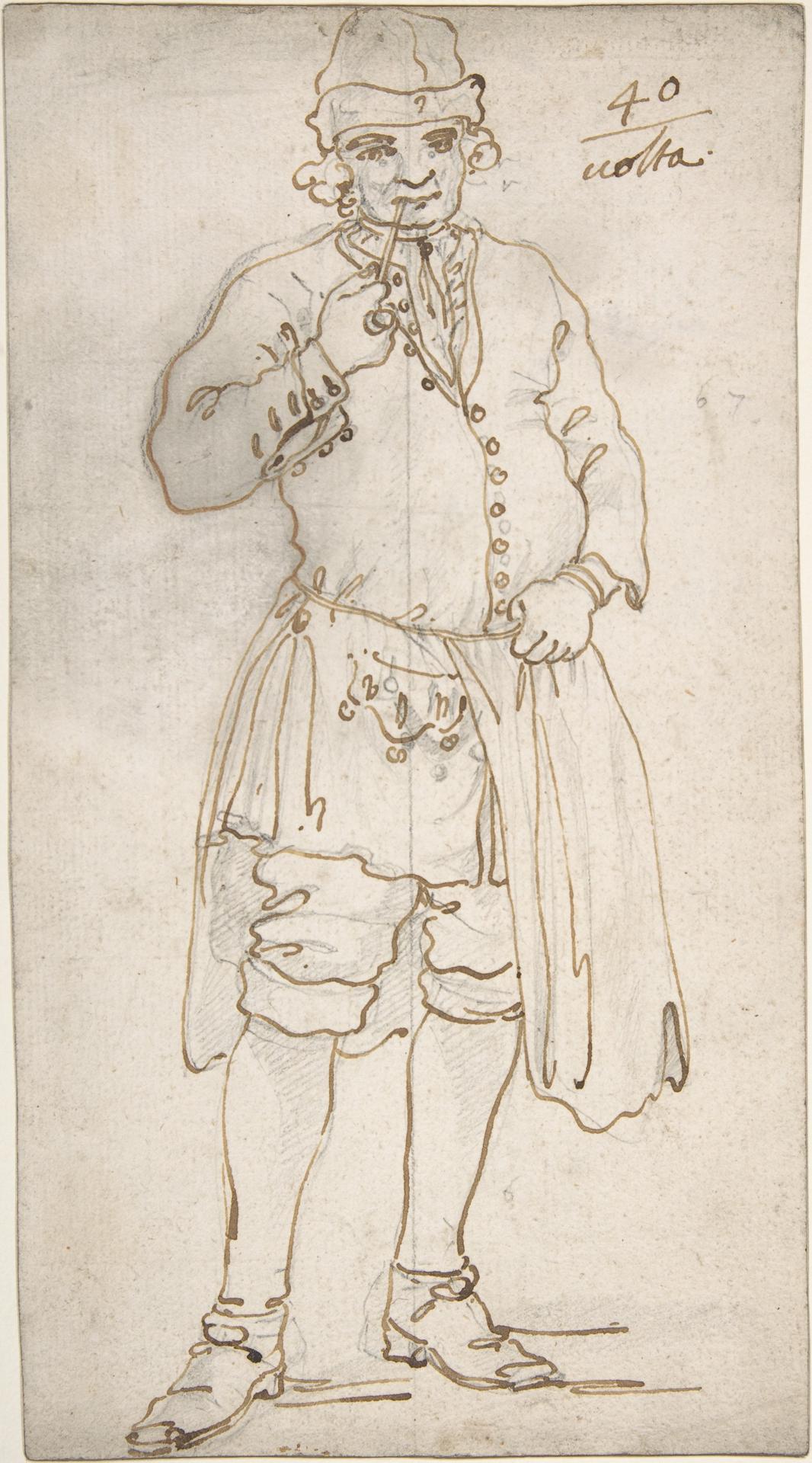
Man Smoking a Pipe (recto); Standing Man and Two Studies of His Head (verso)
Original title: Man Smoking a Pipe (recto); Standing Man and Two Studies of His Head (verso)
kurzbeschreibung
This sheet by Canaletto (Giovanni Antonio Canal), made between 1697 and 1768, shows a man in traditional dress smoking a pipe on the recto. The verso offers studies of a standing man and two heads. Executed in pen and brown ink over traces of lead or graphite, the work measures 29.8 x 16.4 cm.
Description
A man in a cap, buttoned jacket, belted trousers and boots stands before us, holding a pipe in his hand; he appears to be smoking. The clothing and posture are captured with great precision. The white paper ground remains without further elements. Contours and shading in monochromatic browns convey forms and textures.
Context
Canaletto, best known for his views of Venice, also produced figure studies like this one, likely as preparatory work for paintings. The 18th-century sheet reveals the influence of Venetian draughtsmanship. The studies on the verso are typical of working sheets that were often reused.
Impact
The viewer's gaze is drawn immediately to the figure and its characteristic pose, because the white ground avoids any distraction. The precise linework and the calm, everyday scene feel immediate and lively. The result is an intimate, almost documentary effect.
Technique
Pen and brown ink over traces of lead or graphite allow fine, controlled linework. On the verso, graphite studies are added, showing the artist's working method. The combination of ink and graphite permits both precise contours and soft shading.
AI-generated description text
Source: Metropolitan Museum of Art · Public Domain (CC0 1.0)