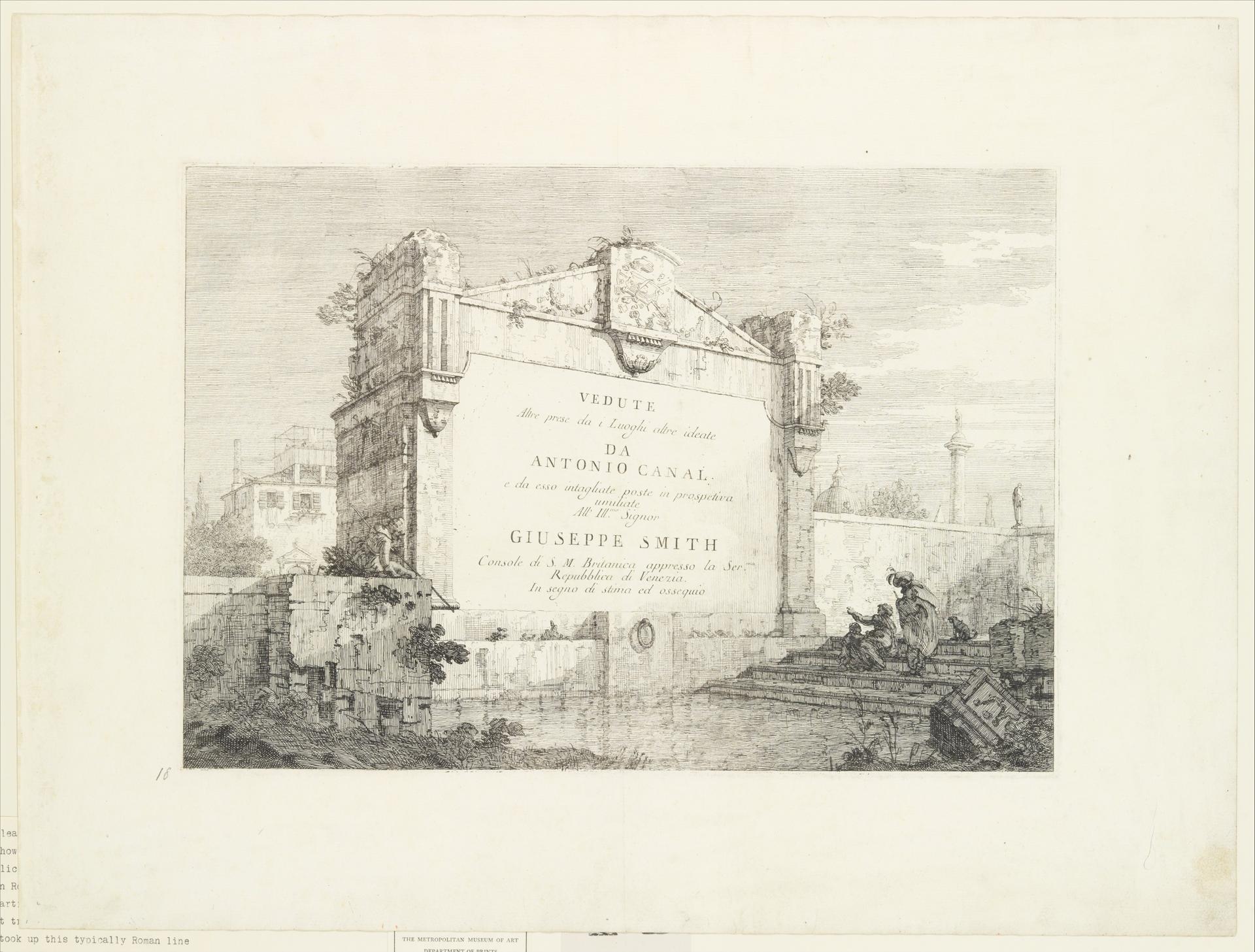
Title page with a large wall of a classical ruin, with a figure seated at right pointing to the dedication, from "Views" (Vedute altre prese da i luoghi altre ideate da Antonio Canal)
Original title: Title page with a large wall of a classical ruin, with a figure seated at right pointing to the dedication, from "Views" (Vedute altre prese da i luoghi altre ideate da Antonio Canal)
kurzbeschreibung
Canaletto's etching from 1735–46 forms the title page of his series 'Vedute altre prese da i luoghi altre ideate'. It features a massive wall of an ancient ruin, a seated figure on the right pointing to the dedication plaque, and further ruins and columns in the background. This impression is the second state of two.
Description
A colossal wall of a classical ruin dominates the foreground. On the right, a figure sits with an outstretched finger indicating a shield-like inscription bearing the series title and the dedication to Giuseppe Smith. Behind rise further ruins and columns, evoking an ancient cityscape. The rendering stays in tones of grey and white; light is evenly distributed, with no strong shadows.
Context
The etching was made between 1735 and 1746 in Venice, where Canaletto worked as a veduta painter. His series 'Vedute altre prese da i luoghi altre ideate' combines actual views with freely invented compositions and was aimed at collectors. The dedication to Giuseppe Smith, the British consul in Venice, attests to the connection with the English art market, which was of great importance to Canaletto.
Impact
The calm, balanced lighting and clear linework evoke an atmospheric, almost elegiac mood. Because real ruins and invented parts interlock, the print gains a timeless, idealized quality and transports the viewer into the ancient world.
Technique
In etching, the drawing is scratched into an acid-resistant layer on a copper plate and then bitten. The precise linear structure of the ruins reveals a confident handling of this process. In the second state, reworkings were made that strengthen the contrasts.
AI-generated description text
Source: Metropolitan Museum of Art · Public Domain (CC0 1.0)