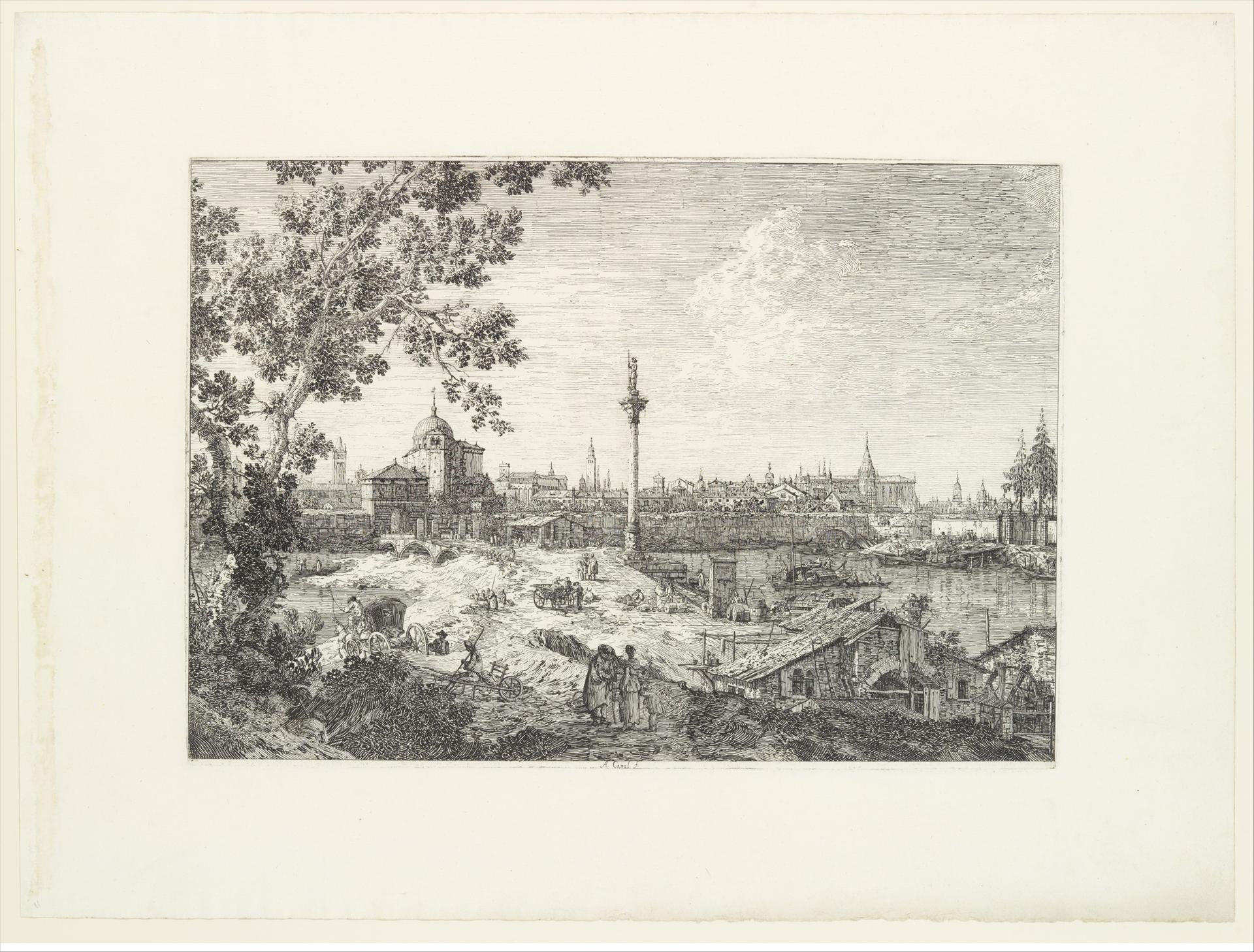
Imaginary View of Padua, with a campanile and domed church at left, a column surmounted by a statue of a saint at center, and a cottage and water-mill at right in the foreground, from "Views" (Vedute altre prese da i luoghi altre ideate da Antonio Canal)
Original title: Imaginary View of Padua, with a campanile and domed church at left, a column surmounted by a statue of a saint at center, and a cottage and water-mill at right in the foreground, from "Views" (Vedute altre prese da i luoghi altre ideate da Antonio Canal)
kurzbeschreibung
Canaletto (Giovanni Antonio Canal) made this etching between 1735 and 1746, an invented view of Padua. The print is in the second of three states. In the foreground a rural area with a small house and a watermill spreads out, while behind it a city skyline rises with a domed church and a campanile.
Description
The view is from an elevated standpoint looking down. In front are a modest farmhouse and a watermill where a few figures are gathered. A column with a saint's statue forms the focal point of the print, and on the left a large tree reaches into the image. The background is closed by a city with several church towers and a campanile. Diffused light lies over everything, giving the subject a calm character.
Context
This print belongs to a series of vedute that Canaletto composed partly from nature and partly from imagination. It was made between the 1730s and 1740s, when the artist had become known above all for Venetian city views. The series appeared during his lifetime and helped spread his reputation beyond Venice. That Padua appears here as an idealized landscape matched the contemporary taste for capriccio-like vedute.
Impact
Calm and rural idyll define the impression, supported by the diffused light and the staffage in the foreground. Real architectural motifs combine with invented parts to create a poetic, almost dreamlike mood. Viewers are transported into an idealized Italian landscape that feels familiar and imaginary at the same time.
Technique
This print was made using etching: the drawing is scratched into a wax layer on the copper plate and then etched. Fine lines and hatching render light and shadow with precision. The second of three states suggests revisions that refined the printed effect.
AI-generated description text
Source: Metropolitan Museum of Art · Public Domain (CC0 1.0)