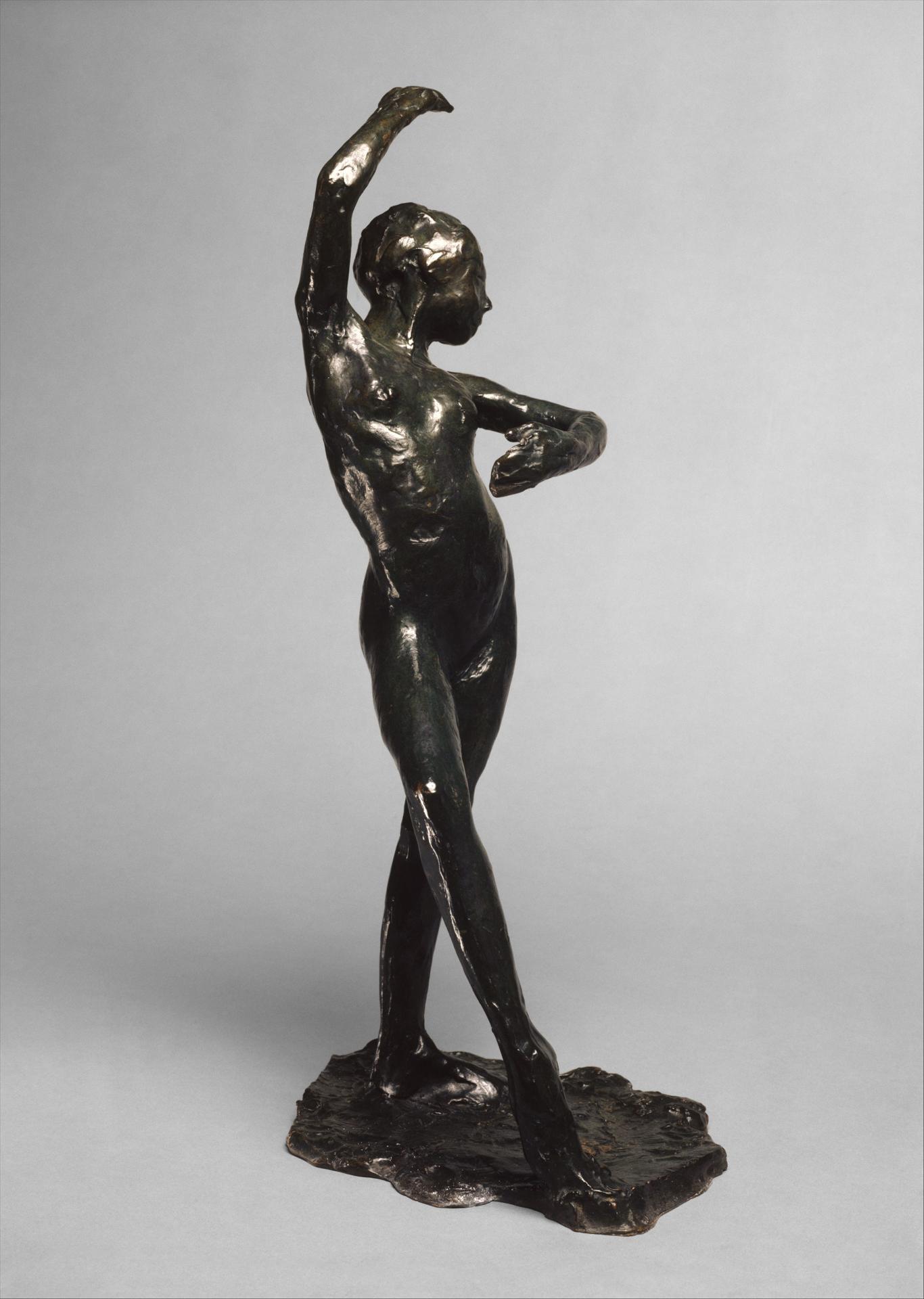
Spanish Dancer (Second State)
Original title: Spanish Dancer (Second State)
kurzbeschreibung
Edgar Degas modelled the Spanische Tänzerin (zweiter Zustand) as a bronze statue; the original wax figure probably dates to around 1884, while the cast was made in 1920. It shows a nude dancer in a restless pose and belongs to the group of Degas sculptures devoted to dance and movement.
Description
A nude figure dances: one arm reaches upward, the other is slightly bent. The left leg draws back a little, the right stands forward, producing a balletic stance. The bronze rests on a flat, irregular base that suggests natural rock. Side light models the contours and surface texture; the patina looks rubbed and glossy in places. A neutral ground lets the figure stand out.
Context
Degas formed the sculpture around 1884, but it was not cast in bronze until 1920, after his death. The artist often turned to dancers, favouring casual moments or unusual poses. During this period he devoted himself increasingly to sculpture, yet showed only a few pieces in his lifetime. Many of his wax models were transferred to bronze posthumously.
Impact
The animated pose and the raw base evoke the impression of a fleeting, living moment. Patina and reflections of light give the metal a warm, sensuous surface that holds the viewer's gaze.
Technique
Executed as a bronze cast whose patina resulted from ageing and treatment. The surface appears slightly worn and shiny, characteristic of the process in which a wax model is lost and replaced by metal.
AI-generated description text
Source: Metropolitan Museum of Art · Public Domain (CC0 1.0)