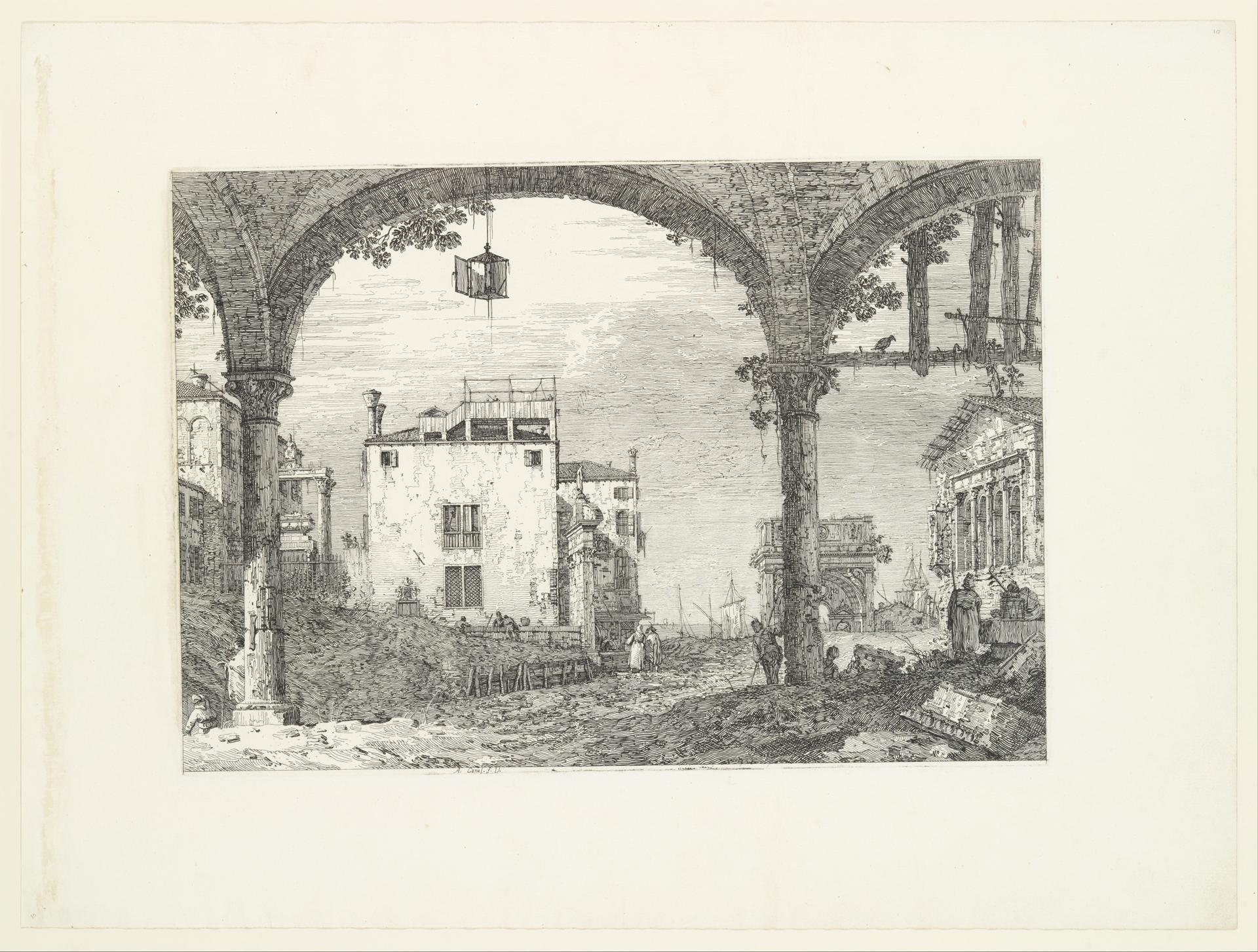
A three-arched portico with an open lantern hanging at center, a triumphal arch and ruins of a classical temple in the background, from "Views" (Vedute altre prese da i luoghi altre ideate da Antonio Canal)
Original title: A three-arched portico with an open lantern hanging at center, a triumphal arch and ruins of a classical temple in the background, from "Views" (Vedute altre prese da i luoghi altre ideate da Antonio Canal)
kurzbeschreibung
An open lantern ring hangs in the central arch of a three-arched portico, the defining motif of Canaletto's etching from 1735–46. Behind it, a triumphal arch and the ruins of a classical temple recede in layers. The print belongs to the series 'Vedute altre prese da i luoghi altre ideate da Antonio Canal' and is in the second state of three.
Description
Three arches span the foreground, their piers framing the view. In the middle opening hangs an open lantern ring; beyond rise a triumphal arch and the shattered remains of an ancient temple. A few figures stand near the arches and at the end of the street, small and scattered. Fine etched lines define the monochrome image, with hatching and contours standing out.
Context
Canaletto, active in Venice between 1735 and 1746 and later in England, combined real views with invented, idealised architecture in this series. The etching was made at a time when he turned increasingly to printmaking to bring his work to a wider public. This sheet is one of the 'Vedute altre prese da i luoghi altre ideate'.
Impact
A quiet, almost nostalgic mood emanates from the ancient ruins and the sparse staffage. The clear lines and symmetrical sequence of arches give the print monumental scale and elegant lightness at once. The open lantern ring sets a silent accent at the centre.
Technique
Etching was done on a plate measuring 30 × 43 cm; the paper measures 44.6 × 59.9 cm. This is the second state of three. With etching, Canaletto achieved fine, precise lines that bring out architectural details and the play of light across the view.
AI-generated description text
Source: Metropolitan Museum of Art · Public Domain (CC0 1.0)